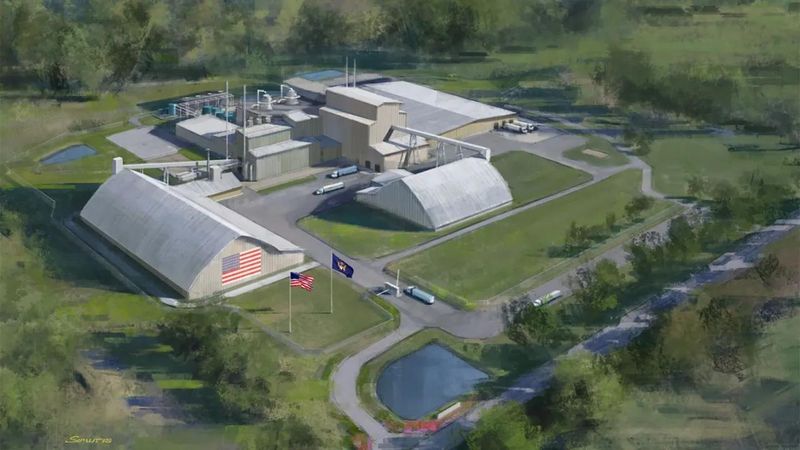
A company seeking to build the United States’ largest mine for potash in Osceola County is partnering with another company to use its mined minerals for another high-demand product: industrial batteries to fuel AI data centers and their massive power needs.
Michigan Potash & Salt Co. LLC announced a memorandum of understanding with Austin, Texas-based startup Group1 Inc., which is developing a potassium-ion battery that it says will be safer than ubiquitous lithium-ion batteries and will help America meet its exponentially growing power needs without critical minerals from foreign sources not always friendly to the U.S.

“From agriculture to energy, we’re proving that the same element that powers our crops can power our critical infrastructure,” said Group1 CEO Alexander Girau in a release.
Michigan Potash intends to mine nearly 800,000 tons per year of potash at its facility in Evart Township. The process involves solution mining, injecting brine water thousands of feet underground to dissolve potash and bring it to the surface, where it would then be dried and reconstituted. The operation would also generate up to 1 million tons per year of marketable, table-grade salt. Brine water waste would be disposed of deep underground via disposal wells.
The mining proposal received a huge boost in the waning days of President Joe Biden’s administration, when the U.S. Department of Energy provided Michigan Potash with a conditional loan guarantee of up to $1.26 billion.
Potash is critically important to agriculture as a fertilizer, significantly boosting crop yields and quality. President Trump designated potash as a critical mineral in early 2025 through executive orders aimed at boosting domestic production, reducing reliance on imports and securing supply chains for agriculture and national security.
Group1 is developing potassium-ion batteries, operating through the same scientific processes as lithium-ion batteries that are found in products from phones to toys to electric vehicles but generating significantly less overheating − an important consideration for industrial-scale batteries − and without reliance on critical minerals such as lithium, cobalt and nickel − minerals often sourced from outside of the U.S. through geopolitical rivals such as China.
“We cannot back up our data centers or run our hospitals while relying on critically dependent and deliberately manipulated global supply chains,” Michigan Potash CEO Theodore Pagano said in a statement.
Group1 officials say they are developing commercial-scale potassium-ion battery platforms that are “critical-mineral-free, high-power and fully manufacturable in the United States.”
The battery platforms have use cases for data centers, defense and industrial markets, Group1 officials said.
“Together, (Michigan Potash & Salt) and Group1 represent the bookends of a new American potash ecosystem − linking domestic raw-material extraction with advanced battery manufacturing to anchor a secure, sovereign and scalable U.S. energy-technology supply chain,” company officials stated.
Under the memorandum of understanding, the companies will explore not only long-term supply and co-investment opportunities, but strategic links between Michigan Potash’s production and processing infrastructure and Group1’s advanced potassium-ion battery manufacturing. The agreement envisions Group1 battery backup systems in use at the potash mine in Evart.
Even 1% of Michigan Potash’s projected mining output would create about 4 gigawatt hours of battery capacity, Girau said, “enough capacity to harden dozens of hyperscale data centers … shore up critical substations and hospitals, and support priority defense installations − without leaning on fragile foreign supply chains.”
Michigan Potash officials cite the potential for 200 permanent jobs at the mine, along with about 1,400 jobs during construction. The mine would triple the county’s industrial tax base, with Michigan Potash projected to pay wages 2.5 times higher than average county wages, Department of Energy officials said.
But environmental groups and some nearby residents have expressed concerns about the mine’s large water needs. The Michigan Department of Environment, Great Lakes and Energy (EGLE) in 2017 approved Michigan Potash’s request to extract 725 million gallons of groundwater annually, almost 2 million gallons per day — more than five times the groundwater withdrawal by Nestlé North America’s Ice Mountain bottled water operation only a few miles away that raised public controversy at the time. The U.S. Environmental Protection Agency in 2017 approved the mine to install three injection wells to dispose of briny wastewater deep underground. The permits survived years of legal challenges from the local nonprofit Michigan Citizens for Water Conservation and others.
Some also estimate the mine when fully operational will mean more than 150 trucks per day driving through the rural community, though company officials envision a rail shipment component lessening the truck traffic.
Contact Keith Matheny: kmatheny@freepress.com.
This article originally appeared on Detroit Free Press: Michigan potash mine developer partners with industrial battery maker
Reporting by Keith Matheny, Detroit Free Press / Detroit Free Press
USA TODAY Network via Reuters Connect