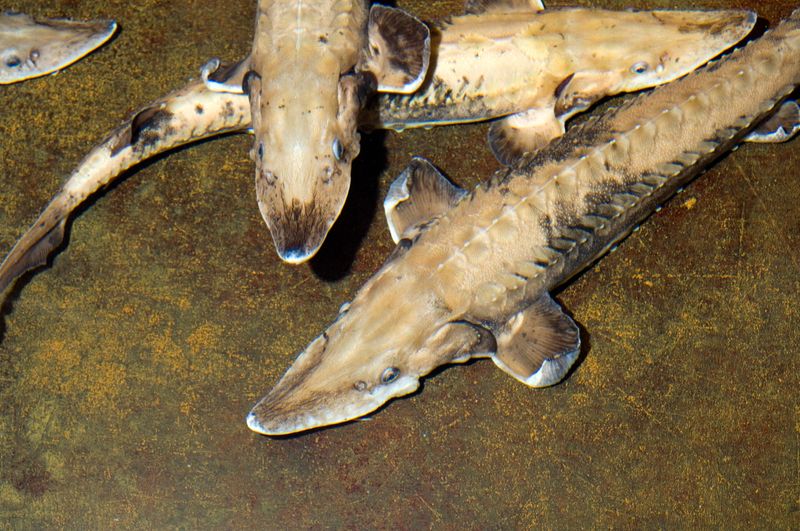
Michigan anglers may soon have more opportunities to battle and catch the Great Lakes region’s largest fish, a fish that traces back to when dinosaurs roamed the Earth.
The Michigan Department of Natural Resources, in consultation with their counterparts in Wisconsin, are proposing to create a “catch and immediate release” fishing season for lake sturgeon in the Menominee River that forms the Michigan-Wisconsin boundary in the far western Upper Peninsula.

If approved by the Michigan Natural Resources Commission, the season would begin on the first Saturday in June 2026 and run through the first Sunday of March 2027 in a section of the Menominee River from the Grand Rapids dam upstream to Sturgeon Falls Dam.
Michigan and Wisconsin fisheries biologists have found that between 4,500 and 6,900 lake sturgeon are believed to live in river reaches separated by hydroelectric dams between the Grand Rapids Dam and Sturgeon Falls Dam. These populations currently sustain a short harvest season running from Sept. 1 through Sept. 30.
“Enacting a (catch-and-immediate-release) season will benefit anglers and should not pose a threat to the robust lake sturgeon population,” DNR division chiefs wrote in a proposed fisheries order presented to the Natural Resources Commission at its Aug. 14 meeting in Gaylord. The added season is supported by local law enforcement in the Menominee River region, local sportfishing clubs and the West U.P. Citizen Advisory Council, the division chiefs stated.
DNR chiefs also propose a tweak to the current lake sturgeon season on Black Lake in Cheboygan and Presque Isle counties in the northern Lower Peninsula. The sturgeon harvest season is sometimes incredibly short, lasting only 17 minutes on Feb. 1 before the quota of six lake sturgeon was reached. Interest in the season has continued to rise, despite relatively stable fish quotas, with 776 anglers registered in 2025, up from 403 anglers in 2019.
The Black Lake season can currently run from the first Saturday in February through the following Wednesday or until the harvest quota is reached. The DNR proposes making the maximum length to the following Monday or until the quota is met.
“With the current season, there is a potential for it to last up to five days, which would be extremely challenging for statewide staff (fisheries and law enforcement) to stay longer than a one- or two-day season due to travel, overtime and overall budgetary issues,” the DNR division chiefs stated in a proposed fisheries order presented to the commission.
The Natural Resources Commission could enact the season changes as soon as its meeting, scheduled for Sept. 11.
Lake sturgeon are the Great Lakes region’s largest fish, relatively unchanged from the time of the dinosaurs. According to Michigan Sea Grant, the sturgeon are nearshore fish that live at water depths of 15-30 feet. They feed along lake bottoms, eating a variety of small animals, including snails, crustaceans, aquatic insects, mussels, and small fish. Most lake sturgeon caught today weigh between 30 and 100 pounds and grow from 3 to 6 feet in length.
Lake sturgeon live longer than any other fish species in Michigan. Male lake sturgeon live an average of 55 years. Females live 80 to 150 years. It takes a long time for the fish to mature − males 15 years; females up to 25 years. The females spawn once every four years.
Considered a net-wrecking nuisance by colonial fishermen in the late 1800s and early 1900s, lake sturgeon were destroyed in large numbers. Their populations were further dwindled by the installation of dams on waterways. The current lake sturgeon population is estimated to be 1% of its historical abundance in Michigan. But habitat restoration efforts and strict harvest seasons have allowed sturgeon populations to stabilize and begin to recover.
Contact Keith Matheny: kmatheny@freepress.com.
This story was updated to add a gallery.
This article originally appeared on Detroit Free Press: Michigan DNR proposes new season to catch Great Lakes region’s largest fish, lake sturgeon
Reporting by Keith Matheny, Detroit Free Press / Detroit Free Press
USA TODAY Network via Reuters Connect