Some childcare providers don’t like the names you’ve been calling them. Terms like “babysitter” and “day care” come up often as the main culprits in conversations with providers.
The qualm isn’t about policing people’s words, says Maria Robertson, who has worked at Little Dreamers Early Learning Center in Lansing for the last 10 years. Or discrediting other versions of the “village” of childcare options that are just as necessary to parents.

It’s simply that these descriptions of her job aren’t accurate, she and other providers said.
“Typically, when someone hears the word day care or babysitter, we think of the standard, someone to watch the kids so parents can go out for a couple hours,” Robertson said. “There’s pizza, there’s TV. We need babysitters, but the term day care doesn’t adequately describe the true work and what is happening in early childhood development.”
“We need to be getting away from broadbrushing and generalizing an entire industry based on one limited perspective of what it is,” she continued.
Beyond being inaccurate, some providers say these terms have a concrete impact on how their jobs are perceived by both parents and policymakers, with real-world repercussions, like woefully little public investment in the industry compared with the K-12 education system.
If the industry as a whole isn’t seen as being part of a child’s education, then it’s easier to neglect when it’s time to write up education budgets, said Robertson. One recent report estimates Michigan’s per-pupil investment in childcare and preschool is between $1,000 and $1,500. That’s in comparison to the over $10,000 per student the state spends on K-12 education.
Terms like babysitter or day care overshadow other words that should be used in many cases to describe the profession, they say, like education.
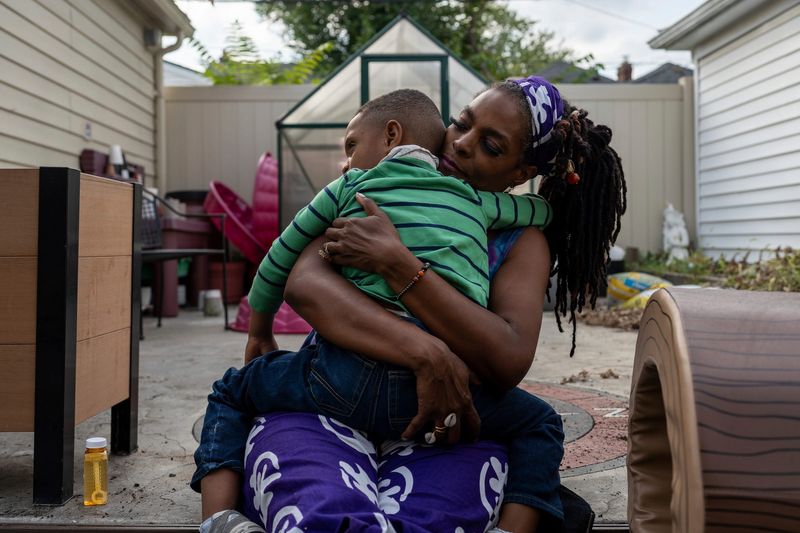
“I call myself an early childhood education practitioner because I put blood, money, sweat, tears and sacrifices into having a level five family childcare site,” said Lorna Parks, who runs House of Joy Child Care out of her home in Detroit. “Level five” refers to the level at which the state of Michigan rates her site’s quality, five (now known as a “Demonstrating Quality” rating) being the highest.
There’s no official set of standards that exists to clearly separate childcare sites that are babysitting versus those that are educating children. The state doesn’t label providers in this way, instead using a rating system of different potential quality indicators providers can opt in to adopting.
Academics and researchers who study rhetoric around work tend to agree: language matters and can have real world outcomes on how jobs are perceived and compensated.
“I think titles are a good example of how some careers are treated as more special,” said Robin Clair, a professor of communication at Purdue University.
What’s the difference between day care and early education?
The key difference between day care and early education is that day care’s primary purpose is to take care of a kid so that a parent can go to work, said Steven Barnett, education economist at Rutgers University and founder of the National Institute for Early Education Research. Whereas a program focused on early learning goes beyond caring for kids and meeting their basic needs – it’s about helping guide them through the developmental stages of early childhood.
Take for example, Little Dreamers Early Learning Center. Basic needs are being met at the childcare site, yes. Diapers are being changed, workers are making sure children are safe and loved, Robertson said.
But they’re also teaching kids, helping them develop cognitive, gross motor, fine motor and social emotional regulation skills. Around half of the teachers at Little Dreamers have advanced degrees in early education and all of the early educators who don’t are working toward a Child Development Associate credential or advanced degree.
“There’s a reason why early childhood educators are getting their master’s in this field,” she said.
But the problem is, the distinction is not necessarily clear to the broader public, said Barnett.
Part of this is because of a lack of knowledge and understanding of the work of early education itself, said Barnett.
“People don’t understand the difference between a well-educated, well-prepared teacher and somebody who is just nice to kids,” he said.
And then part of this is because the industry itself isn’t on the same page. Two different providers might both refer to their childcare sites as “day care,” but one might be using an evidence-based curriculum that puts them in the early education category.
Little Dreamers was called Little Dreamers Daycare Center until it changed in 2025 to Little Dreamers Early Learning Center, said Robertson, to make clear it was “doing more than just providing care,” she said.
In childcare, there aren’t widely agreed upon titles that distinguish certain roles in the profession.
Christine Snyder, director of child and family care at the University of Michigan, likens the industry to the way the nursing field was before the push to professionalize in the late 19th and early 20th centuries. Now nursing has widely known and accepted titles, like a registered nurse versus a nurse practitioner, that have specific credentials, standards and compensation levels attached to them.
The lack of clarity in early childhood education allows for muddiness, says Barnett. Muddiness that means politicians can campaign on ending their state’s publicly funded preschool program by dismissing it as “glorified babysitting,” he said. And muddiness that allows a program in Florida to exist under the guise of “universal high quality early education” while receiving nowhere near the amount of money it needs from the state legislature to provide quality education, said Barnett.
What’s in a name?
To describe what it is exactly that irks her about words like day care and babysitting used to describe her work, Robertson uses an analogy.
A day care describes the location where a service is being given, she says. Similarly, in the medical field, services are being provided at a hospital.
“But as a society we don’t call them all hospital workers,” Robertson says. “There are different levels of expertise, there are neurosurgeons, cardiologists, nurses. We want that same level of respect.”
And saying day care doesn’t encompass the work they’re doing at Little Dreamers 10 hours a day, she says.
Parks says she feels those words inaccurately characterize her expertise.
“We need to stop this day care, babysitter nonsense,” she said. “Parents and families won’t take this information from us seriously because you’re just a day care provider.”
Parks said she believes parents have dismissed her suggestions to refer kids to behavioral or occupational therapists for further support when it’s clear a child is not where they should be developmentally.
Robin Jones, who has run a childcare site in Lapeer County since 1993, doesn’t have an issue with the word day care, but has always stopped people if they called her a babysitter. She’s not sure how much of an impact the terminologies have on the perception of the work of early education. But she knows some in her community have not always seen what she does as real work.
“That happens a lot in day care,” Jones said. “‘You would be at home anyways, so you might as well watch our kids. It’s not a real job.’”
“I think people don’t think deep enough about what it is unless they’ve actually done the work,” Jones said.
Part of this stems from the assumption that childcare is work women should or could be doing naturally, so it’s not seen as an actual profession, said Barnett.
“There’s still this notion of ‘well, any woman could do it,’ ” he said.
Does what we call a job matter?
Parks said she feels like because her profession is misunderstood and devalued, she’s not given the same resources as other professionals who specialize in children’s development.
She says she doesn’t understand why an occupational therapist, for example, works one-on-one with a child. But when it comes to her own work as an early childhood educator, she doesn’t get any additional state funding or support to meet the developmental needs of the kids with autism she takes care of – as many as three at one time. State funding for programs like hers could go toward hiring other teachers to give concentrated support to kids with special needs, she said.
But can what we call a job actually change the way it’s perceived or valued?
Yes, according to Clair, Purdue University researcher who wrote the book “Why Work?: The Perceptions of ‘A Real Job’ and the Rhetoric of Work through the Ages.”
“Language has a powerful impact on society,” she said. “In the world of work, we have seen job descriptors like garbage collector change to sanitary engineer or mailman to mail carrier, giving people more respect or opening up job opportunities for people that did not previously exist to them.”
Beki San Martin is a fellow at the Detroit Free Press who covers childcare, early childhood education and other issues that affect the lives of children ages 5 and under and their families in metro Detroit and across Michigan. Contact her at rsanmartin@freepress.com.
This fellowship is supported by the Bainum Family Foundation. The Free Press retains editorial control of this work.
This article originally appeared on Detroit Free Press: Michigan childcare workers say ‘day care’ label hurts their profession
Reporting by Beki San Martin, Detroit Free Press / Detroit Free Press
USA TODAY Network via Reuters Connect
By Beki San Martin, Detroit Free Press | USA TODAY Network