‘Sit down and shut up’ is the sort of approach the leadership of Michigan’s school-and education-related boards increasingly expect.
That’s the unsettling pattern seeming to spread through Michigan’s schools, universities and public institutions. If an elected official says something the majority doesn’t like, the answer is no longer debate, it will more likely be closed-door dealing — or censure.

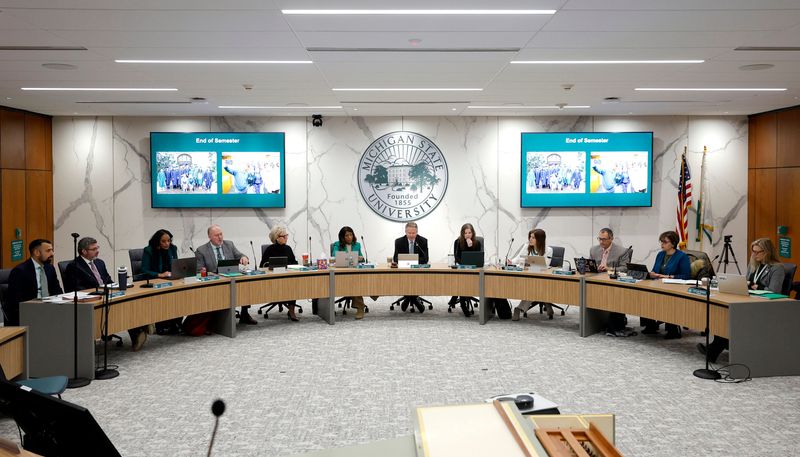
At Michigan State University, trustees recently approved a revised code of ethics requiring board members to support majority decisions and act with a “duty of loyalty” after votes are taken under threat of censure, loss of access to university events and other sanctions. Trustees Mike Balow, R-Plymouth, and Rema Vassar, D-Detroit, refused to sign onto the policy, arguing it infringes on the rights of officials elected directly by Michigan voters.
For that, they were prohibited from attending last week’s Mackinac Policy Conference on behalf of the university — even though MSU had non-refundable tickets for them.
It seems designed as a punishment for daring to speak out about concerns over a private spin off of MSU’s athletic department and their hesitancy over signing non-disclosure agreements that bar trustees from sharing information transparently with the public.
But if the board was intended to act as one body with one voice in all matters, why are there eight individually electable positions?
Trustees are beholden to the Michigan voters statewide who elected them — not the powers that be at Michigan State.
Similarly, the Michigan State Board of Education passed a resolution “just a few weeks ago,” according to Board President Pamela Pugh’s comments during a May 12 meeting, that stated the board would “speak as one body.”
That seems intended to prevent board member Nikki Snyder from a separate and differentiating response to a lawsuit filed in April on behalf of Detroit Public Schools Community District (DPSCD) students that seeks to require the state to eliminate debt incurred while the district was under the state’s control and increase its funding. The lawsuit, which is seeking class-action status, names members of the state Board of Education, Gov. Gretchen Whitmer and State Superintendent Glenn Maleyko.
Pugh reiterated the “one voice, one body” narrative in response to Snyder’s request to the board to create a “wall of conflict,” a formal screen within the representation structure, as litigation proceeds. The board voted down Snyder’s resolution.
On the Rochester Community Schools Board of Education, Trustee Carol Beth Litkouhi was censured and her school-liaison roles were revoked by the board for writing an op-ed in The Detroit News about the Oakland County education millage. The board alleges Litkouhi shared information about the proposed tax hike that undermined the board’s position.
But again, if the seven-person strong school board existed to present simply one voice, it should have one trustee. Aside from information that is truly confidential or sensitive in nature — and not something taxpayers are entitled to know — there is little that should be withheld from the public.
These individual board members shouldn’t have to hand over their First Amendment rights when they’re elected. They should be able to speak honestly under the responsibility of providing truth and transparency to their constituents.
While some confidentiality is necessary for litigation or personnel matters, elected boards increasingly appear to be broadening what is treated as off-limits for public discussion through closed door sessions and other agreements that bind their loyalty away from the people.
No elected official should be required to publicly endorse decisions they believe are wrong. No trustee should have to choose between speaking honestly and maintaining good standing with an institution, and no citizen should have to wonder what information is being withheld because dissent has become professionally dangerous.
Healthy institutions are not afraid of disagreement. They welcome it.
kbuss@detroitnews.com
This article originally appeared on The Detroit News: Michigan boards silence debate with demands for ‘one voice’ | Buss
Reporting by Kaitlyn Buss, The Detroit News / The Detroit News
USA TODAY Network via Reuters Connect