Ann Arbor — High-end student housing is spreading rapidly across large college towns. One result: rooftop pools.
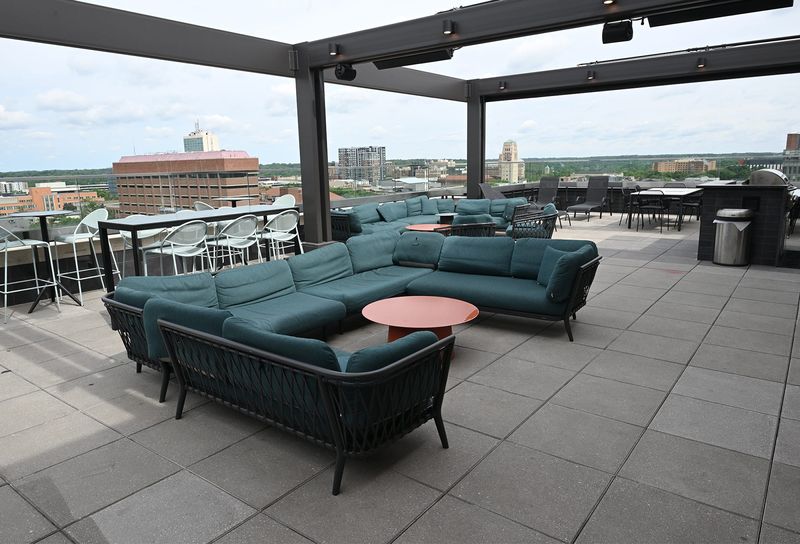
There are others at Washtenaw County’s Vic Village apartments: blue lounge chairs surround a firepit on a rooftop patio; sleek fitness rooms are fully equipped with workout machines; study rooms contain desks, tables and, of course, Wi-Fi; and there’s a game room supplied with arcade and board games.

Your parents’ dorm it isn’t. Marketed as luxury housing for students, Vic Village North and South are just two of the several higher-end apartments near the University of Michigan campus, with other offerings including VERVE, Saga and The Legacy.
Developments like these are becoming increasingly common, not just in Ann Arbor, but in larger college towns across the country where developers are building housing equipped with private bedrooms, wellness spaces and high-end amenities aimed at students. This wave, primarily felt at schools with the highest enrollment levels, has led to rents near the University of Michigan and Michigan State University that exceed $2,000 per month per student in some buildings. Meanwhile, smaller schools such as Grand Valley State University are working to maintain more affordable housing options as they compete to attract students.
Michigan State University student Grace Eliya lives at The Abbott in East Lansing and pays $1,500 a month. Eliya said the appeal was the newness and the private space.
“I knew that I wanted my own kitchen and laundry room,” Eliya said. “The apartment is newer, and it has full appliances. Overall, I think the price and paying for a nicer apartment was worth it for me.”
Experiences like this reflect changing expectations among students, according to Olan Garrett, president of the Association of College and University Housing Officers-International: “We are seeing students that have very different expectations, particularly coming out of the pandemic. The single, private bedroom, the wellness space, all that has recently become expected.”
Rise in luxury: ‘Two years ago is when it changed’
Vic Village North has been open in Ann Arbor for seven years now, while Vic Village South has been open for two. During that time, owner and asset manager Patricia Fix told The Detroit News she has seen the number of luxury apartment complexes take off.
“We were the ones that really first started building the big student housing high-rises here in Michigan,” Fix said. “Two years ago is when it changed.”
City planners credit changing student expectations, combined with growing enrollment and limited housing supply for fueling demand for the complexes. Both the University of Michigan and Michigan State University have reached record or near-record enrollment levels in recent years.
“The University of Michigan continues to grow in enrollment, and employ as an employment center, and so with that comes more demand,” said Brett Lenart, planning manager for the city of Ann Arbor. The University of Michigan recently moved to expand its dormitory options, but Michigan State University has not.
“I have seen universities that are building and saying we’re increasing our enrollment, and while we’re doing that, we’re going to build as well. I just haven’t seen it as much around here,” said Landon Bartley, principal planner for the city of East Lansing.
Near both Big Ten schools, several new apartment complexes are currently in-the-works, attempting to capitalize on the rising student population. These buildings include The Metropolitan, Rambler, The Howard and The Tower on Grand.
Fix said that with all this new construction, Ann Arbor’s luxury housing market is becoming more competitive. At Vic Village, owners had considered building two more apartment complexes in recent years, but ultimately decided against it: “We were planning on building East and West, but with the large amount of student housing that’s going up we considered the risk too high.”
With this increasingly competitive market, Fix said Vic Village relies on its larger private bedrooms and easily walkable location to compete: “The market has changed tremendously.
“We are very lucky that because of our location, we have high occupancy,” Fix said. “One of the things, especially, is the size of the rooms. They are much bigger than everywhere else on campus. People love the living spaces.”
‘I could not afford to live in Ann Arbor my first year’
At Vic Village, rent varies by floor plan. One of its more popular two-bedroom, two-bathroom apartments costs $2,100 or $2,200 per person, per month, depending on whether the bathroom is ensuite.
The average rent for an apartment in Ann Arbor is $2,053 and for East Lansing it is $1,801, according to RentCafe. For comparison, the average apartment rent in Lansing, the state’s capital, is $1,246.
For some students, the growth of luxury housing has left them feeling priced out of their college campuses. Aklesia Maereg, a graduate student at the University of Michigan and member of the Ann Arbor Tenants Union, said prices were just too high for her to live in Ann Arbor her first year.
“I could not afford to live in Ann Arbor my first year, so I had to look for housing elsewhere,” Maereg said. “There’s just this frustration that comes with the thought that you’re not able to make a choice in where you’re living because you simply can’t afford it. That lack of autonomy just feels disheartening.”
Living farther from campus affected their ability to participate in university life, Maereg added: “You’re having to spend more time going to and from campus than you are spending time in the place where you go to school. There was a bit of a disconnect. There were just things I couldn’t do because I had to get home.”
Experiences like this reflect broader concerns about student housing affordability. A 2025 study by MSU researchers found that 8.5% of the over 1,000 students surveyed had experienced homelessness within the previous year, while more than 37% reported at least one form of housing insecurity.
“Housing insecurity could be most obvious as they can’t afford rent, but also things like they need to move multiple times,” Stephen Przybylinski, one of the professors conducting the survey, said. This is also coming at a time when the costs of higher education are rising as well.
Bartley said increasing housing supply could help more students find places to live, but high construction costs often push developers toward luxury projects.
“We’re seeing developers need to build new construction, but it’s very expensive,” Bartley said. “So, I think that their response is, ‘to make this project work, I have to ask a certain asking price,’ so these new shiny units are going to end up being high-end or luxury apartments because it’s expensive to build.”
Fix echoed this sentiment: “You don’t have a choice but to build luxury housing here in Ann Arbor because of the pricing of the land, of the property taxes and the city fees. You cannot do affordable housing unless you have significant, significant government support.”
The affordability debate
Lenart argued that adding new housing, even at higher price points, can help ease pressure on the broader market.
“When people who can afford those units do occupy those units, it is taking a little pressure off of the rest of the market, where maybe you don’t have quite as much higher-income people competing with lower-income households for a finite level of housing,” Lenart said.
At the same time, Lenart explained that housing decisions can involve difficult tradeoffs. He pointed to a recent redevelopment project that replaced a 1960s apartment offering 60 affordable units for a larger complex offering hundreds of apartments at higher rents.
While he can see why some people might be upset about the new high prices coming in, Lenart assures that the units will be of help.
“Sometimes when people see that happening in our community, the thought is ‘I thought we wanted affordable housing’, and when these units are coming online, they’re anything but affordable often,” Lenart said. “It’s absolutely a fair reaction, but I think it misses the complexity of the housing market.”
Not everyone feels the same way.
Chad Frederick, a geography and sustainable planning professor at Grand Valley State University, argued that while expensive units could reduce market prices in the long term, it will take too long to benefit current students.
“There’s the idea that if you build luxury apartments, that they’re going to sort of trickle down and filter into the public as they get older, but that’s a very slow process that takes years, and people need housing now,” Frederick said. “I don’t agree with the assumptions that are built into the construction of luxury student housing, luxury housing for any purpose, but certainly not for students.”
Maereg added: “The increase of luxury housing, or just more housing in general, doesn’t actually address the affordability crisis and doesn’t address the actual experience of tenants who live in these buildings.”
Both perspectives have their merits, Garrett said: “It is a situation where multiple realities can be true at the same time. On the one hand, anything that is new in terms of housing can certainly help alleviate the pressure and make it easier if students have more options. But supply alone does not solve the affordability problem.”
Some luxury housing can be good, he explained, as long as there is also enough affordable housing in the market: “It’s not inherently bad, whether or not you have it,” Garrett said. “What success is going to be is whether students have access to safe, supportive and affordable housing to thrive academically and personally.”
One way cities attempt to reach this balance, according to Lenart, is by offering incentives to luxury housing developers to encourage them to include affordable units. Vic Village offers 14 affordable units, and in exchange was able to build higher.
It’s not just UM and MSU facing housing challenges. Housing decisions can look different at some of the smaller schools in Michigan, like Grand Valley State University.
“Grand Valley has to appeal to a broader range of students,” Frederick said. “So, if you build expensive housing in both places, the UMich might do okay, but Grand Valley is going to be filtering out possible students because they can’t afford the housing that’s associated with that education.”
As a result, even Grand Valley’s higher-end student housing is generally priced below comparable developments in Ann Arbor and East Lansing. Marketed as luxury housing, GVSU’s off-campus apartment 48West offers prices ranging from $599 to $925.
“Almost every school is dealing with a housing challenge, or is going to deal with some sort of housing cost challenge,” Garrett explained. “Every institution has to deal with this in a way that is reflective of the market in which they’re in, that’s reflective of their student base and reflective of what they’re trying to do.”
atisch@detroitnews.com
This article originally appeared on The Detroit News: Luxury housing hits college campuses in Michigan, draws mixed reactions
Reporting by Alyssa Tisch, The Detroit News / The Detroit News
USA TODAY Network via Reuters Connect
By Alyssa Tisch, The Detroit News | USA TODAY Network