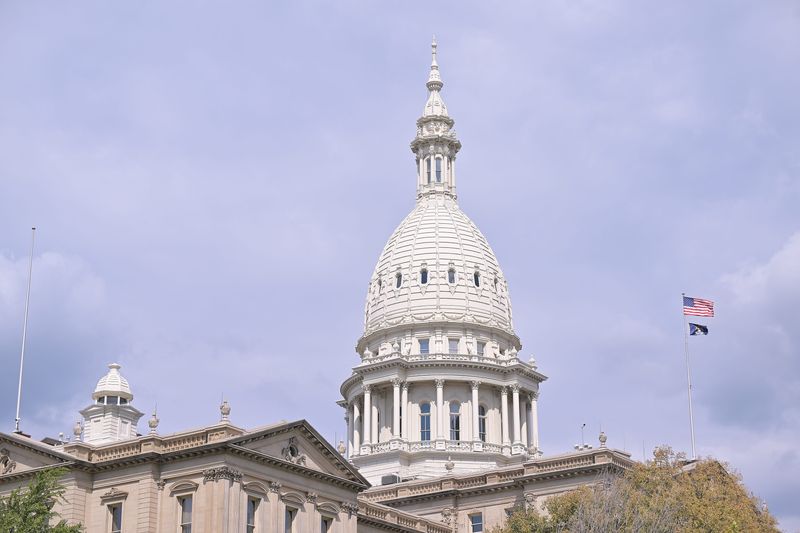
Lansing — At least three lawmakers, backed by two former governors, are pushing to change the way Michigan picks members of the top three university boards, as well as candidates for attorney general and secretary of state.
Currently, the Republican and Democratic nominees for attorney general and secretary of state and the board nominees of the University of Michigan, Michigan State University and Wayne State University are chosen at party endorsement conventions and then appear on the November general election ballots.

But the joint resolutions introduced Thursday in the House and Senate would ask voters to change that process by amending the Michigan Constitution to place the secretary of state and attorney general nominating votes on the August primary ballot and move the university board election process to a gubernatorial appointment system.
The Senate joint resolution was sponsored by Sen. Ed McBroom, R-Waucedah Township, and the House joint resolution was sponsored by state Rep. Greg Markkanen, R-Hancock, and former House Speaker Joe Tate, D-Detroit. Gov. Gretchen Whitmer, in a statement Friday, said the plans were an “interesting solution” that should be given “thoughtful consideration” by lawmakers.
The board appointment process outlined in the resolution resembles the process used to appoint board members at Michigan’s other 12 public universities — a setup, McBroom argued, that yields vastly better outcomes.
“There’s been controversy and turmoil from all three of these universities over the last couple of decades,” McBroom said of UM, Michigan State and Wayne State. “The other universities seem to be far more stable.”
The proposed changes come as the three universities during the past several years have been beset by board-level controversies and scandals, including the handling of allegations regarding serial pedophile Larry Nassar at MSU, similar issues related to Dr. Robert Anderson at UM and perennial presidential departures at the universities.
On Sunday, the MSU board hastily held a virtual meeting to pass new “duty of loyalty” rules to punish trustees who “undermine” board decisions. The trustees also voted to nearly double MSU President Kevin Guskiewicz’s salary to $2 million a year.
“We know this system’s not working very well, and we know what does work well. Let’s change over to that,” McBroom said.
Markkanen argued that the current system for the university boards has resulted in a lack of diversity in geography and experience, with 24 members of the three university boards residing in just six of the state’s 83 counties. Six of the eight UM regents, he added, are lawyers.
“I think our three great research universities would benefit from a more diverse membership,” Markkanen said.
Likewise, the April 19 Michigan Democratic Party convention has spurred calls for audits and reform from multiple top Democrats after problems with the vote-counting system and questions about whether the party’s own rules for the candidate nomination event were followed.
In addition to the legislative push, a separate ballot committee, Voters Not Insiders, has formed to try to get the Legislature to place a proposal on the ballot to shift the attorney general and secretary of state nominations from the conventions to the primary election.
“We are open to anything that will get the bipartisan support and two-thirds vote needed to put the AG and SOS on the ballot,” said Lon Johnson, a former chairman of the Michigan Democratic Party, who’s working on the Voters Not Insiders push.
Former Michigan Govs. Engler, Blanchard get involved
Tate, a former Michigan State University football player, said he’s been disappointed by the “fractured relationships” displayed by the MSU Board of Trustees.
“Too much time has been spent on internal board disagreements and distrust for one another, and it does not benefit the university or students,” Tate said.
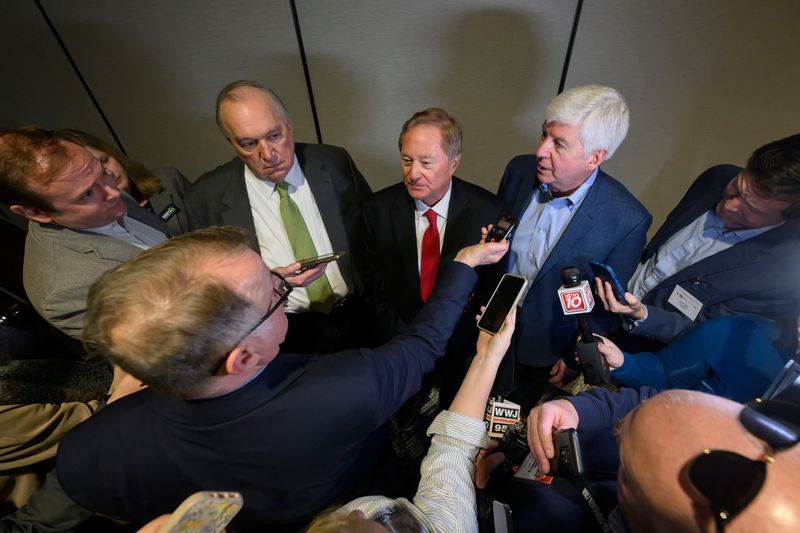
Former Govs. John Engler, a Republican, and Jim Blanchard, a Democrat, have been lobbying lawmakers for a couple of years to change the way the boards are selected at Michigan, Michigan State and Wayne State.
The issue is now “ripe” due to the very public dysfunction on display within the university boards and the acrimony surrounding the 2022 Republican nominating convention and the 2026 Democratic nominating convention, Blanchard said.
Blanchard called on lawmakers to rally around the proposal and stand up for the “three crown jewels of higher education in Michigan.”
“I run into people all the time who say, ‘What is going on with these boards?’” Blanchard said. “I think the political parties have really let down the universities by letting special interests hijack their nomination process. It’s time to move into the future with something positive.”
Engler, who served as MSU’s interim president during the fallout from the Nassar scandal, was spotted Wednesday speaking with lawmakers for some time on the House floor.
Universities need serious people more concerned with the education of students than personality conflicts, drama and self-dealing, Engler said Friday. That isn’t happening with the current partisan nomination process dictating who is on the ballot, he said.
“It’s a randomness that is, I think, very unhelpful in terms of governance and where you’re really seeing the impact is the ability to attract new leadership or even faculty,” Engler told The Detroit News.
The lawmakers are hoping the proposal backed by the former governors would make the Aug. 4 ballot, which would require an extremely tight turnaround to rally support for the proposal in the state Legislature.
Voters Not Insiders is aiming to get the issue on the November general election ballot, giving the Legislature until Sept. 4 to put the proposal up for a statewide vote.
Reform proposal faces a tight timeframe to make the ballot
In order for the matter to make the August ballot, a proposal would need two-thirds majority support in both chambers by the end of the first week of June, almost immediately after lawmakers return from the Detroit Regional Chamber’s Mackinac Policy Conference next week.
The possibility appears far-fetched based on House leadership’s recent statements on the matter.
House Speaker Matt Hall, R-Richland Township, when asked about the issues recently, indicated the university board changes were not a focus, though he was aware of Engler and Blanchard’s efforts to push the resolution.
“We do not have a plan to take that up at this time,” Hall said last week.
On Wednesday, Hall said he hadn’t taken a position on moving the attorney general and secretary of state races to a primary vote and believed the recent push for it was due to Democrats’ problematic nominating convention last month.
“We’re not engaging in any conversations to change it at this time,” Hall said.
But Whitmer said Friday that university board dysfunction of late “has become a bigger distraction for universities, leading to costly investigations and lawsuits,” and it’s clear there needs to be a change.
“This bipartisan proposal from Michigan’s former governors is an interesting solution that has been discussed for decades,” Whitmer said in a statement. “I encourage Democrats and Republicans alike in the legislature to give this thoughtful consideration. “As Michiganders, we all want what is best for our universities and alma maters,” she added. “I can’t think of a better way forward than to leave it up to Michiganders to determine how university boards are selected in the years ahead.”
Spokespersons for Senate Majority Leader Winnie Brinks, D-Grand Rapids, did not respond to a request for comment on the proposal.
However, Secretary of State Jocelyn Benson, who is widely expected to be the Democratic nominee for governor, has endorsed the idea of shifting the attorney general and secretary of state nominations to the primary.
“I would move it to a primary,” Benson said at a Tuesday press conference.
Attorney General Dana Nessel said Friday she would support the changes to both the attorney general and secretary of state nominations and the university board selection process.
But the two-term Democrat acknowledged the convention process likely benefited her in 2018 when she defeated a former federal prosecutor, Pat Miles, whom she said would have had more money to spend in a primary election.
Since then, Nessel said, she’s come to see the partisan process is “fundamentally unfair,” in part because it disenfranchises party members and regular voters who are unable or unwilling to drive to Detroit and sit for four hours to participate in the process.
“It just doesn’t allow enough participation to do it that way,” said Nessel of nominating candidates at conventions. “And, additionally, I completely, 100% trust our regular system of voting. I can’t say that’s true for the convention process.”
Nessel has questioned the validity of the Michigan Democratic Party’s April 19 nominating convention and called for an independent audit, citing problems with the way votes were submitted and counted at the gathering of thousands of party members.
The university board nominations, Nessel said, traditionally functioned as something of a reward for party loyalty. And few voters, especially those voting a straight ticket, pay attention to the race or research the candidates running, she said.
But some of those board members of late have overstepped their bounds and threatened the reputation of the universities, a key factor in attracting top candidates to lead the institutions, the attorney general said.
“It’s got to be a thoughtful process about people who have some experience in higher education,” Nessel said.
The primary election would allow more people to vote on the nominations. While about 7,200 people participated in the Michigan Democratic Party convention in Detroit on April 19, about 1.1 million voted in the last competitive Democratic gubernatorial primary in Michigan.
How the proposals would change the selection process
The resolutions introduced Thursday in the House and Senate would require the secretary of state and attorney general candidates after Jan. 1, 2027, to be nominated during primary elections, not at partisan conventions.
When it comes to the university boards, if adopted, the proposal would discharge the entire boards of UM, MSU and Wayne State on Dec. 30.
From Dec. 31 onward, the boards would consist of nine members appointed by the governor for eight-year terms, with many of the initial slate of appointees serving shorter, staggered terms. The board appointments could not contain more than five people from the same party and would be subject to the advice and consent of the Senate.
Additionally, at least one member of each board must be chosen from a list of three nominees submitted by the university’s alumni association. And at MSU, the state’s land-grant university, at least one member “must have practical farming expertise.” All board members would be subject to state ethics laws, according to the resolution.
For the first round of appointees this year, members would be appointed for staggered time periods: Two for two years, two for four years, three for six years and two for the full eight-year terms.
Whitmer would appoint four members to each board, and the next governor, taking over on Jan. 1, 2027, would appoint the other five members to each board.
eleblanc@detroitnews.com
cmauger@detroitnews.com
This article originally appeared on The Detroit News: Lawmakers push to change Michigan university board, AG and SOS elections
Reporting by Beth LeBlanc and Craig Mauger, The Detroit News / The Detroit News
USA TODAY Network via Reuters Connect