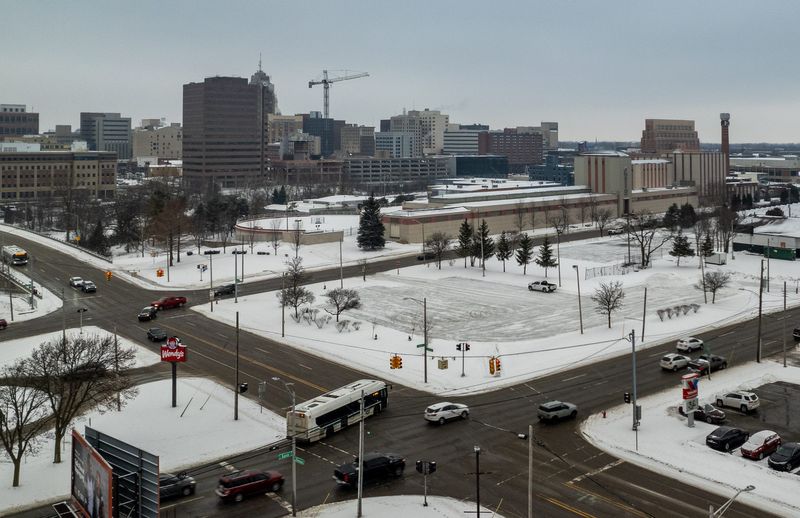
LANSING — The data center proposed for downtown Lansing could bring, on average, about $933,000 in property tax revenue for local governments each year, according to an estimate.
The tax revenue projections from the Lansing Economic Area Partnership estimate $19.6 million in property tax could be collected from 2028 through 2047. That money would flow to multiple taxing jurisdictions, from Ingham County to the Lansing School District to the city, and be applied toward 20 different millages.

Emma Bostwick, vice president of business attraction for LEAP, told the State Journal that the analysis used a 55% fair market value, or the true cash value, for the proposed 24-megawatt, $120 million project.
“LEAP typically provides the utmost conservative estimates but there could be some movement either direction,” she wrote in an email.
LEAP did the analysis for Deep Green, a United Kingdom-based company that went public in November with its proposal to build a data center on land that’s two blocks south of the city’s Stadium District. The land is currently underused parking lots and the company has offered $1.4 million to buy the city’s land.
“Deep Green is driven by a purpose to be different in an industry where data centers are not the most popular across much of the world at the moment,” company CEO Mark Lee said during a Feb. 9 news conference. “We are driven by a purpose to be different and to positively impact the environment and the communities that we work in.”
The LEAP analysis shows that the city and Lansing School District would be the biggest benefactors of the $933,081 average property tax bill Deep Green could pay. The city would receive about $232,487 each year with Lansing schools getting an average of $268,302, according to the estimate. Some of the city’s revenue would go to a Tax Increment Finance Authority, also known as a TIFA, that city spokesperson Scott Bean said “is currently paying debt obligations” related to parking services and the Lansing Center.
Bean said the Lansing city assessor’s office estimated the potential property tax bill of $901,110.
The Lansing Board of Water & Light, which would provide electricity for the data center, would increase its annual equity payment to Lansing, which owns the utility, by $1 million, officials have said.
The proposed data center, which is small by industry standards, requires City of Lansing rezoning and had been working its way through that process for months. The most recent hearing came on Feb. 9, and included about 2 1/2 hours of public comment during the City Council meeting from people opposed to and in favor of the project.
Residents against the data center have said over the past months that they’re concerned about potential negative health and climate impacts, increases to their utility bills, noise pollution and the wave of data centers being built in Michigan and the U.S. to meet increased demands from AI companies. Local labor unions and business organizations, including LEAP and the Lansing Regional Chamber of Commerce, have voiced support for the project.
On Friday, Feb. 13, Deep Green announced that its rezoning application would be resubmitted to address a “procedural issue” and also formalize in contracts the pledges it has made to residents and the city. BWL has said that 16 of the 24 megawatts of electricity needed would come from natural gas fuel cells on site. The fuel cells could produce carbon dioxide emissions equal to more than 11,000 vehicles each year, the State Journal previously reported.
Deep Green’s proposal returned to the Lansing Planning Commission for its March 3 meeting, where commissioners voted 5-2 in favor. The commission previously voted 4-3 against the project, but in favor of selling city land to the company.
Where else the property tax revenue could go
The LEAP property tax estimates only took into account the initial personal property investment in the proposed data center, Bostwick said in an email. The projected revenues could increase as newer and more expensive equipment is added, which in turns increases the value of the facility captured by property taxes.
The property tax projections also don’t include any potential tax revenue from the construction or an estimated 15 permanent jobs at the data center.
The LEAP projections include average annual property tax for the following mileages:
Ten other dedicated millages could receive, on average, $392 to $10,749 from 2028 through 2047, according to LEAP’s analysis.
Deep Green officials told City Council on Feb. 9, that the company isn’t currently and won’t seek city tax incentives connected to the project, but hasn’t ruled out seeking state tax benefits. In 2024, state lawmakers passed legislation to create tax breaks for data centers but by the end of the year Bridge Michigan reported there was already an effort underway to repeal those tax breaks.
The two state senators who represent parts of Greater Lansing — Democrats Sen. Sarah Anthony and Sen. Sam Singh — each voted in favor of the tax breaks.
The area’s eight House lawmakers split their votes. Rep. Brian BeGole, a Republican, and Democrats Rep. Julie Brixie, Rep. Penelope Tsernoglou and Rep. Angela Witwer voted in favor. Democrats Rep. Kara Hope and Rep. Emily Dievendorf, and Republican Rep. Gina Johnsen voted against the tax breaks.
Deep Green says benefit goes beyond property taxes
Deep Green and the city have presented the project as providing more than just tax revenue to the city. Among the biggest benefits is the heat reuse, which is central to Deep Green’s other data centers.
The proposed Lansing data center will have technology that captures excess heat and transfers it to BWL’s system for use downtown. On Jan. 26, BWL General Manager Dick Peffley told City Council members that “90%” of the excess heat diverted to the BWL system will come from the fuel cells, not the data center itself.
The fuel cell facility wouldn’t burn the natural gas, Peffley told the State Journal, which makes it a cleaner energy generation than similar facilities that burn natural gas.
BWL, like all power providers in Michigan, is required under state law to provide 80% clean energy by 2035 and 100% by 2040. However, it’s unclear whether the state would designate the fuel cells as clean energy, Peffley said, because they would be the first in Michigan. BWL has already started outreach to state lawmakers about the clean energy designation.
The fuel cell facility, however, could produce about 105 million pounds of carbon dioxide each year, equivalent to what 11,109 vehicles would produce in the same time, according to one estimate. Lee, Deep Green’s CEO, said in an email that the on-site power would cut the expected emissions from the data center in half, when compared to using BWL’s grid for all the needed power.
BWL is years into a process to switch from steam to a hot water system downtown, which began before Deep Green approached the city. Peffley estimated that as part of the switch, BWL would have to build three or four facilities around the city to generate heat. The two fuel cells at the Deep Green data center could cut the needed facilities in half, Peffley said, and they each cost about $5 million.
The rezoning request could return to the City Council in April. Councilmember Ryan Kost, who represents the city’s Ward 1, has publicly said he intends to vote against the request.
Contact reporter Matt Mencarini at mjmencarini@lsj.com.
This article originally appeared on Lansing State Journal: Lansing data center could pay $900K a year in property taxes, estimate shows
Reporting by Matt Mencarini, Lansing State Journal / Lansing State Journal
USA TODAY Network via Reuters Connect