

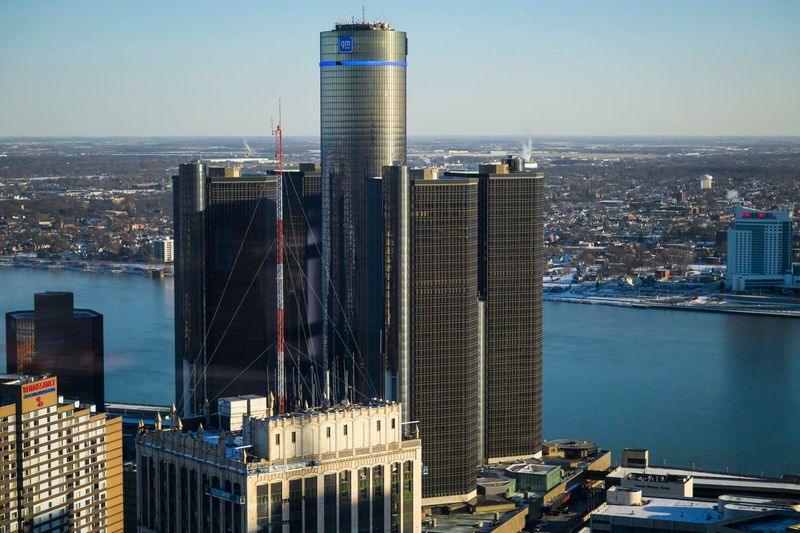
Lansing — Top Michigan Democrats have been voicing optimism this week that a compromise can be reached in the Legislature to bolster an economic development program that could spur the redevelopment of Detroit’s riverfront Renaissance Center.
Their comments come after House Speaker Matt Hall, the top Republican in the Legislature, told The Detroit News he wanted a “big deal” on the state budget that included a broad property tax cut, new spending on university buildings and tax incentives sought by billionaire Dan Gilbert for the nearly-vacant Renaissance Center towers.

Democratic Gov. Gretchen Whitmer has been backing a plan to boost the cap on the state’s transformational brownfield program, which allows developers to keep tax withholdings resulting from their projects, from $1.6 billion to $3.5 billion. That would potentially free up space for the Detroit project and others across the state.
“Today, more people are moving to Michigan than leaving for the first time since the 1990s, and Detroit’s population is growing again because people want to be part of our state’s comeback story,” said Stacey LaRouche, a spokeswoman for Whitmer. “If we want to keep building momentum, we must ensure Michigan has the tools necessary to get the job done.”
The Democratic-led Senate voted on a bill in December to raise the brownfield transformation cap to $3.5 billion. But it’s sat stalled in the Republican-led House since then.
Republican then-Gov. Rick Snyder originally signed the program into law in 2017, allowing developers to keep up to 50% of the taxes their projects generate to help recoup the cost of building on the site. The tax subsidy has been used or is being used to help finance a riverfront overhaul in Grand Rapids and the construction of Gilbert’s $1.4 billion skyscraper complex at the former J.L. Hudson department store site on Woodward Avenue, among other projects.
Under the program, developers can capture revenue from sales taxes, use taxes, income tax withholding and personal income taxes — revenues that would normally flow to the government.
The Michigan Strategic Fund, an economic development board appointed by the governor, has the power to approve transformational brownfield plans under the program, deciding the specifics of the tax benefits allocated for each project.
Gilbert’s real estate development firm, Bedrock, has been lobbying lawmakers to raise a cap on the incentive programs for brownfield properties to wring out $175 million in tax subsidies on a $1.6 billion investment to tear down two of the Renaissance Center’s office towers and create a new public space along the riverfront.
Bedrock is pursuing the redevelopment project in partnership with General Motors, which has owned the Renaissance Center for nearly 30 years but moved its headquarters to Bedrock’s Hudson’s complex earlier this year.
Last week, Bedrock CEO Jared Fleisher said increasing the cap on tax incentives for brownfield projects available to developers had become “leverage” in state budget negotiations.
Senate Appropriations Chairwoman Sarah Anthony, D-Lansing, is the lead Senate Democrat on the budget and the sponsor of the transformational brownfield bill.
“Any strong state needs a strong economic development policy, policy that delivers real return on investment for its people while providing stability and assurances to the businesses willing to go out on a limb and invest in our communities,” Anthony said Wednesday. “As we near the incentive cap on the transformational brownfield program, the Senate took action last year on my bill last year to extend this program.
“Speaker Hall and the House Republicans should deliver on their so-far empty promises to build a stronger economy and pass our bill to responsibly extend this program.”
In December, the nonpartisan Senate Fiscal Agency said only about $9.7 million remained available under current law for the transformational projects.
The program does have its detractors.
For instance, when the Senate voted in December, Sen. Joe Bellino, R-Monroe, said some of the projects being floated for the expanded program involved buildings owned by “millionaires and billionaires” who are now asking lawmakers and taxpayers for financial relief to revamp them.
Forbes pegged Gilbert’s net worth at $28 billion, while GM recorded nearly $15 billion in profits in 2024.
“That’s why I’m against it,” Bellino said.
Last week, Hall characterized the Renaissance Center tax abatement as a Democratic priority that could be balanced against the Republican property tax relief plan to reach a deal on the state budget.
“I think you’ll see some of those conversations going on at the same time, with the goal of making a big deal that includes parts of all of them,” Hall told The News.
In the House, state Rep. Alabas Farhat, D-Dearborn, has been pushing for the brownfield program’s expansion.
“It has had statewide success, which is rare but most of all it is performance-driven, accountable, and effective at attracting investments whether it be in Macomb to Muskegon or Wayne County and anywhere in between,” Farhat said.
cmauger@detroitnews.com
Staff Writer Beth LeBlanc and Politics Editor Chad Livengood contributed.
This article originally appeared on The Detroit News: Key Democrats push for tax program that could revitalize Detroit RenCen
Reporting by Craig Mauger, The Detroit News / The Detroit News
USA TODAY Network via Reuters Connect
By Craig Mauger, The Detroit News | USA TODAY Network
