Gary Glaser is 75 years old, and while he has no immediate plans to die, he takes it on faith that he ultimately will.
He can live with that. But what haunts him is the idea of his films disappearing with him.

Glaser’s passion was making documentaries. Across his decades of earning less money than he’d have liked and less attention than he deserved, he completed a dozen of them and won three local Emmys.
Now, at a point when technology has made his craft so much easier and more affordable, he’s basically retired. Instead, his focus is on licensing his creations — the best way to avoid being smothered by the same copyright laws that keep the Disney empire from hoarding Mickey Mouse forever.
“I am seeking some way to keep my work alive,” he said, and OK, “maybe pick up a little bit of dough.”
It’s the longevity that matters most, though. While he has had plenty of practice being poor, he has never been immortal before. And his subjects deserve it more than he does.
In “The Hudson’s Building,” Glaser interviewed the cafeteria manager who oversaw the downtown cafeteria’s legendary Maurice salad and the groundbreaking supervisor of the ever-knowledgeable elevator operators. In “Borderline: The Story of 8 Mile Road,” he put a late-in-life spotlight on Mr. Belvedere, the home remodeling baron who became one of the first commercial stars on Detroit television.
“Train Station” is a reminder that before Michigan Central’s jubilant renovation, it had disintegrated into a Beaux-Arts paintball arena and graffiti training ground. The feature-length “Stranded at The Corner: The Battle to Save Historic Tiger Stadium” peppered the Ilitch empire for what it called intentional neglect, well before the mirage that is District Detroit infuriated a new generation.
“That’s all history,” Glaser said, and it doesn’t belong in limbo. Or in a crypt.
No help from the obvious places
In broad strokes, the copyright on a film made from 1978 onward expires 70 years after the demise of its creator.
In equally broad strokes, a copyright issued before then expires after 95 years. That’s how the earliest versions of Mickey Mouse and Popeye entered the public domain in 2024 and 2025, at which point each character immediately became the star of a slasher movie.
If that’s unkind, it can also be pretty darned clever: As a title, “Popeye: The Slayer Man” kills.
Glaser, of Farmington Hills, isn’t concerned about Mr. Belvedere wielding a chainsaw. His worry is that if no one acquires the rights to distribute or profit from his works, they will simply disappear for 70 years after he dies, kept from view to respect copyrights until no one remembers Hudson’s or Tiger Stadium anyway.
He has three smart and capable nieces, he noted, but they’re not in the film distribution business, and being responsible for their childless uncle’s creative babies would be more of a burden than a blessing.
Maybe the new Dan Gilbert project on the old store site would be interested, he thought, with its three-story event space called the Department at Hudson’s. Then the brand manager there emailed to politely say things were crazy busy just now, but they’d keep his name on file.
Maybe WTVS-TV, since it has aired his films before, but with public broadcasting’s funding slashed, probably not.
Maybe the Detroit Historical Museum, where he has done presentations, but while “we have paid for rights to use documentaries,” said exhibitions chief Tracy Irwin, “we more often prefer to partner with filmmakers or photographers, etc.”
“But donations,” Irwin said, “we are very open to.”
Cardboard box to black tie
Glaser grew up in northwest Detroit. His dad owned a menswear shop in Highland Park, his mom was a seamstress, and they worried together when he created a film and video major for himself at Oakland University.
“You don’t study film,” his father said, “you develop it.”
Glaser landed a job producing “Bill Kennedy at the Movies” on WKBD-TV (Channel 50), then set off westward along the trail of broken dreams.
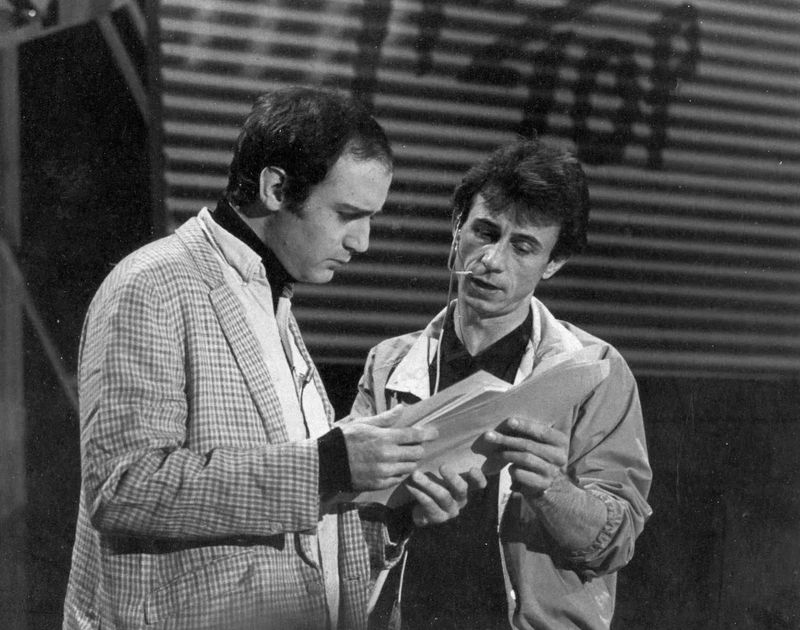
He spent the ’80s in Los Angeles, working mostly in props or as a stage manager at a mammoth production studio, and he’d send his parents photos of himself with the stars who passed through — taking a pretend punch in the jaw from Muhammad Ali, going over a script with Andy Kaufman.
“They thought I was hanging around with these people,” he said, when what he actually wound up doing was sleeping in a box in a homeless camp for three months while he researched the film he called “Justiceville.”
Only slightly less broke than the people he was filming, long before a good cell phone could record a credible documentary, he would sometimes have to pawn his camera to pay bills and suspend production until he could buy it back. It made for an inviting headline in the Los Angeles Times: “Skid Row Movie Maker Has Hit the Skids Himself.”
Then “Justiceville” won a local Emmy … and not much changed but his time zone. He flourished for a while, teaching and working in video production in Kalamazoo, but making documentaries and making a living were not parallel paths.
“Only two people can make money doing documentaries,” he said, those being historian Ken Burns and provocateur Michael Moore, “and oddly enough, they’re both from Michigan. There must be a two-per-state limit.”
Driving a soft bargain
Glaser has never married, though in L.A., he was nearly engaged to the hand model who poked the Pillsbury Doughboy in the belly. He has never owned a house. He drives a 2006 Ford Focus.
Then again, he knows the world of graffiti like an insider, after making “Bombing L.A.” And when word spread of the Emmy nomination for “Justiceville,” his homeless friends offered to take up a collection to rent him a tuxedo.
If there’s a price to be put on that, it’s more than he can imagine.
The rights to his works would come much cheaper.
Most of them are available to download for $2.99 at glaserproductions.com. Consider that a template for the larger purchase.
“Believe me,” he said, “I’m not asking thousands of dollars to make it happen.”
And, he’s not just representing himself. More than anything else, he said, he feels an obligation to the people who’ve looked into his lens and shared their lives.
Jessie Schneidewind, who knew the secrets of the Hudson’s Maurice dressing, told of military-grade inspections each day before kitchen staffers could even begin to cut carrots. She had applied for a job in food service, she said, based on size: “I was quite short. I didn’t think they would want me in back of a counter.”
Namon Clarke, the understated and dignified supervisor of the elevator crews, recalled being the only African American among the 800 managers in a staff meeting.
“Integration wasn’t moving along,” he said diplomatically, until the personal intervention of J.L. Hudson Jr., “a man of ethics and great understanding.”
Glaser was willing to sacrifice for art, he said, but he also sacrificed for them — and none of it will mean much if the art disappears.
Reach Neal Rubin at NARubin@freepress.com.
This article originally appeared on Detroit Free Press: Keeping Hudson’s and Tiger Stadium alive, even after filmmaker dies
Reporting by Neal Rubin, Detroit Free Press / Detroit Free Press
USA TODAY Network via Reuters Connect