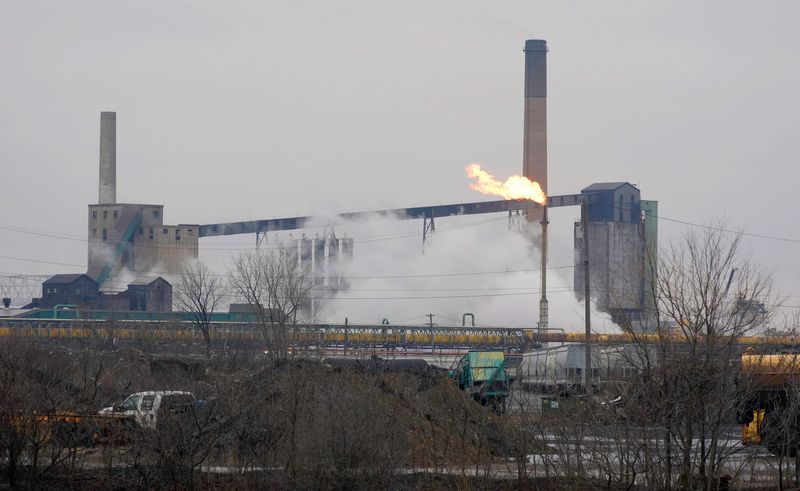
A U.S. District Court judge has ordered Michigan utility giant DTE to pay a $100 million penalty for the persistent, excessive air pollution emanating from one of its subsidiary factories on Zug Island.

U.S. District Judge Gershwin Drain, in his ruling Tuesday, Feb. 17, also ordered DTE to come into compliance with the federal Clean Air Act by following stricter “new source review” air pollution permitting guidelines at the EES Coke Battery plant. The utility must also form a Community Quality Action Committee and provide it with $20 million in funding for community air quality improvement projects.
“This is a rare good day for environmental justice in Detroit,” said Nicholas Leonard, executive director of Great Lakes Environmental Law Center, which represented the environmental nonprofit organization Sierra Club in the lawsuit.
DTE officials in a statement said the ruling will have “negative implications” for the coke supply vital to the U.S. steel industry, and that the utility intends to appeal the ruling.
EES Coke Battery LLC operates 85 ovens at its Zug Island facility. There, coal is heated in an oxygen-free atmosphere until all its volatile components evaporate, leaving behind coke. The coke is then used in steelmaking to heat iron ore and remove its oxygen content, leaving behind pure iron.
The process leads to the release of potentially health-harming sulfur dioxide, and EES Coke Battery is one of the largest emitters of sulfur dioxide pollution in Michigan — about 3,600 tons of the pollutant into the atmosphere in 2021, according to the EPA.
The U.S. Environmental Protection Agency issued a notice of violation against EES Coke Battery in 2020, and the U.S. Justice Department sued the company two years later, after the EPA found the company did not follow Clean Air Act permitting requirements to prevent significant air quality deterioration, update pollution controls to best available technologies, and other “New Source Review” requirements when making a major modification to plant operations. The company years earlier had modified how it was using coke oven gas, a byproduct of the coking process, as a fuel.
The Sierra Club and the city of River Rouge joined in the lawsuit against EES Coke Battery with the federal government. The government later amended its complaint to add DTE as defendants to the case, claiming they are also liable for the alleged Clean Air Act violations as “operators” of the facility — a contention the utility disputed.
In February 2025, the court found EES Coke Battery liable for Clean Air Act violations in a summary judgment, a direct court finding based on available evidence. The court, at the same time, denied DTE’s motion for summary judgment, finding that there were issues for the court to later decide on whether DTE should be considered operators of EES Coke Battery.
The Court held a bench trial on the DTE’s liability and the appropriate remedy in September 2025.
In his ruling Tuesday, Drain found that the government had proven that DTE was indeed the operator of EES Coke Battery. The $100 million civil penalty was based on testimony showing DTE benefited economically by about $70 million from delaying or avoiding compliance costs. That amount, to which the judge added a multiplier, is “to ensure the civil penalty levels the economic playing field and adequately deters future Clean Air Act violations.”
Drain declined to impose specific air pollution control targets, leaving that to the state’s environmental regulator, the Michigan Department of Environment, Great Lakes and Energy to determine during the permitting process. Testimony during the trial indicated that desulfurization technology, which could be incorporated at the plant, can reduce sulfur dioxide emissions by more than 90%. EES Coke Battery in 2015 considered and rejected installing desulfurization technology, which it estimated would have cost $165 million.
Theresa Landrum, a southwest Detroit resident, environmental justice advocate and Sierra Club member, called Tuesday’s ruling “a monumental victory.”
“Our families and neighbors can never get back the years lost to breathing dirty air,” she said. “This ruling gives me faith that big corporations can be held accountable for breaking the law, and it gives me hope for the future.”
The Community Quality Action Committee will be composed of seven members, including residents and representatives of environmental advocacy organizations, who are charged with maximizing public health and air quality improvements in Ecorse, River Rouge, and the 48217 ZIP code, predominantly African American neighborhoods surrounded by heavy industry that University of Michigan research determined is the most polluted ZIP code in Michigan.
Examples of possible projects include funding and distributing stand-alone HEPA air purifier devices to households near EES Coke, installing filtration systems in schools, and home weatherization programs, said Dr. Dolores Leonard, a Sierra Club member, who, like Landrum, lives in the 48217 ZIP code.
“Through our efforts, we won millions of dollars to help fund things like air purifiers in homes and schools that will help kids breathe easier,” she said. “These wins will undoubtedly save lives.”
DTE responded to Free Press inquiries seeking comment with an emailed statement: “We are extremely disappointed in the court’s ruling and its negative implications on the domestic supply of coke to the U.S. steel industry. We have been anticipating this order and are eager to make our appeal to the 6th Circuit Court. We remain committed to compliance and have been operating within the limits of the valid original state permit — both today and during the time period in question. “
Contact Keith Matheny: kmatheny@freepress.com.
This article originally appeared on Detroit Free Press: Judge orders DTE to pay $100M penalty over Zug Island factory pollution
Reporting by Keith Matheny, Detroit Free Press / Detroit Free Press
USA TODAY Network via Reuters Connect