On paper, it should never have been a hit record.
But despite the odds stacked against it — the 6-minute length, the somber subject matter, the last-minute recording session — “The Wreck of the Edmund Fitzgerald” went on to become one of the defining singles of the 1970s.

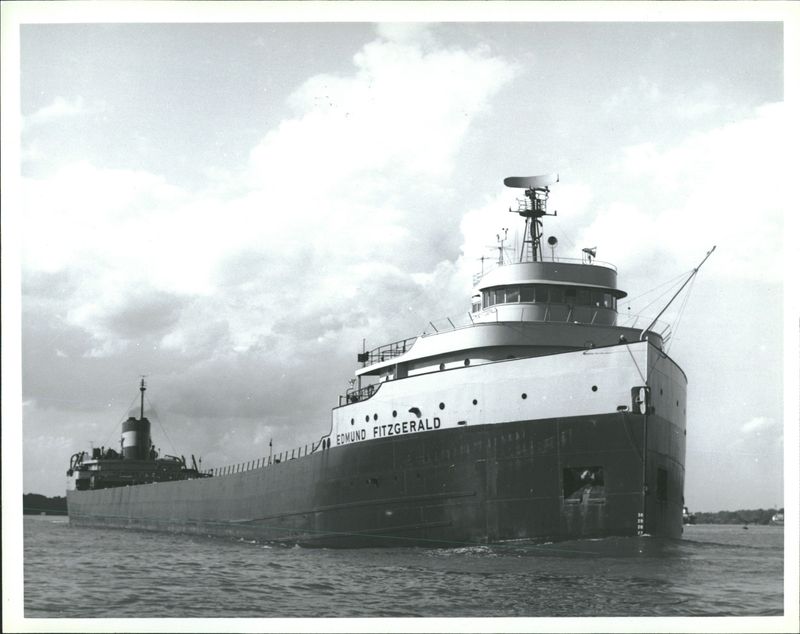
Canadian songwriter Gordon Lightfoot was a week from his 36th birthday when the SS Edmund Fitzgerald, the biggest Great Lakes freight ship of its era, gave way to Lake Superior amid a daunting storm on Nov. 10, 1975.
As recounted in Lightfoot’s stirring ballad, the shipwreck took the lives of 29 men, a toll marked by a ringing of bells at Detroit’s “maritime sailors’ cathedral,” as his lyrics famously depicted it.
The disaster was still fresh in the headlines when Lightfoot and his band hunkered down in a Toronto studio in December 1975 at the end of a long recording day, amid work on the forthcoming album “Summertime Dream.”
Virtually on the fly — the lyrics weren’t even finished yet — they crafted the track that would later be heralded as one of the masterpieces in Lightfoot’s long, rich body of work.
“It’s funny — it was meant to be filler,” says pedal steel guitarist Ed Ringwald, then best known as Pee Wee Charles. “Gord said we’d use it to fill the album up. I mean, it was a really long song. What radio stations were going to play that?”
In fact, recalls bassist Rick Haynes, “The Wreck of the Edmund Fitzgerald” wasn’t even initially intended for the upcoming record. At that stage, it was “just this little ditty” Lightfoot had tinkered with one night in front of the band.
But the next evening, having made quick work of other songs on the recording docket, Lightfoot and the group found themselves ahead of schedule. The clock was still running on the studio time they’d reserved.
“The engineer said, ‘You’ve got the time booked. You’ve got the guys here. What about that song about the shipwreck?’” recounts Haynes. “Gordon said, ‘Well it’s not really finished yet. It still needs to be polished up.’”
Still, they decided to give it a whirl. With a few simple directions from Lightfoot, the tape started rolling, band members began playing, and out came a haunting, unrelenting sound that evoked the sensation of a roiling sea, complete with an opening drum fill that struck like a thunderclap.
And by the end of those 6 minutes, they’d created a recording that would join the canon of popular music’s hallowed first-take hits.
Church bells and news stories
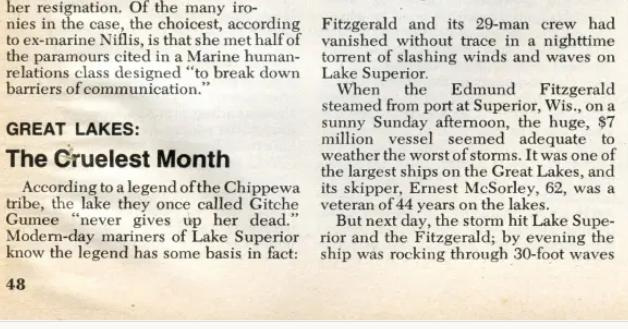
Legend has long held that Lightfoot was sparked to write “Edmund Fitzgerald” after encountering an article about the disaster in the Nov. 24, 1975, edition of Newsweek magazine.
That piece, headlined “The Cruelest Month,” certainly had its influence — indeed, Lightfoot’s opening verse directly borrowed key imagery from the story’s lead paragraph.
But a chance moment two weeks earlier in downtown Detroit may have been just as crucial.
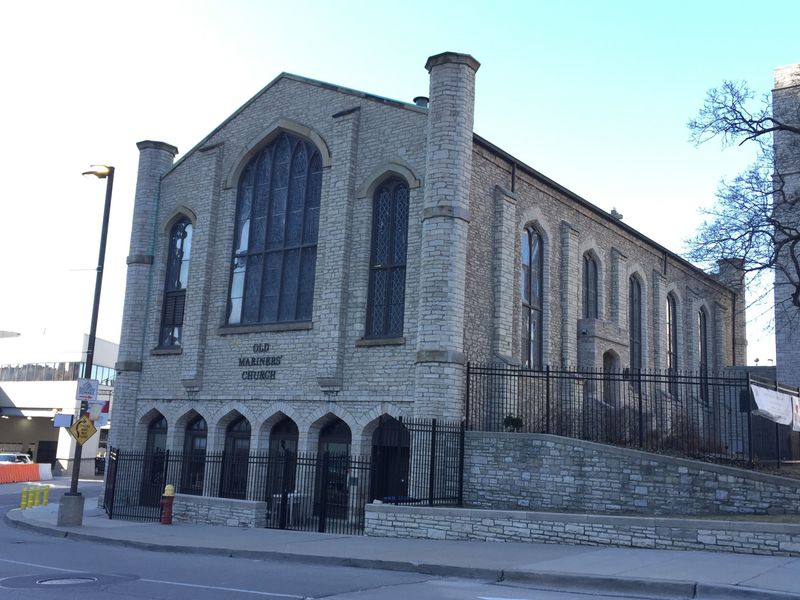
As recounted by the son of the late Rev. Richard Ingalls, longtime rector of Mariners’ Church on Jefferson Avenue, it was pre-dawn Nov. 11 when Ingalls made a phone call to confirm the loss of the Edmund Fitzgerald and her crew.
Ingalls then “entered the bell tower and, with solemn deliberation, pulled the rope and rang the bell 29 times,” his son writes in a new online retrospective. “He then knelt in private devotion at Mariners’ altar, under the larger-than-life stained-glass Christ figure whose right hand is raised, commanding the storm-tossed sea: ‘Peace. Be still.’”
Outside, a wire-service reporter happened to pass by. Hearing the early-morning bells, he approached the church to verify with Ingalls they’d been rung in honor of the Fitzgerald.
That reporter’s breaking story, detailing the ringing of the bells and the Detroit church’s history of service to Great Lakes sailors, was actually the first one read by Lightfoot, says the Rev. Richard Ingalls Jr., who took over his dad’s role as rector in 2006.
Ingalls Jr. says Lightfoot privately described the scenario to him years later: While flying to Toronto after a run of California concerts, the musician read the wire piece in the Los Angeles Times and was immediately moved.
“Reading that on the flight back, he got a really strong feeling there was something he had to do,” Ingalls tells the Free Press. “So the idea of the ballad was already starting to bubble in his brain. He couldn’t ignore it. When the Newsweek article (later) came out, it made him listen to that inner voice, and that’s when the creativity really kicked in.”
Lightfoot’s song became inextricably linked to the 183-year-old Anglican church on Detroit’s riverside, and Ingalls remains quietly honored by his father’s role.
“So it was that a pure, private act of devotion became a part of the song, and of the legend,” he says.
In the immediate aftermath of the Fitzgerald’s sinking, many details about the events of Nov. 10 were fuzzy. Lightfoot, relying on real-time reports such as the Newsweek article, wound up with a few inaccuracies. (Among them: The freighter’s load of iron ore was in fact bound for Detroit, not Cleveland as the song attests.)
Ingalls says that at one point, Lightfoot contemplated releasing a revised version of the track, but ultimately opted against it. After all, his song had already done its most important job as a piece of art.
“He really captured the spiritual depth and conveyed what these guys went through,” Ingalls says.
‘Magic’ in the studio
At Toronto’s Eastern Sound Studios that December night in ’75, the musicians instantly knew they’d been part of something special.
They’d all locked into the feeling of the tragic event, with the swells of Ringwald’s pedal steel providing a mournful tone, Haynes’ bass setting the sonic foundation for a rolling ship in a storm, the guitar of Terry Clements offering an edge of menaced distortion, thanks to a Fender amp with a hole in the speaker.
“It was like there was magic in that room, and you could feel it during the recording,” says Ringwald. “I can still imagine it now, and that was 50 years ago.”
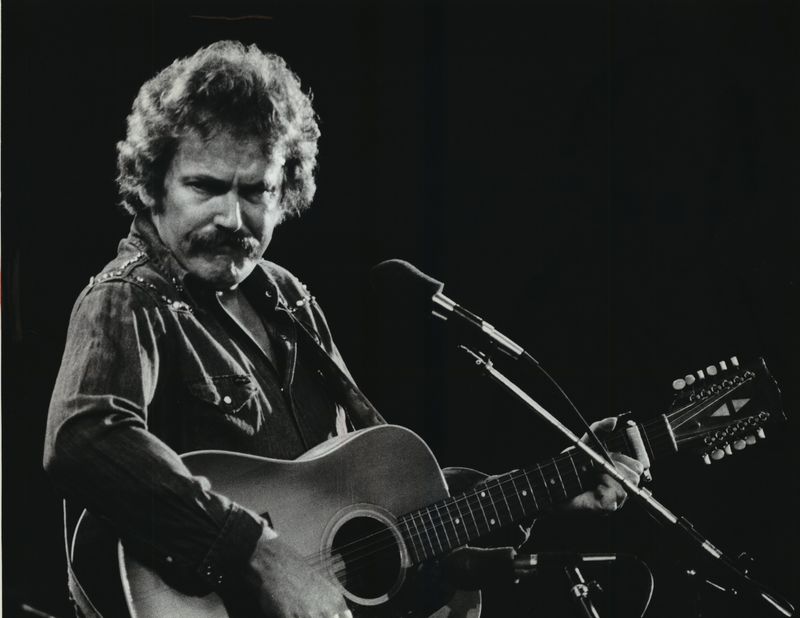
Lightfoot, joining on 12-string acoustic guitar, had provided minimal instruction ahead of time, sketching out a basic arrangement and telling drummer Barry Keane he’d nod when it was time for him to jump in.
The ensemble taped several more renditions of the instrumental track. But it was that initial, impromptu take that stuck.
“In the music business, first takes are talked about almost mystically,” says Haynes. “And this was a first take, top to bottom.”
Watching over the session was record producer and eventual Warner Bros. Records President Lenny Waronker, part of the Rock & Roll Hall of Fame’s 2025 class of inductees.
Lightfoot’s vocals were added later, as his crisply enunciated singing, vivid lyrics and Irish-style folk melody sold the storytelling.
“Gord had been no stranger to writing songs about the sea in various forms. He knew how to journalistically capture that concept, and that was part of the obvious success of the exercise here,” says Haynes. “He had a vision that was clear in his mind.”
Lightfoot penned much of “Edmund Fitzgerald” while a heavy storm blew through Toronto, the bassist says. In his Beaumont Road house, Lightfoot was ensconced in his favorite writing spot — a “funky old room in a third-floor turret,” as Haynes describes it.
“That gale was blowing in and rattling the windows,” says Haynes. “He had all those elements going on while he was thinking about the events that took place on that ill-fated freighter. Gord was a master at noticing what went on around him and translating that into everyday terms people could relate to. Once he started down the road with that song, it wouldn’t miss, because he was such a master technician.”
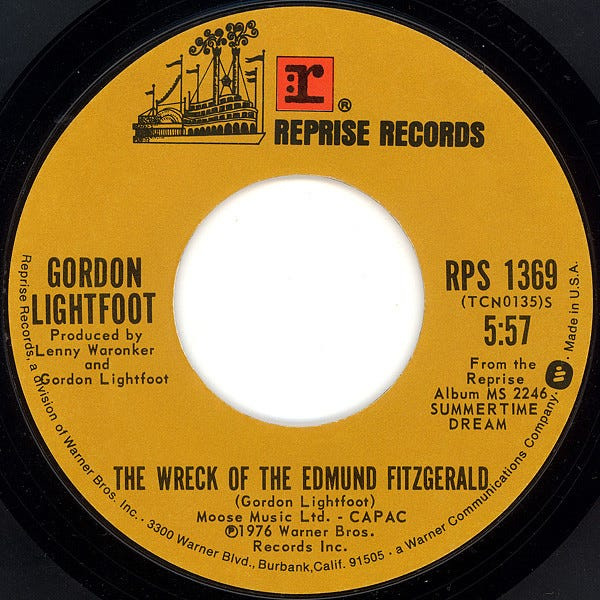
“The Wreck of the Edmund Fitzgerald” was released by Reprise Records in August 1976. By autumn it had topped the Canadian charts while peaking at No. 2 stateside.
“There’s always something that will grab you in a hit song,” says Ringwald. “When you hear that first note of Terry’s playing and the 12-string, it just grabs you. And then throughout, it just takes your emotions up and down. It was such a wonderful tribute to all those men and their families.”
A bond with Detroit
In a musty old hall in Detroit they prayed / In the maritime sailors’ cathedral / The church bell chimed ’til it rang 29 times / For each man on the Edmund Fitzgerald
— Gordon Lightfoot, “The Wreck of the Edmund Fitzgerald”
Like many Canadian artists, Lightfoot had enjoyed an early stronghold in Detroit since his emergence at the turn of the ’70s, thanks in part to the famed radio programmer Rosalie Trombley at CKLW across the river in Windsor, Ontario.
Still, “The Wreck of the Edmund Fitzgerald” had an understandably special resonance in the Motor City and across the Great Lakes State.
Red Hot Chili Peppers drummer Chad Smith, who was a rock-obsessed metro Detroit teenager in 1976, describes his enduring affection for the Lightfoot track.
“I love that song,” Smith tells the Free Press. “Gordon Lightfoot was such a great storyteller. It’s deep — just an epic classic. And for it to be a hit with, like, 17 verses? This ain’t no pop song, and I love that.”
Ringwald says label officials had pestered Lightfoot to greenlight a radio edit — something to suit the standard 3-minute, 30-second hit format — but the songwriter refused, insisting: “There’s a whole story here, and I’ve got to tell it.”
In their first Michigan concert following the song’s release, Lightfoot and his band played Pine Knob Music Theatre in suburban Detroit. That night, says Ringwald, came “a crazy moment I’ll never forget”: Just as they launched into “Edmund Fitzgerald,” a thunderstorm swept across the Clarkston amphitheater.
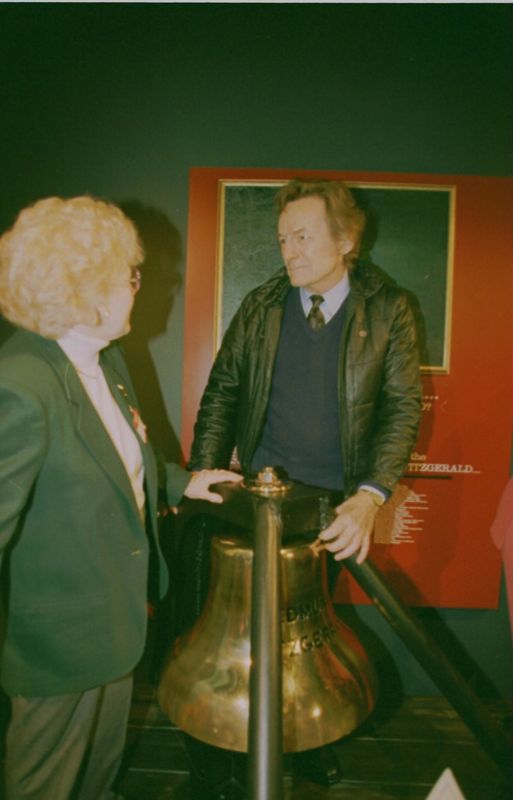
At Mariners’ Church, where the Fitzgerald memorial bells had rung out, Lightfoot was a quiet visitor through the decades, including drop-ins during his Detroit tour stops.
His first trip there compelled him to make one tweak to his lyrics: On record, he’d described the place as “a musty old hall in Detroit.” In concert, he began changing “musty” to “rustic.”
The church’s annual Great Lakes Memorial Service had come to include the choir’s performance of “The Wreck of the Edmund Fitzgerald.” One year, unbeknownst to most of the congregation, Lightfoot was seated up front with family of Fitzgerald victims.
As the choir’s expected moment came, Lightfoot was invited to a stool in front of the altar to perform his song with an acoustic guitar — the same spot where Rev. Ingalls had knelt to pray following the shipwreck.
“There was a murmur, then you could hear a pin drop,” Ingalls says. “People were basically holding their breath while he sang.”
Lightfoot died the evening of May 1, 2023, in Toronto.
The next afternoon, 230 miles across the Great Lakes region in Detroit, the Mariners’ Church bells were rung 29 times once again — before chiming an additional time to honor the man who had brought them to life in song.
Ingalls had preceded the singer in death, passing in 2006. A few days later, the pastor’s son got an unexpected phone call.
“Gordon told me, ‘Your dad meant a lot to me. He was a very kind, thoughtful man,’” says Ingalls Jr., recounting Lightfoot’s main insight: “He treated every day as a gift, which we all should do.”
Contact Detroit Free Press music writer Brian McCollum: 313-223-4450 or bmccollum@freepress.com.
This article originally appeared on Detroit Free Press: ‘It was meant to be filler’: Story of Gordon Lightfoot’s ‘Wreck of the Edmund Fitzgerald’
Reporting by Brian McCollum, Detroit Free Press / Detroit Free Press
USA TODAY Network via Reuters Connect