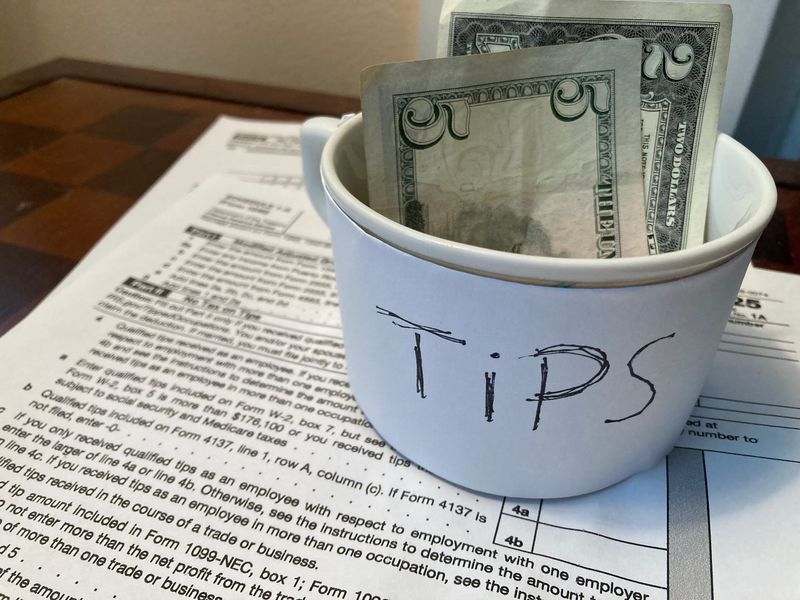
Just days before the April 15 tax deadline, the Internal Revenue Service issued final regulations and clarifications for jobs and situations that qualify for the so-called “no tax on tips” deduction.
A preliminary list issued in September gave tax filers some earlier guidance on “no tax on tips” occupations.

The list is a long one but so, too, is the list of reasons you might qualify — or not — when it comes to a new deduction of up to $25,000 for tip income.
The final regulations list more than 70 separate occupations of tipped workers from bartenders to clowns to golf caddies to locksmiths to massage therapists to podcasters to water taxi operators, who might qualify to claim a deduction on specific tip income. Other guidelines, including income limitations, also must be met.
What’s a new job on the occupations list?
One update: The final regulations expand the list to include visual artists and floral designers in the personal services category and add gas pump attendants in the transportation and delivery category.
The Department of the Treasury and the Internal Revenue Service also defined “qualified tips” that eligible taxpayers may claim as a deduction.
According to the release issued April 10, Treasury and the IRS received more than 300 comments. A public hearing was held on Oct. 23, 2025. The final regulations describe the comments and how they are addressed in the final regulations.
What kind of tips qualify? What doesn’t?
The final regulations further clarify that qualified tips must satisfy certain requirements, including how the tip is paid.
A qualified tip could be paid by cash, check, credit card, debit card, and gift card. The IRS also said qualified tips can include “tangible or intangible tokens that are readily exchangeable for a fixed amount in cash, or another form of electronic settlement or mobile payment application denominated in cash.”
Mark Luscombe, principal analyst for Wolters Kluwer Tax & Accounting in Riverwoods, Illinois, said qualified tips would not include physical or intangible forms that are not readily convertible into a fixed amount of money, such as cryptocurrencies, non-fungible tokens, in-kind gifts, or anything requiring a resale to determine its value.
“Only if, on receipt, the taxpayer can associate a fixed amount of money with the physical or intangible thing received and can immediately convert it into that amount of cash, does it constitute a qualifying tip,” Luscombe said.
In addition, as previously reported, tip income that qualifies for the tax deduction on Schedule 1-A does not include “service charges unless the customer has an option to disregard or modify the service charge.”
The IRS offered an example such as when a restaurant imposes an automatic 18% service charge for large parties and distributes that amount to waiters, bussers and kitchen staff.
“If the charge is added with no option for the customer to disregard or modify it, the amounts distributed to the workers from this service charge are not qualified tips,” the IRS said Friday, April 10 in a news release.
“Qualified tips must be paid voluntarily by the customer and not be subject to negotiation,” according to the IRS.
What’s the income limit for ‘no tax on tips’
Income limitations apply. If you make too much money overall, you might receive a partial tax break or no tax break at all.
The deduction for tip income starts phasing out for single taxpayers with modified adjusted gross incomes over $150,000 and at above $300,000 for married couples filing a joint return.
The deduction phases out at a rate that boils down to $100 for each $1,000 over the threshold.
The tax break on tip income completely phases out when one’s modified adjusted gross income is $400,000 for single filers and $550,000 for married couples filing a joint return.
Remember, if married, you’re looking at the modified adjusted gross income for the couple, not just the spouse who receives tip income. Married couples who file separately cannot claim the deduction for tip income.
Another key point: Workers can take the deduction only for qualified tips that are included on Form W-2, Form 1099-NEC, Form 1099-MISC, Form 1099-K, or reported by the worker on Form 4137.
The IRS said gig workers and other self-employed individuals can qualify for this deduction if their occupation is on the “List of Occupations that Receive Tips” and the other statutory and regulatory requirements are met. The new law limits the deduction for self-employed individuals to the individual’s net income.
“Taxpayers are already benefiting from No Tax on Tips since the IRS already is issuing refunds to eligible workers,” said IRS Chief Executive Officer Frank J. Bisignano in a statement Friday, April 10.
“Given the wide variety of workers who receive tips, these final regulations help implement an important tax benefit for American workers.”
The IRS noted that the list of occupations that receive tips is classified by the “Treasury Tipped Occupation Code” system, comprising a three-digit code and description for each of the occupations listed within the final regulations. Occupations fall into eight categories:
Contact personal finance columnist Susan Tompor: stompor@freepress.com. Follow her on X @tompor.
This article originally appeared on Detroit Free Press: IRS adds more jobs that are eligible for ‘no tax on tips’
Reporting by Susan Tompor, Detroit Free Press / Detroit Free Press
USA TODAY Network via Reuters Connect