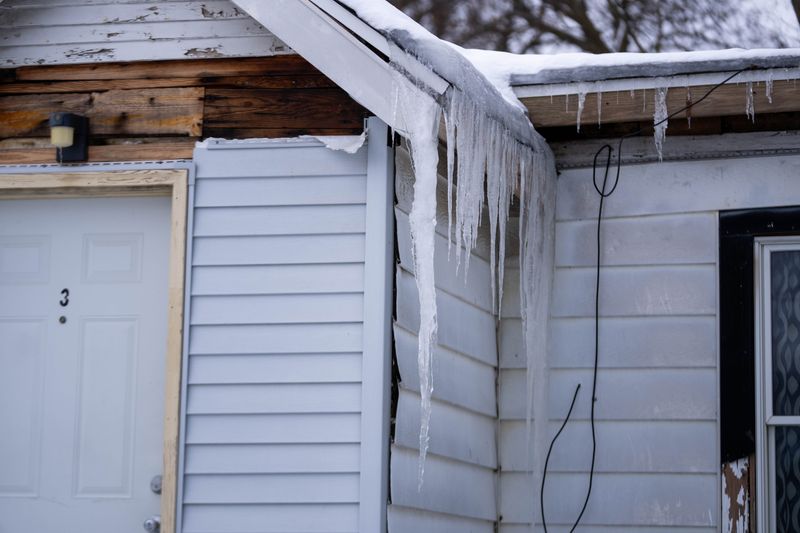
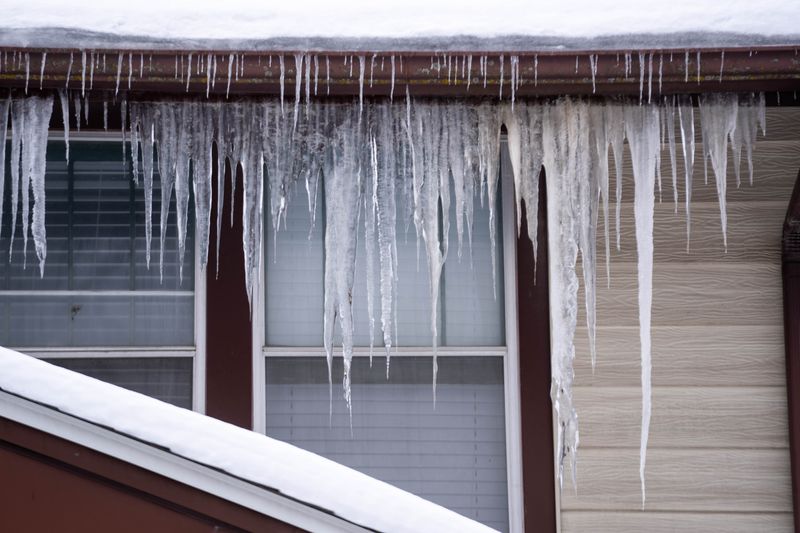
If you’ve looked up at your roofline this winter and noticed icicles hanging from the eaves, you’re probably spending more to heat your home than you need to — and you may end up needing roof repairs.
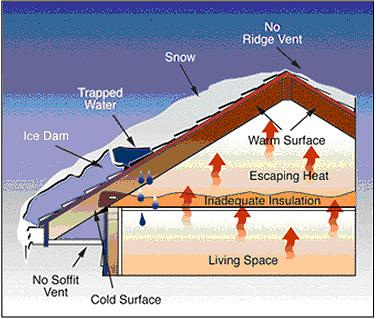
Icicles and ice dams are caused when water freezes along gutters or downspouts from a mixture of temperature fluctuation and heat escaping from your home, according to the National Weather Service. Heat rising through your ceiling and attic to the underside of the roof melts accumulated snow and ice, which then refreezes after the water runs away from the heat source — ultimately leaving snow and ice in your gutter that pours and drips over into icicles.

“Icicles on a roof can be a perplexing sight. After all, how can water melt during sub-freezing temperatures? The culprit is your home’s insulation,” the Grounds Guys explained. “Poor insulation is the main reason why icicles form on gutters and roofs. Even something as innocent as icicles can grow and damage your gutters with their weight or pry under your shingles and retreat into the attic, where the ice often melts to cause more damage in its water form. All of this happens because of ice dams in the gutters.”
“In snowy climates, ice dams are a common winter problem that can cause significant damage to your home’s roof and interior,” “This Old House” said. “Heavy, unchecked ice dams can compromise a roof’s structural integrity, so preventing them also means preventing costly repairs.”
The Insulation Institute says up to 90% of U.S. home lack the correct amount of attic insulation.
“Having the correct amount of attic insulation can help you maintain a comfortable temperature throughout your home and help save money on your energy bills — plus, prevent major issues like ice dams in the winter,’ the organization said.
In addition to preventing the need for roof repairs, the EPA’s Energy Star website says sealing your home and properly insulating can save up to 19% on heating and cooling costs.
Here’s how to prevent ice dams this season.
Why are icicles forming on my gutters?
Ice dams are common in northern climates and are defined as “heavy snow buildup melts during the day that then refreezes when temperatures drop overnight,” according to the National Weather Service.
“This cycle is usually caused by heat escaping from your home into the attic, warming the roof, and melting the snow,” Standard Heating and Cooling, of Albany, New York, said. “The melted water then trickles down and freezes when it meets the colder air at the roof’s edge, forming icicles. In some cases, this process can create even more problematic ice dams.”
Should I knock icicles off my gutters?
Experts don’t recommend it, though it can be done responsibly.
“While icicles are rarely sharp or large enough to impale a person, they can still cause bruises, cuts, and broken bones when they fall. In fact, about 15 people are killed by icicles annually in the United States,” the Air Force Safety Center said.
In addition, removing icicles, especially when they are large, may result in damage to the gutter or shingles of the roof, so hiring a licensed contractor is the first recommendation, according to the Dry Home Roofing & Siding, of Sterling, Virginia.
“The most common advice for dealing with icicles is usually to knock them off with a pole,” Homes & Gardens magazine said. “However, the experts don’t advise this for the biggest icicles. It can be very hazardous.”
How can I prevent ice dams and icicles?
If you can’t add insulation, “This Old House” recommends several methods for dealing with the problem, including heated cables.
“Heated cables help prevent ice dams that lift shingles and cause leaks,” the website said. “This solution allows you to equalize your roof’s temperature by heating it from the outside instead of blowing in cold air from the inside. Just be sure to install the cables before bad weather hits.”
Recommendations from Apex Exteriors Inc., of South Elgin, Illinois, include:
Long-term fixes for icicles and ice dams
“This Old House” suggests a variety of long-term solutions for dealing with poorly insulated attic and roof spaces.
“Getting rid of ice dams for good is simple, in principle,” “This Old House: said. “Keep the entire roof the same temperature as the eaves. You do that by increasing ventilation, adding insulation, and sealing off every possible air leak that might warm the underside of the roof.”
How much insulation should I have in my attic?
Different climates require different insulation R-values. You will need a higher R-value of insulation if you live in the Northeast than if you live in Southern California.
“If your home is more than 10 year old, you likely need more insulation. There are many ways to retrofit a home with fiberglass and mineral wool insulation,” the Insulation Institute said.
Insulation is identified and labeled by R-value. “R” stands for resistance to heat flow. The higher the insulation R-value, the greater the insulating power.
In Michigan, recommended attic R-values range from R49 at the low end to R60 in all areas of the state.
How can I tell if I have enough insulation?
A “poorly insulated” home may have as little as 4 to 5 inches of insulation — a visual examination will show the tops of ceiling joists are visible. Insulation that fills to the top of the joists is about R21.
A home with 12 to 14 inches of insulation may have an R-value of 38. An R49 value requires 16 to 18 inches of insulation.
Contact Sarah Moore @smoore@lsj.com
This article originally appeared on Lansing State Journal: Icicles hanging from your home? Why that’s a bad thing
Reporting by Sarah Moore, Lansing State Journal / Lansing State Journal
USA TODAY Network via Reuters Connect