Detroit — Exiting Turn 2 onto the long, Jefferson Avenue straight headed, Detroit Grand Prix racers row their steeds through all six gears, their howling, 12,000-RPM engines hitting 185 mph as they reverberate off the canyon of Detroit buildings.
The Chevrolet Detroit Grand Prix Presented by Lear feeds our need for speed. It also feeds the homeless.

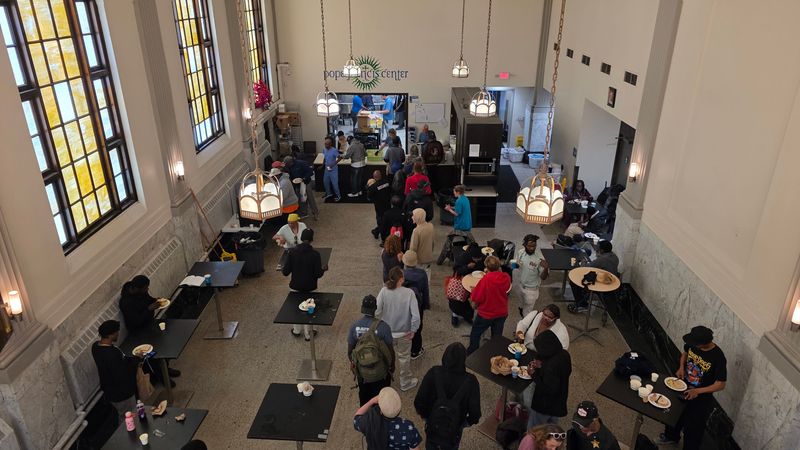
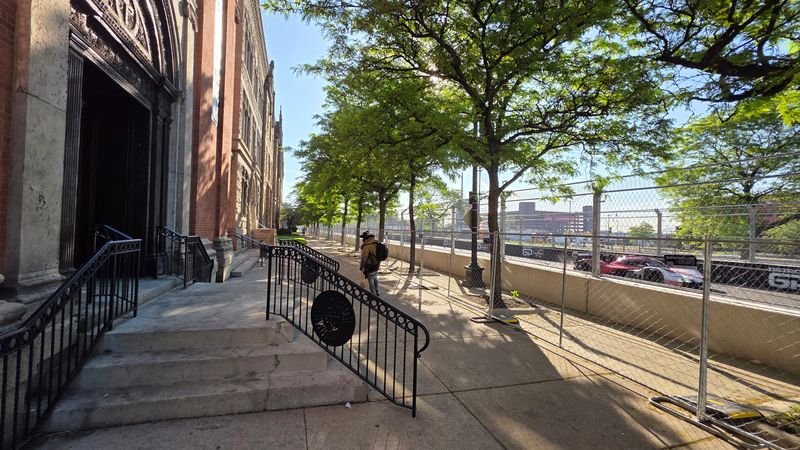
One of the buildings that lines the ¾-mile long straight is Detroit’s oldest church, St. Peter and Paul at 438 St. Antoine, which houses the Pope Francis Day Center for the homeless. It’s one of four charities (Belle Isle Conservancy, the Boys & Girls Clubs of Greater Detroit, and the Detroit Public Safety Foundation are the others) that the Grand Prix, now in its fourth year downtown, prioritizes.
On Friday night, the Grand Prix hosts its annual PwC Grand Prixmiere dinner, which has raised millions for Detroit — including about $1 million to help feed the 300-450 needy men and women who file into the 3,000-square-foot Day Center every day from 7-11 a.m. for food, clothing and medicine.
“Their support has been really helpful to us,” Father Tim McCabe, who has run the Pope Francis Center for 11 years, said Friday over the roar of the 8 a.m. IMSA Weathertech Sportscar Series practice. “There are few people who have been more consequential to this city in terms of investment than Roger Penske — really lifting up the city and the people that live here.”
The race cars thundering by on the other side of the Jersey barrier are music to his ears.
“Our clientele loves it, they really do,” said McCabe, who will receive the Daniel J. Loepp Community Champion Award at this year’s Prixmiere event. “They like the excitement that comes with it, and they feel included. It’s such a rare experience for the homeless to feel included in anything. They feel invisible.”
Since it returned to the Motor City in 2007, the Grand Prix has raised the visibility of neighborhood charity. For the 13 years it was on Belle Isle (2007, 2008, 2012-2022), the event helped raise over $13 million to rebuild the island’s infrastructure, aquarium and historic fountain.
Since the Grand Prix moved downtown in 2023, the city has been Job One.
“We wanted to make sure that everybody benefited from us moving from Belle Isle back downtown,” said Michael Montri, the vice president of Penske Entertainment who runs the Grand Prix. “We didn’t want to come back downtown and put a big fence up around the entirety of the venue and say this is now our venue and you must pay to get in.” Montri and his Penske team met McCabe as they approached Jefferson businesses ahead of the first downtown Grand Prix in 2023. The plan? To turn Detroit’s 35-mph, six-lane avenue into a 185-mph centerpiece for a 1.6-mile track that wrapped around General Motors Co.’s Renaissance Center headquarters.
“We wanted to go out to the community to make sure that we didn’t displace anybody,” said Montri. “None of the businesses that are on Jefferson. Our goal was to not have any negative impact of having this race here. We wanted to have a positive impact.
“Father Tim at Pope Francis Center was one of the first ones completely supportive. Right from the jump.”
As with Belle Isle’s rebuilding, Penske Entertainment was determined that the event make a fundamental impact on the city — not just provide window dressing for an annual sporting event.
Father Tim’s rebuilding ambitions are just as grand, but on a very human scale. In addition to daily care and feeding, the Pope Francis Center has invested heavily in the 60,000 square-foot Bridge Housing Campus program in Detroit’s Core City — a dedicated rehabilitation facility to help homeless people rejoin mainstream life.
“I went to the business community and presented a solution,” said McCabe, 63. “I don’t believe in Band-Aid approaches, I wanted transformational systemic changes. When you get someone like Roger backing you, that gives you credibility. Homelessness is a problem that can only be solved when we’re all working together — as a private-public partnership. I’m not interested in continuing a broken system that keeps these guys trapped in homelessness.”
The Bridge has been open since late 2024 and has rehabilitated 35 citizens and counting. With an operating budget of $7.2 million, the Pope Francis Center has benefited substantially from Grand Prixmiere charity — including an additional $2 million raised this spring at a Ford Field fundraiser honoring Penske.
“The Grand Prixmiere is now in its 12th year, and we’ve raised just under $10 million over those years,” said Montri. “It’s a great fundraiser Friday night, and it’s a great way to kick off the weekend. Remind everybody why the Grand Prix exists.”
In addition to its core four charities, the Detroit Grand Prix also opened the door to other Detroit businesses not located in downtown Detroit — but that wanted to take advantage of the weekend’s 100,000 attendees and media exposure.
“We wanted businesses that were outside the core downtown area to benefit from this,” said Montri. “Let’s bring those businesses down to the venue and figure out a way — free of charge — for those businesses that are out in the neighborhoods. Let’s figure out a way to get them to interact with our, our fans . . . who will then go and visit their brick-and-mortar business, because of the interaction that happens at the racetrack.”
An example? The Pink Poodle bridal shop on Livernois.
“They set up, set up shop, and one of the newscasters on one of the local TV stations interacted with them, actually ended up buying one of their dresses,” said Montri. “They’re a great story.”
The roots of the Penske team’s community work dates back to the 2006 Super Bowl, which brought a flood of attention to the downtown. Chairman Penske was determined to make that attention sustainable beyond a one-time event.
The idea of bringing the Detroit GP back as an engine for community growth was born. Its dollars help sustain Detroit’s needy every day in the form of clean clothes, medication and food. Good food.
“We get really good produce and quality food for these guys,” said McCabe. “When we got real food into these guys, the behavior problems just plummeted. You can see how calm it is in here. We have people with addiction and mental illness — but nutrition really makes a difference. We actually see it happening, so it’s become part of our mission, and Penske has helped us to do that.”
Henry Payne is auto critic for The Detroit News. Find him at hpayne@detroitnews.com or @HenryEPayne.
This article originally appeared on The Detroit News: How the Detroit Grand Prix speeds food to Detroit’s homeless
Reporting by Henry Payne, The Detroit News / The Detroit News
USA TODAY Network via Reuters Connect