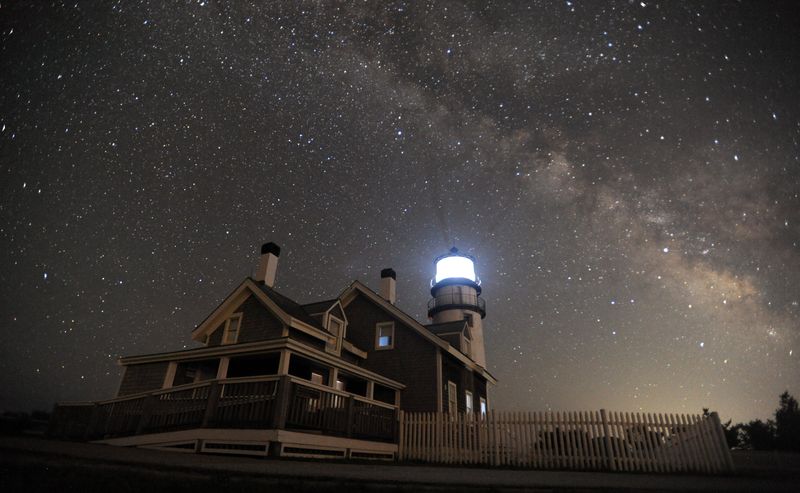
If a night under the stars sounds like your ideal Memorial Day weekend plan, this could be a better holiday than usual because the Milky Way will appear in the night sky.
Visibility may be difficult this weekend with showers and storms forecast off and on, but you may see the core of our galaxy, according to NASA. Milky Way “season” runs from about February to October, according to Capture the Atlas, a Milky Way photography website.

When weather conditions allow, you can enjoy prime Milky Way vistas at one of Michigan’s 10 dark sky areas.
Here’s what to know about Milky Way visibility this Memorial Day weekend.
Will the Milky Way be visible during Memorial Day weekend?
The Milky Way could be visible, though rain and clouds could block views in Michigan skies much of this Memorial Day weekend, local National Weather Service forecasts suggest.
In the Northern Hemisphere, the Milky Way rises in the southeast, travels across the southern sky and sets in the southwest, according to Weather.com.
By June, the center of the Milky Way, “the core,” will be best visible, Preston Dyches wrote in June 2025 for NASA.
When is Milky Way season?
Milky Way season, when the galaxy’s bright center becomes easier to see from Earth, is from February to October, according to the Milky Way photography website, Capture the Atlas.
Because visibility from Earth depends on the latitude, the farther south you go, the longer the Milky Way season lasts. In the Northern Hemisphere, which includes the continental United States, the best time to see the Milky Way is generally from March to September, according to Capture the Atlas.
Where can you see the Milky Way in Michigan?
Weather permitting, head to a clear, dark area for best Milky Way viewing. Michigan is home to six dark sky state parks, three international dark sky parks and an international dark sky sanctuary.
What times offer best Milky Way viewing?
The Milky Way is generally visible from sunset to sunrise, or when it’s darkest outside, according to Capture the Atlas. Typically, the sky is darkest from about midnight to 5 a.m. You can check sunrise and sunset times at your location using the website Time And Date.
Between February and June, the Milky Way is best seen in the early morning.
To spot the Milky Way, look for the Summer Triangle, a shape formed by three bright stars that spans across the Milky Way, science news website LiveScience recommends. The Summer Triangle includes Vega in Lyra, Deneb in Cygnus and Altair in Aquila.
What is the Milky Way?
The Milky Way is the galaxy in which our solar system exists. It’s a spiral galaxy that appears as a rotating disc curving out from a dense central region, according to the James Webb Space Telescope’s website. The galaxy features a disc of stars that spans more than 100,000 light years.
Our solar system is toward the edge of the galaxy, so when we look into the sky we see the collection of stars as a bright area across the night sky.
USA TODAY contributed.
Contact Jenna Prestininzi: jprestininzi@freepress.com.
This article originally appeared on Detroit Free Press: Holiday weekend, Milky Way season coincide. 9 places to see our galaxy
Reporting by Jenna Prestininzi and Eric Lagatta, USA TODAY NETWORK / Detroit Free Press
USA TODAY Network via Reuters Connect