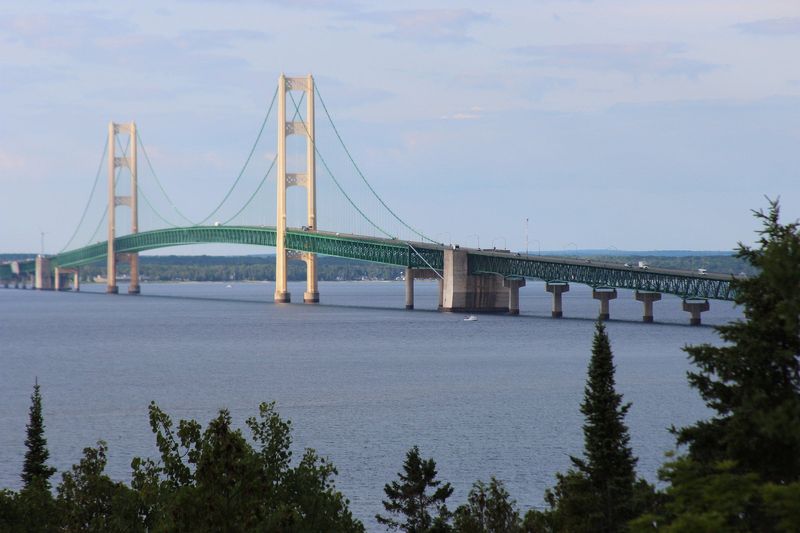
Ten Native American tribes around the Great Lakes have filed an amicus brief with the U.S. Supreme Court, urging the high court to find against Canadian oil transport giant Enbridge in its legal dispute with the state of Michigan over the Line 5 oil and gas pipeline on the Straits of Mackinac lake bottom.

“The Anishinaabe way of life relies on the Great Lakes ecosystem and the Straits of Mackinac in particular,” wrote the tribes’ legal representative, attorney Caroline Flynn of Earthjustice, a Washington-based nonprofit public interest environmental law organization that litigates high-impact cases to protect the environment, health, and wildlife.
Flynn noted that five of the tribes she represents in the brief hold treaty rights dating to 1836 to use the Straits of Mackinac and surrounding lands and waters — the Bay Mills Indian Community, the Grand Traverse Band of Ottawa and Chippewa Indians, Little Traverse Bay Bands of Odawa Indians, the Little River Band of Ottawa Indians, and the Sault Ste. Marie Tribe of Chippewa Indians.
“For centuries, citizens of those Tribal Nations have sustainably harvested fish in northern Lake Michigan, Lake Huron, and the Straits of Mackinac, among other reserved uses.,” Flynn stated in her brief. “Today, the Straits remain among the most important and productive of all of the ceded waters for Tribal citizens, who continue to fish these waters for subsistence and income.”
Michigan Attorney General Dana Nessel filed a lawsuit against Enbridge in state court on June 27, 2019, seeking to halt Enbridge’s continued operation of Line 5 in the Straits. The attorney general alleges violations of public trust doctrine, public nuisance and the Michigan Environmental Protection Act. Enbridge sought to move the case to federal court on Dec. 15, 2021, arguing that federal laws pertaining to interstate pipelines and the potential complications with Canadian-U.S. pipeline treaties supersede state law.
But federal law enacted by Congress requires a party to seek to remove a state case to federal court within 30 days. The U.S. District Court for the Western District of Michigan initially upheld Enbridge’s move. The U.S. Court of Appeals then reversed the district court’s finding, instead ruling that Enbridge’s move after the 30-day deadline was untimely and no exceptions applied.
The U.S. Supreme Court has agreed to take up that specific argument — on whether the 30-day limit on moving a state case to federal court applies, or if any exceptions to that rule apply — in its new term, which runs from October 2025 through the end of June or beginning of July 2026.
Flynn argues on behalf of the Great Lakes tribes that the Court of Appeals got it right in its ruling — that Enbridge filed its request to remove the state case to federal court beyond the statutory 30-day deadline.
“(The Great Lakes tribes) and the rest of the Great Lakes community have a paramount interest in the timely resolution of the State’s claims against the aging Straits Pipelines’ continued operation,” she stated. “If it were not for Enbridge’s procedural gamesmanship, the merits of this state public-trust dispute may well have been settled long ago — and the risks to (the tribes’) critical treaty-protected resources addressed. That is exactly why Congress limited the period for jurisdictional maneuvering and imposed only explicit, well-defined exceptions to that timeframe.”
A second federal lawsuit involving Michigan and Enbridge, filed over Gov. Gretchen Whitmer’s November 2020 move to revoke the company’s 1953 easement to use state bottomlands in the Straits of Mackinac for Line 5, was already removed to, and is pending in, federal court.
Built in 1953, Enbridge’s Line 5 moves 23 million gallons of oil and natural gas liquids per day east through the Upper Peninsula, splitting into twin underwater pipelines on the Straits of Mackinac bottom, before returning to a single transmission pipeline through the Lower Peninsula that runs south to Sarnia, Ontario. Many have expressed concern about the aging pipes over several years, as anchor strikes, missing pipeline supports and loss of protective pipeline coating have been discovered.
A 30-inch oil transmission line also owned by Enbridge ruptured in July 2010 in Marshall, spilling more than 1.1 million gallons of oil, fouling 38 miles of the Kalamazoo River and prompting a cleanup that took four years and more than $1 billion. Many fear a similar pipeline mishap on the Straits bottom, where Great Lakes Michigan and Huron meet, would be greatly more devastating.
Enbridge maintains that the pipelines are vital for regional energy transmission and have been operated safely for more than seven decades. The company is currently proposing to build a 21-foot diameter, 3.6-mile tunnel underneath the bed of the Straits of Mackinac to house a new, 30-inch diameter pipeline to move the oil and natural gas liquids.
Contact Keith Matheny: kmatheny@freepress.com.
This article originally appeared on Detroit Free Press: Great Lakes tribes file brief with U.S. Supreme Court in Line 5 Straits of Mackinac case
Reporting by Keith Matheny, Detroit Free Press / Detroit Free Press
USA TODAY Network via Reuters Connect