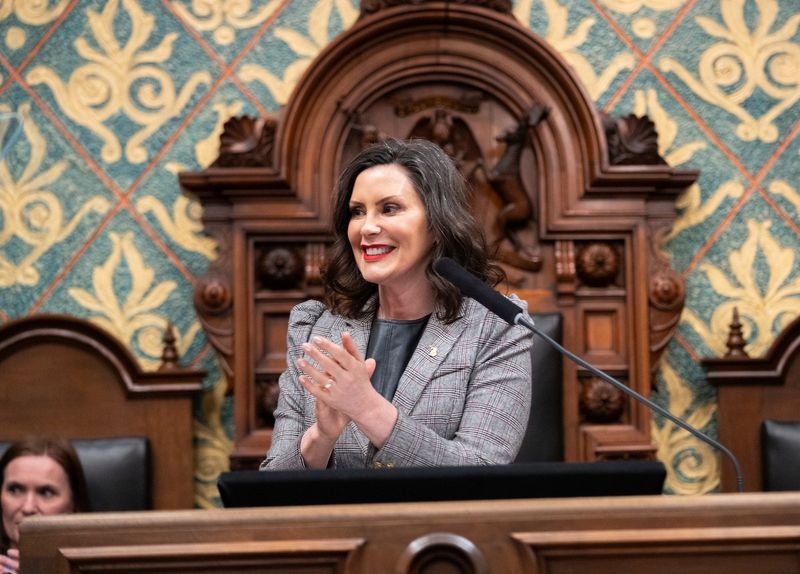
LANSING — Gov. Gretchen Whitmer will present her 2027 budget proposal to state lawmakers Feb. 11, and her budget director is warning that Whitmer’s eighth and final budget may be her most challenging one yet.
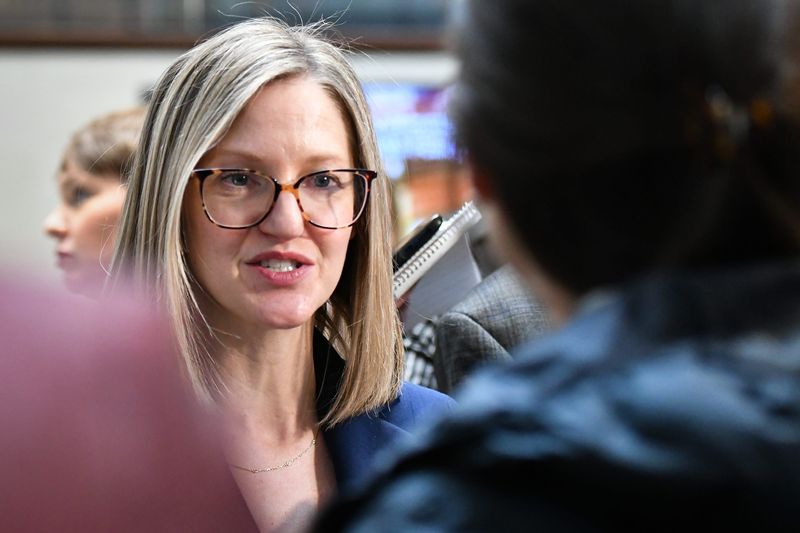
“This year will be unique,” State Budget Director Jen Flood told the Detroit Free Press in a Jan. 29 interview.

“We’ve got some uncertainty in the economy. We’ve got rising health care costs that are impacting Michiganders and the state budget,” Flood said.
At the same time, Michigan is starting to feel more of the impact from the federal budget reconciliation passed by Congress and signed into law by President Donald Trump in July 2025, which “passed the buck to states on programs that matter most and core services like access to health care and food assistance for families,” Flood said.
Under the state constitution, Whitmer must leave office at the end of this year after completing two four-year terms.
As Flood, Whitmer, and other officials put finishing touches on the budget, the state faces uncertainty and significant higher costs for implementing federal work requirements for Medicaid and for increasing Michigan’s share of administrative costs for the SNAP (Supplemental Nutrition Assistance Program) program to 75%, up from 50% currently due to the changes to federal law, Flood said. Michigan’s increased SNAP administration costs alone are expected to total $95 million next year, she said.
Michigan also must invest in improved systems and deploying more state workers to local offices where they can help applicants fill out accurate forms, to reduce the SNAP error rate, or the state could face penalties of about $320 million a year, she said.
Flood would not give a total dollar figure for how the federal changes are expected to impact Michigan’s 2027 budget, except to say that it would be hundreds of millions of dollars. She also did not disclose the total amount of spending Whitmer will propose for 2027.
The Michigan budget faces those challenges despite taking steps in 2026 to mitigate the impact on Michigan of the federal budget reconciliation, known as House Resolution 1, or the One Big Beautiful Bill Act, Flood said. Those steps included “decoupling” Michigan’s corporate tax from federal tax law so that Michigan businesses could take advantage of federal tax cuts in certain areas without those tax cuts impacting the amount of taxes those businesses pay at the state level.
Another major step taken in 2026 was a bipartisan plan to secure $2.7 billion in federal health care funding after new federal law changed the rules on how the state portion of Medicaid coverage could be funded, Flood said.
Initially, Michigan estimated H.R. 1 of 2025 would have a cumulative impact on the state budget of $10 billion through 2032, Flood said. That estimate has since been reduced to $4 billion over the same time period, mainly through actions the state took last year, “but $4 billion is still significant,” posing challenges to not just the 2027 budget but those in subsequent years, she said.
On Jan. 16, after state revenue projections were revised downward at an estimating conference held at the Capitol, House Speaker Matt Hall, R-Richland Township, called for more spending cuts in the 2027 budget, saying he wants to eliminate “waste, fraud and abuse.”
Flood said Michigan is not alone, as nearly all states face similar challenges and many are worse off than Michigan.
The National Governors Association was among the groups that signed a Jan. 8 letter to congressional leaders asking for delays and modifications to some of the federal changes to reduce the immediate impact on states. It was not clear as of Jan. 29 whether any of those pleas would be heeded.
Michigan has built up record reserve funds since the COVID-19 pandemic. Flood would not say whether the budget would use any or all of the $538 million state officials are permitted under state law to spend from the Budget Stabilization Fund, also known as the Rainy Day Fund, based on a calculation that considers personal income in Michigan and other factors. Currently, the Rainy Day Fund holds more than $2 billion.
“I know the Governor is committed to leaving the state in better shape than she found it,” Flood said.
Referencing the Rainy Day Fund, Flood said “these are resources that are available during challenging times, so we’ll be looking at all of our options.”
Contact Paul Egan: 517-372-8660 or pegan@freepress.com.
This article originally appeared on Detroit Free Press: Gov. Gretchen Whitmer to present her final state budget Feb. 11
Reporting by Paul Egan, Detroit Free Press / Detroit Free Press
USA TODAY Network via Reuters Connect