

Auburn Hills — What Ramzi Chakra thought would be a profitable Mother’s Day for his business quickly turned into a dire situation for him and his employees.
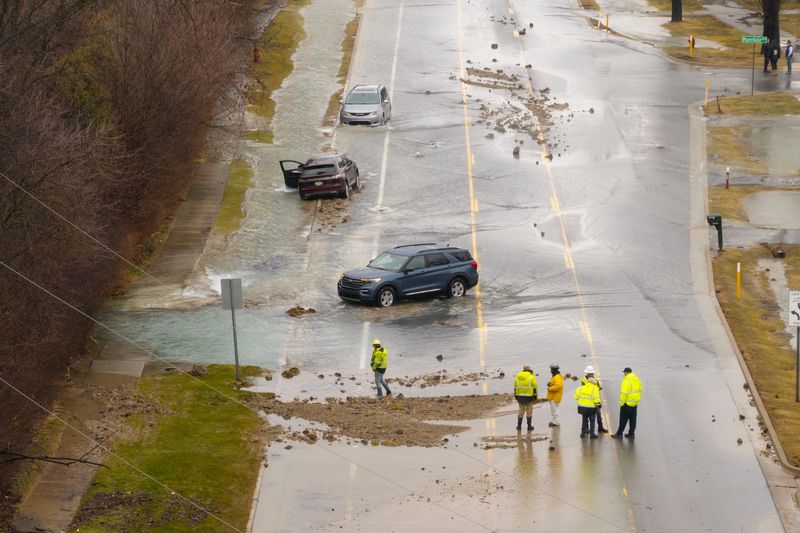
Chakra, who owns Common Roots Cafe in downtown Auburn Hills, was one of 200,000 residents in northeast Oakland County who were forced to restrict water use when a water main in a transmission line ruptured May 10. It took three days before water pressure was restored and six days before a boil order was lifted in Auburn Hills, Orion Township, Orion Village, Rochester Hills and parts of Oakland Township.

“Employees were worried that they might have to get jobs elsewhere because we can’t put them to work if there’s no business,” said Chakra, 36.
In preparation for the possibility of more than a week without drinking water, Chakra stocked up on water bottles at his store for residents to pick them up. Fortunately for him, water was restored before the end of the week.
The water main rupture in Auburn Hills wasn’t the first such break in Metro Detroit in recent memory. In February 2025, a water main ruptured in southwest Detroit, displacing hundreds. In September 2025 and March 2026, a water main on 14 Mile ruptured, placing Novi under a boil water advisory.
“It was frustrating,” said Ellen Krugel, who lives with her husband Noah in the Bristol Corners neighborhood in Novi. “It’s no fun having to boil water and be careful.”
These water main breaks have raised questions for the Great Lakes Water Authority, which oversees water operations for eight southeast Michigan counties and 3.8 million residents. The region’s residents have bridled at the rise in wholesale water and sewer rate increases, with a 5.8% water rate hike starting July 1, after a rate cap was lifted two years ago by law.
But GLWA has more infrastructure cash needs than it has money, GLWA CEO Suzanne Coffey said. Founded in 2014 as part of Detroit’s bankruptcy resolution, GLWA inherited an aging network of water infrastructure. Some water mains, like the one that ruptured in Detroit, are near the end of their life. Others, such as the ones that affected Novi and northeastern Oakland County, were poorly constructed when they were installed in the 1970s.
“The question becomes, ‘Why don’t you just replace it all?’ At $20 million a mile, it’s more than $1.6 billion that we do not have budgeted,” Coffey said.
Coffey said GLWA is in regular communication with state lawmakers in Lansing and with Michigan’s congressional delegation in Washington, D.C., about seeking additional money for infrastructure projects. State lawmakers and members of Congress said they’ve made efforts to secure more money for the authority.
In the meantime, GLWA is monitoring the condition of the pipes to try to get ahead of any ruptures. But critics said that’s still not enough.
“You can do all the testing in the world, but unless you’ve actually got the funds to replace the sections that need to be replaced, we’re just preparing for a disaster,” said state Rep. Kelly Breen, D-Novi.
GLWA attempts to get ahead of the faulty pipes
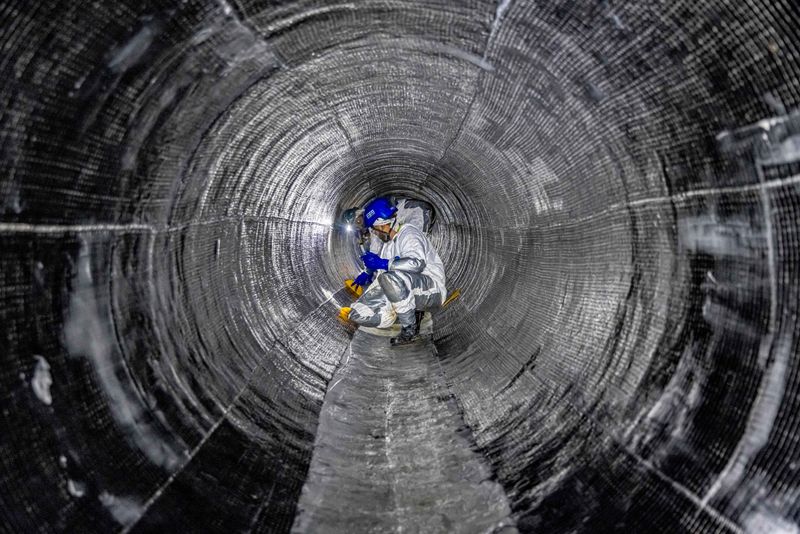
The pipes that ruptured in Novi and northeastern Oakland County were built with pre-stressed concrete. They also have a steel cylinder and wires for compression and sealing.
They were manufactured by Interpace, a now-defunct company that faced a host of litigation before it went out of business, Coffey said. An estimated 4% of the concrete pipes built by Interpace are faulty, and there’s no way for GLWA to know where the flawed pipes are located, she said.
The time has long since passed to place “any kind of claims for what we’re experiencing today. Because that’s the easiest first question, right? If we have defective pipe, what’s the remedy?” Coffey said.
While Coffey said the cause of the May rupture is still being assessed, she suspects the water main has defects like the one on 14 Mile.
“The first (rupture), I get. The second one, I didn’t understand why it happened so soon after they fixed it,” Novi’s Noah Krugel said. “It was frustrating.”
Asked if she can give residents in Metro Detroit any assurances, Coffey noted that 96% of the Interpace pipes are in good condition. She also said GLWA is doing frequent inspections and monitoring to get ahead of ruptures.
Some of the technology GLWA uses for monitoring and inspections includes using an electromagnetic detector that can assess the condition of the wires in the walls of the pipes. The authority also uses a “smart ball,” which uses acoustics or sound waves to detect a leak. If the ball hears a loud sound, it means there’s a leak problem that needs fixing, Coffey said.
But the GLWA CEO also said inspection practices have limitations in detecting faulty pipes. The water main at 14 Mile was in good condition when GLWA inspected it five years ago, she said.
“We were doing this — inspect, renew, inspect again, renew, and then this pipe broke. And then we looked again at the inspection and said, ‘Why did it break?’ So our international consultants said, ‘We’ve seen this only three other times in the world on this pipe,'” Coffey said.
‘We should probably bank on it happening again’
The possibility of a water disruption has prompted some residents in Oakland County to take steps to be prepared for the possibility.
The Krugels said they keep a supply of water in their house since the water main break in May. They also keep a tub in their house that they can fill with water in an emergency.
In Auburn Hills, Chakra said an emergency plan is especially important because of the presence of faulty Interpace-built pipes.
“If that many of them are faulty, we should probably bank on it happening again,” he said.
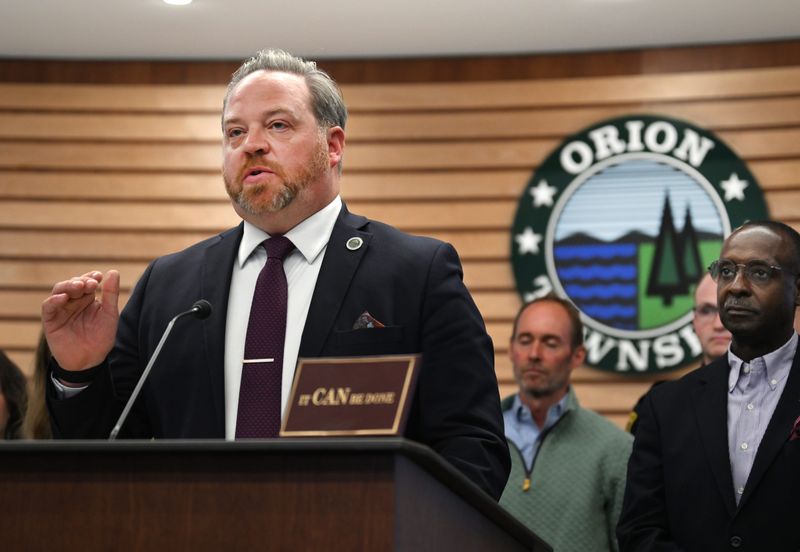
Coffey has gone to communities and explained the importance of having a plan in place for emergencies. During the May rupture, Pontiac assisted Auburn Hills, Rochester Hills and Orion Township by limiting its water use. Orion Township Supervisor Chris Barnett also held multiple news conferences and video messages on social media to keep residents informed of the situation until they could use their water again.
The response to the Auburn Hills break was “a shining example” of communities working together, Coffey said.
“I’ve been saying this message since we went through our situation — a failure to plan is a plan to fail,” Barnett said. “You need to be prepared.”
Barnett has also taken his experience navigating the water outage to other communities. As president of the Supervisors’ Association, he held a luncheon for fellow township supervisors to hear about Orion Township’s response.
“Most of them had a lot of questions, weren’t really sure what to do, and we’re giving them our playbook,” Barnett said. “That’s the good thing about government. We’re not in competition.”
‘Stuff is not fixing itself’
While Barnett spoke highly of having a plan, he still emphasized the need for more money to improve the region’s water infrastructure.
Barnett has worked with Republican U.S. Rep. Lisa McClain of Bruce Township, who is a high-ranking House GOP leader, to get the region “resources we need to meet this challenge head-on,” according to a statement from McClain’s office.
Democratic U.S. Rep. Haley Stevens of Birmingham said she’s secured more than $15 million in federal funding for water, wastewater and stormwater projects across Oakland County. Stevens also said she’s written legislation “to help communities deploy advanced water treatment technologies and strengthen long-term system reliability.”
“The repeated water main ruptures we have seen are unacceptable and underscore the need for sustained investment in Michigan’s water infrastructure,” said Stevens, who is running for the U.S. Senate.
At the state level, Breen said the Democratic-led Senate has received a request to earmark $20 million to repair the water mains on 14 Mile and in southwest Detroit. The request was submitted before the Auburn Hills rupture, she said.
But Breen said whether GLWA gets anything from the Legislature “is up in the air.” The Senate and the Republican-controlled House continue to negotiate about state budget specifics as the informal deadline to pass a budget of July 1 nears.
“I would not be surprised if nothing comes through, but I’m hoping that something would be in the budget,” Breen said.
“We don’t see that money being readily available, but we still ask,” Coffey said.
Orion Township’s Barnett said communities could use their experiences with water outages to lobby for more infrastructure funding in Lansing and Washington. He said it’s not a time to “point fingers,” but explain the impacts of water main ruptures in the region.
“Stuff is not fixing itself,” Barnett said, “and if we do nothing, we’re going to find ourselves in the exact same situation, whether it’s Orion Township or Novi or fill-in-the-blank.”
mbryan@detroitnews.com
This article originally appeared on The Detroit News: GLWA seeks more government aid as it urges readiness for main breaks
Reporting by Max Bryan, The Detroit News / The Detroit News
USA TODAY Network via Reuters Connect

By Max Bryan, The Detroit News | USA TODAY Network
