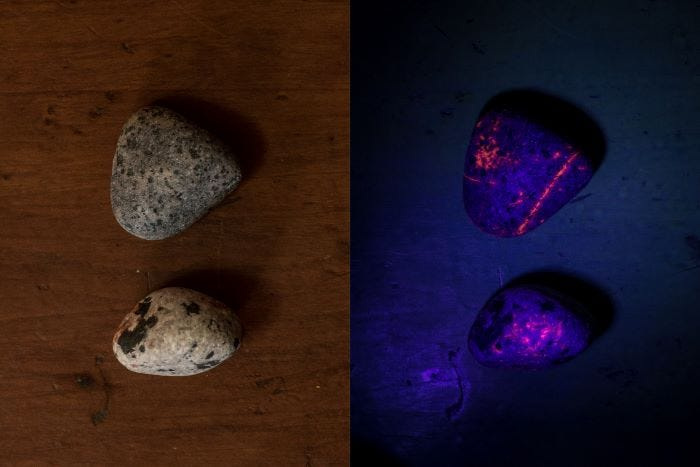
Most people do their rock hunting during the day, but you can’t find “Yooperlites” until the sun goes down.
Yooperlites are rocks that fluoresce in the dark under ultraviolet light. They became known when a UP resident discovered them in 2017, according to the Michigan Department of Environment, Great Lakes and Energy.

Spring is the best time to search for Yooperlites and other rocks, according to Pure Michigan, because winter ice moved beach sand and stones around, and now has broken up for the season, leaving newly unearthed stones along Lake Superior’s shoreline to be discovered.
Throughout the year, the best time to seek Yooperlites and other stones is after a storm, when waves have disrupt and uncover new rocks.
Here’s what to know about the rock that is found in the Upper Peninsula along Lake Superior:
What is a Yooperlite?
Yooperlites are a variety of sodalite-rich syenite found in the Upper Peninsula of Michigan.
Syenite is a coarse-grained, plutonic (intrusive) igneous rock that primarily consists of the minerals feldspar, typically orthoclase feldspar, and often includes smaller amounts of other minerals such as hornblende, mica, or amphibole. Unlike granite, which is another common intrusive igneous rock, syenite contains minimal to no quartz, Geology Science said.
Sodalite is a deep blue to blue-violet mineral best known for its use in jewelry, sculpture, and decorative stonework. Sodalite forms in igneous rocks that crystallized from sodium-rich, silica-poor magmas. That’s how it got its name—soda + lithos, or “sodium stone,” according to Rock Your World gem & art gallery.
In normal light, a Yooperlite looks like granite. Sodalite replaces quartz, so the larger the mineral size, the brighter the shine, EGLE said. There are roughly five classes of Yooperlites:
Where can I find Yooperlite rocks?
The rocks can be found in different areas throughout Michigan, but are most likely to be found in the Upper Peninsula along Lake Superior, often on beaches near Grand Marais and in the Keweenaw Peninsula.
Yooperlites can be found as loose pebbles and cobbles along many Lake Superior beaches and even in some inland gravel pits. The stones are derived from igneous rocks near Marathon, Ontario, known as the Coldwell Alkaline Complex and were transported into Michigan by glaciers during periods of continental glaciation.
How to search for them:
Is there a limit on how many rocks a person can collect?
According to the EGLE, one person can not exceed 25 pounds per year on state-owned and public trust lands.
Techniques for identifying rocks
These identification techniques, according to the EGLE, can help rock hunters determine the type of rocks they have:
Appearance
Unique properties
Unique properties
Where can I find agates in Michigan?
The stones can be found across multiple locations in Michigan including:
How are agates formed?
Agates are formed when gas bubbles in lava leave a hole in the “vesicle” in the rock, according to the Michigan Department of Environment, Great Lakes, and Energy.
Silica (silicon dioxide) solutions flow into the hole in the host rock and fill it up over time, making the bands, the news release says.
Jalen Williams is a trending reporter at the Detroit Free Press. Contact him at jawilliams1@freepress.com.
This article originally appeared on Detroit Free Press: Glowing rocks in the U.P.? What to know about ‘Yooperlites’
Reporting by Jalen Williams, Detroit Free Press / Detroit Free Press
USA TODAY Network via Reuters Connect