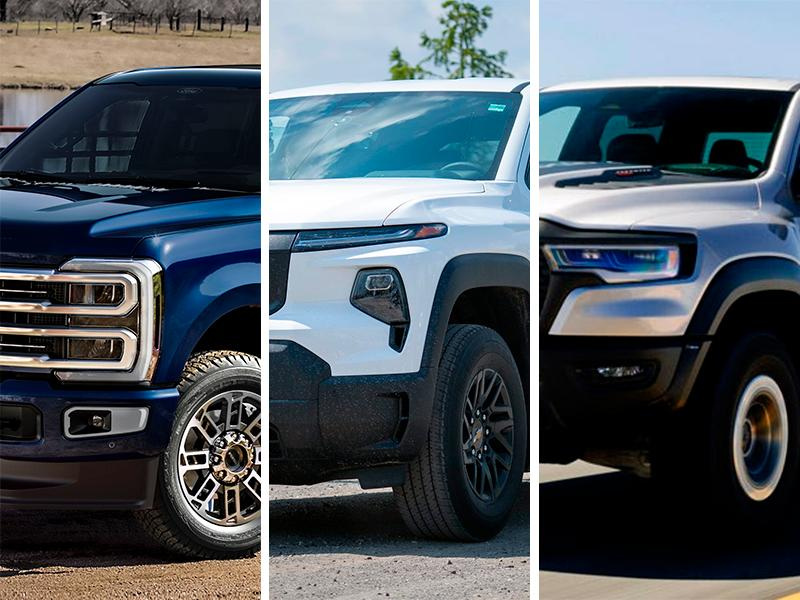
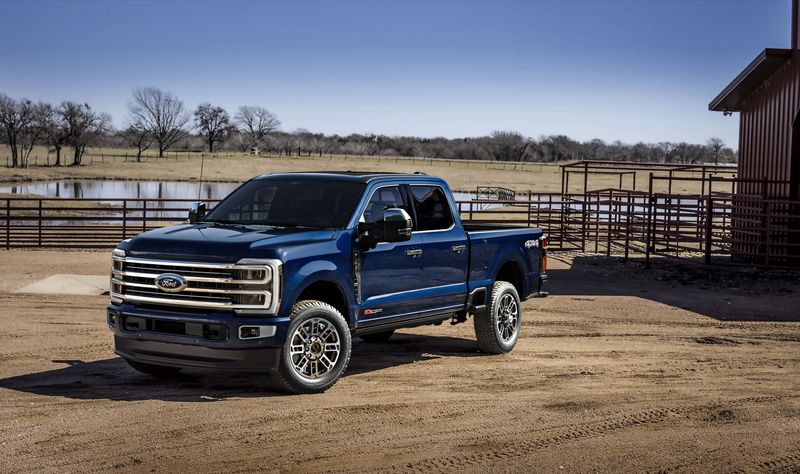
In April, Ford Motor Co. boasted that the F-Series pickup — despite having lower U.S. sales compared with the year ago period — was still the nation’s top-selling truck in the first quarter, nearing the 50th year in a row of holding that title.
But to defend the title, Ford has work to do in the upcoming months. It faces a lower than usual F-Series inventory after a fire at a key aluminum supplier last fall disrupted Ford’s production of many vehicles, including its profitable best-seller: the F-Series. Ford uses the light-weight aluminum in the bodies of its trucks to achieve fuel efficiency.

As Ford factories run at a feverish pace to catch up on that lost production, its crosstown rivals see a chance to make a grab for market share.
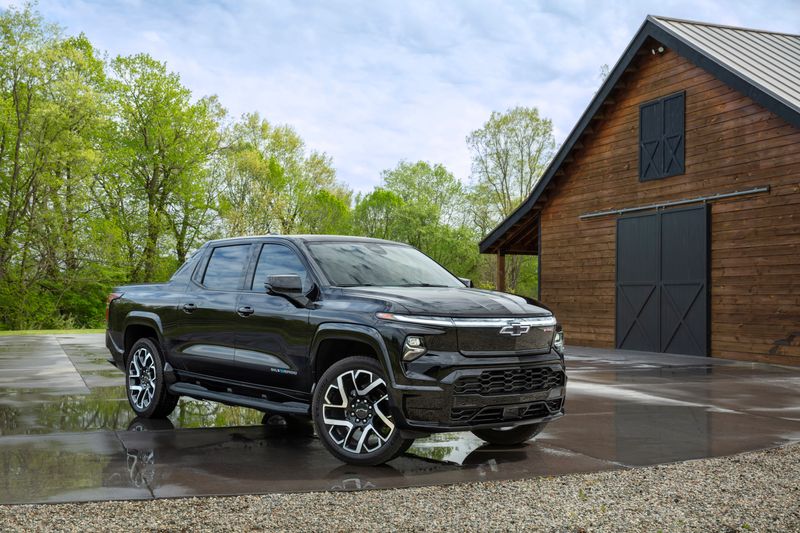
General Motors has announced it will increase its heavy-duty Chevrolet Silverado and GMC Sierra pickup production at Flint Assembly plant starting in June, citing increased demand as the reason.
Stellantis, which makes Ram, has developed a new line of so-called muscle trucks with Ford customers in mind. The muscle trucks are smaller, sportier versions of Ram’s 1500 light duty pickup. Ram’s brand boss told the Detroit Free Press on May 19 that he was “absolutely” thinking of going after Ford’s customers as Ram developed the line of new trucks. Ford offers the F-150 Lobo, a racy “street truck” version of its F-150 and the Maverick Lobo.
Industry experts say Ford’s inventory shortfall leaves a small window of opportunity for GM and Stellantis to win sales from Ford and it won’t be easy; in fact, expect a bloody battle.
“Truck plants typically operate near full capacity,” said Sam Fiorani, vice president of global forecasting at AutoForecast Solutions. “GM and Stellantis do not have much additional space to make more of their trucks, but will squeeze out every unit they can in the hope of taking buyers from Ford. Full-sized trucks are among the last remaining areas were brand loyalty exists, increasing the problems for Chevrolet or Ram to lure a customer away from Ford, but it won’t stop them from trying.”
Despite the challenge, Fiorani said it is possible that Ford could lose a few buyers to Chevrolet or Ram. But, he added, “This is such a financially important segment for Ford, that they will do just about anything to keep the supplies of the trucks coming and satisfy as many potential customers as possible.”
Ford’s fix runs into a glitch
In early April, Ford leaders said it had a 55-day supply of F-Series at the end of the first quarter. A 60-day supply is considered the industry standard for healthy inventory. Ford said the company is down by about 60,000 pickups from a year ago.
To fix that, Ford announced its plan to add 50,000 F-Series pickups to the inventory this year. The plan included speeding up the line at Kentucky Truck Plant in January, where it builds the Ford F-Series Super Duty, Ford Expedition and Lincoln Navigator, to increase the jobs per hour as well as hiring 100 new employees at the plant. Ford also launched a third shift and crew at the Dearborn Truck Plant to maximize F-150 assembly there.
Ford will start F-Series Super Duty production at Oakville Assembly Complex in Canada late this year, a move it announced in 2024. Finally, Ford said all Ford F-Series truck assembly plants — Kentucky Truck Plant, Dearborn Truck Plant, Kansas City Assembly Plant, Ohio Assembly Plant — will skip summer shutdown this year to increase F-150 and F-Series Super Duty production by “more than 50,000 trucks.”
Ford’s leadership said at the time it is working with its aluminum supplier Novelis to get it back online — which Novelis says will be next month. But Ford leaders said it could be later this year before F-150 inventory stabilizes.
Despite all of those efforts, Ford fell slightly behind in production recently when it could not get enough flawless aluminum from various suppliers, according to a person with knowledge of the situation. This person asked to not be identified because they are not authorized to speak publicly.
That issue with aluminum has been resolved, the person said, adding that Ford remains on track to catch up on production provided there are no more hiccups in the supply chain.
But on May 21, Ford had to pause F-150 production at its Dearborn Truck Plant for at least two days to repair a broken piece of equipment in its stamping plant. According to people familiar with the plant, Ford has been running two 10-hour shifts a day at the factory and builds about 1,000 pickups across those shifts. That means a shutdown for this length of time could result in a loss of about 2,500 or more pickups. That’s more lost truck production that Ford faces having to make up.
Ford’s inventory by the numbers
But F-Series inventory at dealerships, while it has been slightly improving each month this year, remains considerly lower than the year-ago period.
In May, Ford had 179,900 F-Series in dealer inventory nationwide, compared with 227,300 in May 2025, according to AutoForecast Solutions data. Its data from January through May show F-Series inventory (it does not break it out by heavy-duty or light-duty) to be consistently about 57,000 to 62,000 units shy of the year-ago period.
Meanwhile, inventory of Ram 1500 light duty pickups on Cars.com is up 40% year-over-year in April from a low point last year when Ram was shedding prior model inventory, said Aaron Bragman, Cars.com Detroit bureau chief. The Ram 2500 and 3500 heavy duty models gained inventory as well, up 10% year-over-year.
Bragman said: “GM appears to have a split strategy as they prepare for the next generation Sierra/Silverado for model year 2027. The company is favoring production of the Sierra 1500 over the Silverado 1500. It is more expensive and carries higher margin.”
Cars.com data showed inventory of the Silverado light-duty pickups is down 15% in April compared with the year-ago period. But Sierra inventory is up 23%. For the heavy duty variants, inventory was down 22% for the Silverado and 10% for the Sierra.
Bragman said his data shows the Ford F-150 inventory is down 31% in April compared with the year-ago period, but it still holds the highest inventory share in the category “though its lead has narrowed significantly.” Ford’s Super Duty inventory declined 12% year-over-year in April.
A dealer’s dread
At Village Ford in Dearborn, owner Jim Seavitt said if a consumer wants an F-Series truck, they should get it now because stock is far below what it should be and new ones are dribbling out of the factory.
Village Ford has 55 pickups in stock and given how many Seavitt said he typically sells each month, he should have 100 in stock.
“It’s low all over Detroit and I imagine it is low across the nation, too,” Seavitt said. “I sell 35 to 40 F-Series a month. But I can only get five or six wholesale (from the factory). The trucks from the plant are very slow in coming in because aluminum is not only used in the F-Series, but in a lot of other products. This puts us way behind the ball.”
Seavitt has many customers with leases expiring in the next month or two and he has inventory worries across his entire lineup, not just the popular F-Series. He worries about losing customers to competitors, given tight inventory.
“I think if you need a truck and you need it quickly, you’ll look for that truck somewhere else. So are we concerned? Yes. I think every Ford dealer in Detroit is concerned,” Seavitt said, noting that many Detroiters can get employee pricing plans from GM and Stellantis as well as from Ford, which is running an employee pricing for all sale through July 6.
But Seavitt said he knows Ford will fight.
“They do not want to lose truck leadership and I don’t think we will,” Seavitt said. “But I understand the opportunist point of view from GM and Stellantis.”
GM increasing production
While Ford did not provide its inventory levels to the Detroit Free Press, spokesman Said Deep said the inventory level it has now will meet demand.
“F-Series stock is sufficient and continues to build,” Deep said. “F-Series grew its year-to-date sales lead to nearly 50,000 over that second place truck maker in Detroit and Ford is well on its way to its 50th year as the best-selling truck in America.”
By second place truck maker, Deep means Chevrolet, and its Silverado.
In the first quarter, Ford sold 159,901 F-Series, a 16% decline from the year-ago period, but still topping its closest two rivals. Chevrolet sold 127,545 Silverados, down 0.1% and Ram sold 98,425, a 24.8% increase over the year-ago quarter. GM’s other pickup, the GMC Sierra, came in fourth place having sold 75,607 in the quarter, a 3.7% decline from the year ago period. The sales figures combine sales of heavy-duty and light duty pickups.
Consistent strong demand for Silverado and Sierra pickups is the driving force for GM’s decision to increase truck production, GM spokesman David Caldwell told the Detroit Free Press. He said tight inventory levels in the first quarter are the result of strong sales last year following the best combined sales of Silverado and Sierra vehicles in 20 years.
GM also is working hard to replenish inventory for SUVs, though Caldwell noted the company does not disclose inventory or production by vehicle line for competitive reasons.
At GM’s Fort Wayne Assembly plant in Indiana, UAW Local 2209 Bargaining Chairman Rich LeTourneau said he hasn’t noticed any change in truck production volume, but added that his plant has been busier as GM decreases light-duty Silverado pickup production at its Oshawa Assembly plant in Canada and its factory in Silao, Mexico.
“We’re guaranteed the same amount of trucks for the 2026 calendar year and 2027,” LeTourneau told the Detroit Free Press. “At Fort Wayne Assembly we normally get 295,000 to 300,000 every year.”
GM’s decision to ramp up truck production at Flint Assembly is more than a reaction to Ford’s supply problems — it’s smart lifecycle management, according to Paul Waatti, director of industry insights for AutoPacific.
In an ever-evolving market with uncertainties surrounding trade and gasoline prices potentially altering consumer appetites, Waatti said GM’s focus is on the vehicles where its assembly plants are dialed in, suppliers are established and mature, early quality wrinkles have been addressed, and development costs have largely been absorbed.
“With GM’s next-generation full-size trucks approaching, maximizing outgoing Silverado and Sierra production while demand remains healthy is simply good business practice,” he said. “The opportunity is to protect dealer inventory, capture some conquest demand from Ford’s disruption, and generate cash from a proven truck line before the next product cycle resets the equation.”
Ram’s new trucks target Ford
At Stellantis, Ram CEO Tim Kuniskis knows that it may be a herculean task to win over customers from other truck brands, but that doesn’t stop him from trying.
In the first quarter, Ram posted a 20% gain in sales, bucking an industry-wide downturn and netting its highest sales gain in three years. Kuniskis said a good warranty package and the return of the HEMI V-8 engine is behind the growth.
Kuniskis said he is always seeking to grow Ram’s market share, as he did in the first quarter, but he also said it’s difficult — and expensive — to get another brand’s truck buyer to buy his trucks instead. Even more difficult to get customers from Ford.
“Market share is a great measurement,” Kuniskis said. “But it’s loyalty. Because if you look at loyalty, it is so hard. Once you lose somebody, it’s so hard to get them back.”
As Ford struggles to meet demand on F-150s, Kuniskis said he knows those buyers want trucks, but to win them over, it may cost him.
“It’s really, really expensive (to poach buyers), so you try not to,” he said. “Because Ford in particular is over 80% loyalty. So, you can get somebody that wants a Ford to come and buy your vehicle. But you’re gonna have to give them a really compelling reason to give up that loyalty, because it may be generational loyalty.”
Ram is currently producing 1500 pickups — particularly those equipped with a 5.7-liter HEMI V-8 engine — at a slightly slower clip than what would be ideal, Kuniskis said. The truck brand’s manufacturing facilities are not equipped to produce the engines in the massive numbers consumers are demanding, after the HEMI was discontinued for the 1500 pickups after the 2024 model year and revived two model years later.
Smaller competitors coming
While Ram sales continue to climb in contrast to Ford’s F-150 first-quarter sales, Kuniskis said he is also working to develop brand new vehicles with another company’s customers in mind. At a news media preview of the brand’s latest line of so-called muscle trucks — which are smaller, sportier versions of their basic 1500 light duty pick ups — Kuniskis said he was “absolutely” thinking of Ford’s customers as Ram developed the line of new trucks.
While the muscle truck Rumble Bees may be more specialized and flashy, Ram confirmed at Stellantis’ investor day on May 21 that it is bringing two entirely new trucks to the U.S. market — and both will compete with Ford models.
At its North American headquarters, the automaker unveiled three more significant products that will hit the U.S. market in the coming years. Ram is getting ready to launch a compact pickup, the Rampage, a long-awaited midsize pickup, the Dakota, and hopes to be the first to market with a range-extended Ram 1500 — a vehicle Stellantis’ Chief Design Officer Ralph Gilles said he drives every day.
The two smaller trucks will fill a hole for Ram that was previously occupied solely by its competitors.
“We were a little late to the party, to be honest,” Gilles said while revealing the new Dakota.
The Rampage, pulled from the South American market, will slot in next to the Ford Maverick in the compact truck segment. And the Dakota, sporting strong flares around the wheels and a boxy front end, will compete directly with the Ford Ranger.
Ford is not worried
Ford’s Deep remained unfazed by the bullseye Ram has placed on Ford pickups, telling the Free Press, “At the end of the day, leaders lead. For nearly 50 years, millions of truck owners have spoken, keeping Ford the No. 1 best-selling truck in America. Our focus is simple: Keep listening to our owners, keep innovating, and continue building the best trucks out there — today and in the future.”
Jamie L. LaReau is the senior autos writer who covers Ford Motor Co. for the Detroit Free Press. Contact Jamie at jlareau@freepress.com. Follow her on Twitter @jlareauan. To sign up for our autos newsletter. Become a subscriber.
This article originally appeared on Detroit Free Press: Ford’s pickup production woes ignite a new truck war with GM and Ram
Reporting by Jamie L. LaReau, Liam Rappleye and Jackie Charniga, Detroit Free Press / Detroit Free Press
USA TODAY Network via Reuters Connect