Ford Motor Co. has been quietly upgrading safety and security measures inside its U.S. factories over the past three years, adding security officers, upgraded surveillance systems and cameras, testing the use of detection dogs trained to search for firearms and explosives and enforcing a zero tolerance policy for those who break the rules.
The last change has ruffled the feathers of some local UAW leaders, but more on that later.

The Dearborn-based company started the security enhancements as a proactive measure after hearing concerns from the workforce on various issues they wanted addressed, said Ford spokesman Dave Tovar.
The feedback, he said, came through a variety of channels, including plant leaders walking the floor each day interacting with workers, holding skip-level meetings in which a supervisor of a supervisor has recurring meetings with employees outside the chain of command to see how their relationship with their direct supervisor is going, an anonymous reporting system Ford has in place and direct complaints.
“Our priority is providing a workplace free from violence, harassment, substance abuse and other threats to employee safety,” Tovar told the Detroit Free Press. “Over the past few years, we have taken extensive measures to proactively improve employee safety and security.”
Tovar said the proactive steps Ford is taking is not a response to any recent violent incidents at Ford facilities.
But in 2017, at Ford’s Woodhaven Stamping Plant, a 24-year-old man, who was reported to be a disgruntled employee at the plant, pulled out a gun and killed himself, according to WXYZ-TV report. In 2023, police were forced to shoot a man who allegedly pointed a gun at officers at the Ford Wayne Integral Stamping and Assembly Plant in Wayne, according to a CBS News report.
Other automakers have experienced security problems, too. In 2022, at General Motors’ Orion Assembly Plant in Orion Township, one man killed another after a fight broke out, as the Detroit Free Press reported. Both men involved worked for a cleaning service hired by GM.
In 2023, there was a shooting at GM’s DMAX factory in Moraine, Ohio, that left one man dead and a second person wounded. In 2021, a Tesla employee at the company’s plant in Fremont, California, was accused of fatally shooting one of his co-workers outside of the company’s facility, according to CNN.
Factories get dogs, cameras and more
Those are just a few examples of workplace issues that can arise at factories that Ford wants to avert.
Most recently, Ford has taken to piloting a K-9 program that uses a specially trained dog to detect for firearms and explosives at its Michigan Assembly Plant in Wayne. All firearms are forbidden on any of Ford’s properties.
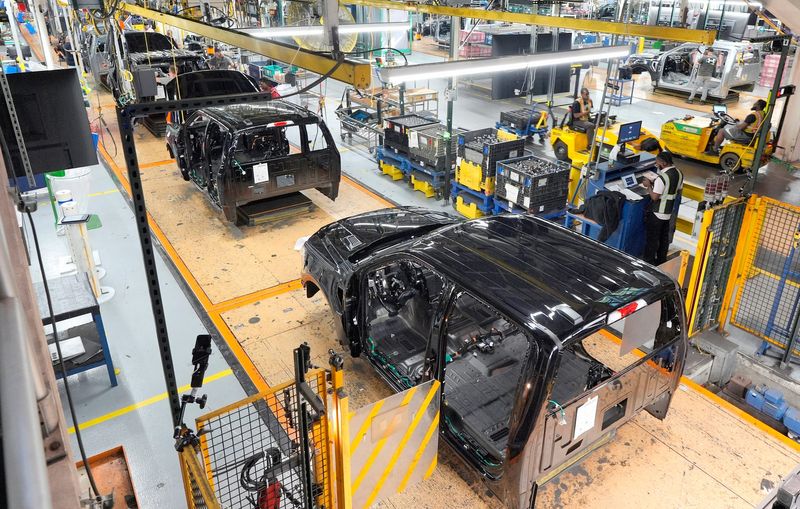
As the Detroit Free Press first reported, Ford was bringing in a K-9 unit to Michigan Assembly Plant starting on July 27 to run a 90-day pilot program there. Ford builds the Bronco SUV and Ford Ranger pickup at that factory where it employs about 6,300 hourly and salaried workers.
A memo obtained by the Detroit Free Press on July 25 by Plant Chairman Scott Elliott and addressed to UAW Local 900 members, who are the people who work at Michigan Assembly Plant, the program is part of a continued commitment to maintain a safe workplace. Ford was initiating the program, the memo said, “to collect data using a trained K-9 unit that is specifically trained to detect firearms, ammunition, and explosives. The K-9 involved in this pilot is not trained to detect narcotics or marijuana.”
Ford’s Tovar said that 90-day K-9 unit pilot test is “part of a broader effort to explore emerging security technologies and best practices across Ford facilities. Just as Ford rigorously tests new technology to keep our customers safe on the road, we’re committed to doing the same for the spaces where we work.”
Since then, Tovar told the Detroit Free Press that Ford has initiated a number of new security measures across all its U.S. facilities starting in 2023 that include:
Local UAW files charge against Ford
In some instances, there have been employees who have been terminated for breaking Ford’s policies. The Local UAW can file a grievance if it believes there were mitigating circumstances that should allow for a terminated person to get their job back.
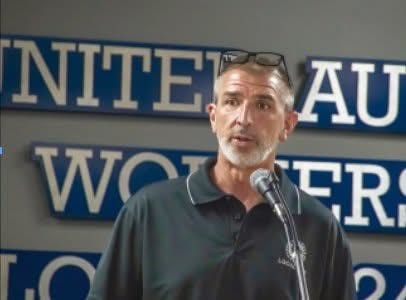
This is where Ford’s crackdown has ruffled at least one local union, UAW Local 249, which represents some 9,000 workers at Ford’s Kansas City Assembly Plant in Claycomo, Missouri, where the automaker builds the F-150 pickup and Ford Transit commercial van. In a post published July 24 on UAW Local 249’s social media page, Bargaining Chair Jim Fisher said that for the past few months the union and Ford have been at odds “over the unreasonable penalties imposed on our members.”
Fisher said in the post there are some flagrant violations that do not merit giving a UAW worker a second chance. But an example he gave of someone who should get another shot when they have been fired is when a member’s doctor doesn’t complete their medical paperwork on time, writing, “There is no reason not to return them to work once the paperwork is corrected.” He said Ford’s new policy does not even allow for that person’s case to be heard.
Ford’s Tovar said not allowing a person’s case to be heard is not true and the company follows the contract’s grievance procedures and the law.
Nevertheless, on July 28, UAW Local 249 filed a charge against Ford with the National Labor Relations Board, which has been reviewed by the Detroit Free Press. The charge against Ford reads: “Within the last two months the Employer has repeatedly violated ARTICLE VII of the Collective Bargaining Agreement in regards to the Grievance Procedure by not making a sincere and determined effort to settle meritorious grievances by Denying ALL grievances involving discharged employees contrary to past practices all in violation of Section 8(a)(4)(5) of the Act.”
In the UAW’s contract with Ford, in Volume 1, Article VII it states that the “parties shall make a sincere and determined effort to settle meritorious grievances in the voluntary steps of the Grievance Procedure and to keep the procedure free of unmeritorious grievances.”
He said, she said
The UAW Local 249’s lawyer, Carl Kimbrell, a partner at Kimbrell & Associates in North Kansas City, Missouri, told the Detroit Free Press that at least some of the grievances around fired workers involved employees who may have committed something minor, or were otherwise employees with a spotless record. In the past, those employees would be offered a “second chance” and would likely get their job back.
“Lately though there has been a complete refusal to even discuss any of these grievances, and they are ALL summarily denied,” Kimbrell said in an email.
One example of a meritorious grievance Kimbrell gave was if an employee is off work, “Ford mails them a ‘quit notice,’ which says that if the employee does not properly respond as requested within the short time frame set out in the notice, that the employee will be terminated.”
If the employee fails to respond because say she or he was in the hospital or at a family funeral out of town at the time the notice arrived, that person would be fired and the union would file a grievance explaining the reason the notice was missed, he said.
“Previously, Ford would in most cases, relent and allow this employee to return to work, possibly on probation,” Kimbrell wrote in an email. “But now, the way management is treating these grievances, they do not even allow the union to offer an explanation, they just Deny, Deny, Deny all of these grievances regardless of the reasons.”
Ford’s Tovar said that description of company actions is not accurate and Ford follows “labor law and our contracts with the UAW. We enforce our policies and investigate every report of misconduct fully and fairly.”
But some cases involve plant safety violations, and that is the one thing that Ford is working to upgrade and crack down on, he said.
“The majority of these (safety) concerns are raised by fellow UAW members,” Tovar said in a statement to the Detroit Free Press. “We owe those employees a serious response. We understand some would prefer the old horse trading and patronage approach to employee discipline. But the days when employees who seriously endangered or harassed their coworkers were reinstated, sometimes repeatedly, are over.”
Tovar said that if the union disagrees with a disciplinary decision, it has the right to file a grievance and if unsatisfied with that outcome, the union can take the case to a neutral arbitrator.
“That process exists precisely to ensure everyone has a fair hearing,” Tovar said.
Fisher declined to comment about the NLRB filing and his post when reached by the Detroit Free Press.
But Kimbrell said: “At some point in the future the NLRB will require us to submit a position paper. That will detail what has been done, and what we would like to see corrected.”
Jamie L. LaReau is the senior autos writer for USA TODAY Co. who covers Ford Motor Co. for the Detroit Free Press. Contact Jamie at jlareau@freepress.com. Follow her on Twitter @jlareauan. To sign up for our autos newsletter. Become a subscriber.
This article originally appeared on Detroit Free Press: Ford zero tolerance stance at plants draws questions from a UAW local
Reporting by Jamie L. LaReau, Detroit Free Press / Detroit Free Press
USA TODAY Network via Reuters Connect
By Jamie L. LaReau, Detroit Free Press | USA TODAY Network