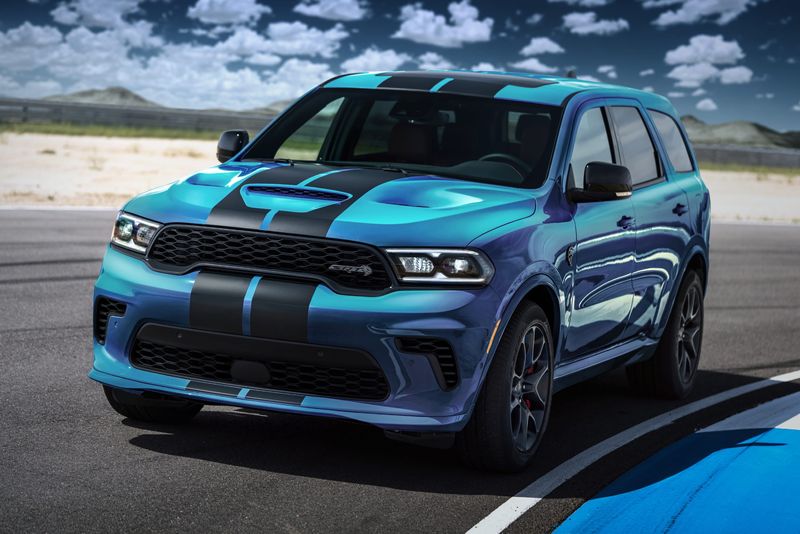
Dodge has prevailed against a consumer fraud lawsuit which alleged the automaker falsely represented the scarcity of Hellcat SRT Durangos after initially billing the high-powered SUVs as a limited edition vehicle before continuing production of them a year later.
In March 2023, several people who bought a Hellcat Durango filed the suit against Dodge, saying they bought the vehicles with the expectation they would be a one-year run of a niche car. In fact, Dodge marketed the Hellcat Durango in the 2021 model year as just that, saying in promotional material that the vehicle would be available only once.

But for the 2023 model year, Dodge rolled out another batch of them. Since then, the brand has offered a Hellcat powered SUV for each model year, including for 2026, for which Dodge debuted a “jailbreak” color-and feature-customization package.
The initial complaint in the lawsuit, which has since been dismissed in Dodge’s favor, said the buyers of the vehicles, who paid prices ranging from $89,000 to $114,225, would not have bought them if they had known Dodge would continue to produce the vehicles.
“(Dodge) sought to capitalize on marketing the Vehicle as a unique, once-in-a-lifetime and exclusive opportunity,” the complaint alleged. “If (the buyers) had known that (Dodge was) untruthful in making an affirmative misrepresentation about the limited edition run for one year of the Vehicle, (they) would not have purchased the Vehicle at all.”
In a 2022 interview with Motor Authority, then-Dodge CEO Tim Kuniskis acknowledged initial buyers who were upset over the revival of the Hellcat Durango after the first year, but said that at the end of the day, Dodge wasn’t going to leave money on the table.
“Let’s be honest, it’s a publicly traded company. I have an obligation to the shareholders to make as much money as I can,” Kuniskis told Motor Authority. “So how do I look at shareholders and go, ‘Yeah I have 3k people willing to spend 85k for an SUV,’ and I told them sorry, too bad? It’s a tough call, but at the same time it’s not a very tough call. … If I have an opportunity to bring a car back to market that people love, I have to do it. I don’t wanna piss anyone off, but if I have 3k orders cash in hand, I gotta do it.”
Judge: ‘I disagree’
The seven plaintiffs in the suit sought repayment for their purchase of the SUVs and an injunction that would stop Dodge from making any more Hellcat Durangos.
But in a January ruling, U.S. District Court Judge Jennifer Hall dismissed the suit, saying the claims Dodge made in its advertising campaign were not legally binding. Hall pointed to the warranty booklet issued with the vehicle upon purchase that stipulates the “only” warranty claims the brand makes are in the booklet, and nowhere else.
“(The plaintiffs) argue that FCA’s public statements that it would only make Hellcats in 2021 should still be deemed to be an ‘express warranty’ — that is, a contractual promise — that it would only make Hellcats in 2021,” Hall wrote in her ruling. “I disagree with Plaintiffs.”
Hall also said there was no indication Dodge sought to mislead consumers by pitching the product as limited edition. Dodge simply changed its plans.
The Hellcat Durango is currently the only vehicle produced by Dodge’s parent company Stellantis (formerly FCA) to house the supercharged V-8 engine, though the brand has dropped Hellcats into several vehicles over the last decade. Stellantis has supercharged the previous generation of Dodge Chargers and Challengers, the Jeep Grand Cherokee Trackhawk and a Ram 1500 dubbed the TRX. Ram announced it will revive the TRX for the 2027 model year and Dodge officials have hinted endlessly — though have yet to confirm — that they will put a Hellcat beneath the hood of the new generation of Dodge Charger.
Liam Rappleye covers Stellantis and the UAW for the Detroit Free Press. Contact him: LRappleye@freepress.com.
This article originally appeared on Detroit Free Press: Dodge wins lawsuit over limited edition Hellcat Durango controversy
Reporting by Liam Rappleye, Detroit Free Press / Detroit Free Press
USA TODAY Network via Reuters Connect