Rare is the person who doesn’t have a friend who left behind a mess.
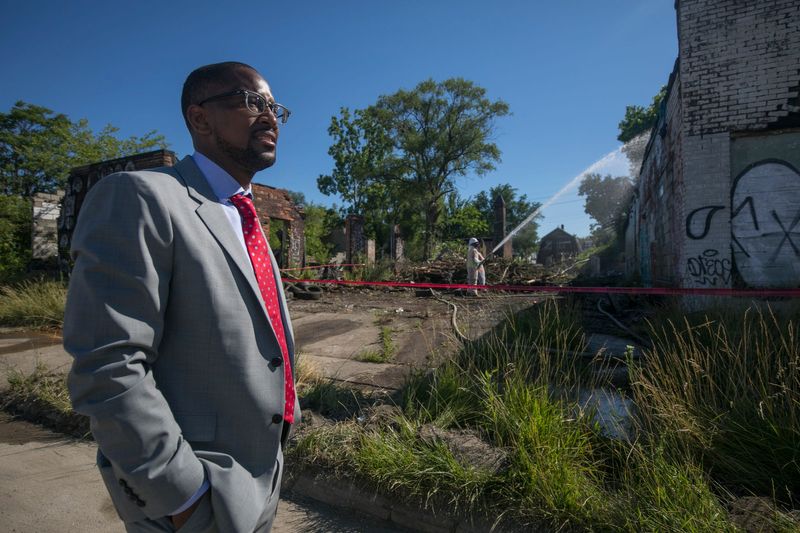
In the case of Mayor-elect Mary Sheffield, that person is Brian McKinney, CEO of Gayanga, the demolition company accused of using polluted dirt to fill holes in Detroit neighborhoods.

It’s bad enough Sheffield’s votes as City Council president to approve more than $4 million in city contracts for McKinney while they were dating became an issue late in the mayor’s race — a controversy that didn’t stop Sheffield from winning 77% of the vote.
It’s worse that it raises questions about her ethics as she basks in the afterglow of being the first woman elected mayor in Detroit’s 324-year history.
The biggest problem, however, may be that McKinney and Gayanga could contribute to the fiscal challenge that Sheffield and other mayoral candidates predicted awaits whomever replaces Mayor Mike Duggan when he moves on to campaigning full-time for governor next year.
Gayanga could also become a headache for Hizzoner’s independent gubernatorial bid, a potential predicament we’ll discuss after I tell you why the rags-to-riches tale Duggan extolled in his 2020 State of the City address may have an unhappy ending for Detroiters.
Sheffield voted Nov. 18 to uphold the Detroit Inspector General’s ban on doing business with McKinney until the IG determines how much contaminated dirt Gayanga may actually have used to fill the holes left after it knocked down abandoned homes under city contracts that paid the company tens of millions in tax dollars. Sheffield’s vote won’t be enough to stop the questions about the nature and extent of her relationship with McKinney, including whether she accepted gifts or trips from McKinney in violation of the city’s ban on freebies.
Another question of particular relevance to those of us who pay taxes in Detroit is whether contractors complaining to City Council and circuit court judges that McKinney and Gayanga stiffed them will be able to convince those officials that we taxpayers should be stuck with the bill.
Bonds that tie?
My colleague Dana Afana met a gaggle of contractors last week who told her that McKinney and Gayanga owe each of them hundreds of thousands of dollars for work they did as subcontractors on city deals with Gayanga.
Before Afana recorded their tales of owe, I spoke with a lawyer for the contractor Detroiters should be most concerned about.
MWV Environmental Services sued McKinney and Gayanga last month in Wayne County Circuit Court, claiming they are owed more than $634,000 for asbestos abatement they did, but for which they were never paid. That’s the kind of work that involves going into a rickety wreck of a structure and pulling out all the nastiness that could cause cancer. This must be done before an abandoned structure can be knocked down so the demolition doesn’t release a host of airborne demons that could pose a greater threat to a neighborhood than the shack that just got sacked.
It’s the kind of work few of us would do for anything less than a pile of cash — and none of us would do for free.
MWV, like Gayanga, is a Detroit-based, minority-owned company. Its owner, Katrenia Moncrief, is a woman — and a veteran.
Unlike the other contractors looking to get paid, MWV also sued the city of Detroit.
The reason Moncrief put you and me in the frame is because she alleges the city failed to ensure Gayanga got insured by taking out bonds which would essentially require the company that issued the bonds to pay subcontractors if McKinney and Gayanga failed to pony up.
“I don’t know why there weren’t bonds filed. But I know it’s incredibly rare, and I don’t know how something like that could happen,” Gary August, an attorney for MWV told me last week. “The owner isn’t supposed to let you start working on the project until they’ve made sure you’ve provided everything you’re required to provide under the contract.”
The owner, in this case, is the city of Detroit.
“That the city allowed this to happen is a shocking dereliction of duty that exposed the contractor to not getting paid,” August added.
The contractor, in this case, is MWV.
August, who told me he has been working on government contracts and bonds for the past quarter century, said public contracts require bonds because they’re different than private deals. If, say, I hire you to put a new roof on my crib but don’t pay you, you could put a lien on my house that would prevent me from refinancing or selling it until I pay up. Contractors can’t put a lien on, say, a city, because a city will never go up for sale (even though public officials may occasionally sell it out).
Detroit’s top lawyer, Corporation Counsel Conrad Mallett Jr., disagrees with August.
“While the city’s practice has been to require bonds on demolition contracts, it is under no legal obligation to do so,” Mallett, a former chief justice of the Michigan Supreme Court, told me through a city spokesman. “The fact that a bond was not secured in this case was an administrative oversight on the city’s part. However, that does not change the fact that Gayanga alone has the full obligation to pay its subcontractors.”
Gayanga, by the way, says it doesn’t owe MWV — or TKMS and Lou’s Transport, which also sued Gayanga and McKinney — anything.
“Gayanga and Brian McKinney categorically deny the allegations referenced,” spokesman Shaun Wilson told me. “We have consistently met every contractual obligation in good faith, and we reject any suggestion to the contrary.
“These disputes are not a reflection of our business practices, but stem from factors outside of our control, including the city’s failure to collect required bonds, an accelerated timeline imposed on Gayanga and its subcontractors that was not contractually agreed upon, and increased cost beyond the original bid.
“We remain focused on resolving any open disputes and will address these matters through the appropriate legal channels.”
If August and MWV are right, and if other contractors decide to sue the city along with McKinney and Gayanga, it is we, the taxpayers, who could be on the hook for millions of dollars that we’ll either have to pay through increased taxes … or a reduction in city services.
Bigger bills could come due
Gayanga’s legal woes could cause politicians to pay a price, too.
Regardless of whether Sheffield has to answer the aforementioned questions, as mayor she absolutely will have to find ways to balance a budget that will feel a strain if the federal dollars that flowed to Detroit under Democratic President Joe Biden slow to a trickle under Republican President Donald Trump.
This is more than a notion. Although Detroit elections are nonpartisan, Sheffield is a Democrat. Trump has sent federal troops and the National Guard to patrol some big cities run by Democratic mayors. Sheffield said she is against having soldiers in Detroit. The Trump administration has moved to cut federal funds for cities and states that oppose his initiatives.
Then there’s the end of a hiatus in paying pension obligations, which the city enjoyed under the plan which helped Detroit emerge from bankruptcy on Dec. 10, 2014.
Sheffield has proposed increasing revenue with an entertainment tax, but she also has called for expanding programs to help more Detroiters that will require more spending. And she says she’ll reduce property taxes.
If the economy slows down, as some experts expect, city income tax collections will drop.
Any costs generated by defending the city against Gayanga-related lawsuits, let alone any judgments that could require the city to pay Gayanga’s debts to subcontractors, would be yet another new expense for the new mayor at a time when she’s trying to increase spending while facing declining revenues.
Promises help politicians win elections.
Failing to fulfill them can wreck reelections.
Gayanga could come back to haunt Duggan, too.
The man featured on billboards across Michigan as America’s most effective mayor surely doesn’t want his Republican and Democratic rivals to run commercials undermining his record of accomplishment here by pointing to a controversial company he once hailed. Under those circumstances, asking voters whether they want Duggan to do for Michigan what he did for Detroit doesn’t sound so hot.
Duggan’s opponents could pull a clip from his 2020 State of the City address — in which he lauds Gayanga as an example of the kind of companies which flourished during his tenure — find a funny photo of him and then superimpose text from the Inspector General’s report banning Gayanga from city business.
National Democratic organizations have already pledged to spend millions of dollars to stop the former Democrat from winning the gubernatorial election as an independent.
Duggan scored political points by outing those Democratic organizations for using the Freedom of Information Act to try to access city records they hope will help them dig up dirt on him. But what if the dirt they’ve been looking for all along is in the neighborhoods Duggan might otherwise hold up as a prime example of how he’s cleaned up Michigan’s biggest city?
But enough of the politicians’ potential perils. Let’s get back to me and you.
If the Inspector General finds that Gayanga used polluted dirt to fill holes left at most or all of the roughly 2,400 demolitions it performed, and the dirt needs to be dug up and replaced; or worse, homes constructed on those sites need to be demolished so the dirty dirt can be removed, or even worse, residents and neighbors sue McKinney, Gayanga and the city for exposing them to a health hazard, we could be facing a crisis that rivals the Flint water fiasco.
When you look at it that way, that ugly old lamp or incontinent cat a former partner left behind doesn’t seem so bad after all.
M.L. Elrick is a Pulitzer Prize- and Emmy Award-winning investigative reporter, director of student investigative reporting program Eye On Michigan, and host of the ML’s Soul of Detroit podcast. Contact him at mlelrick@freepress.com or follow him on X at @elrick, Facebook at ML Elrick and Instagram at ml_elrick.
This article originally appeared on Detroit Free Press: Dirty dirt mess could bury Detroit taxpayers and politicians
Reporting by M.L. Elrick, Detroit Free Press / Detroit Free Press
USA TODAY Network via Reuters Connect