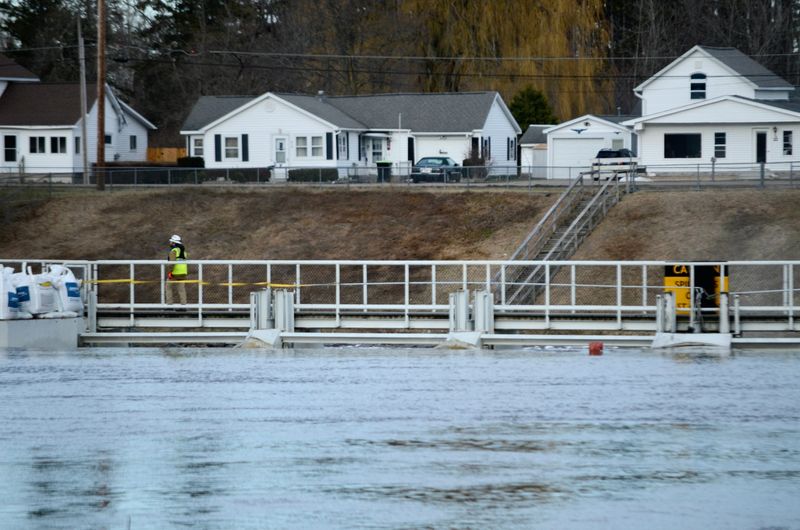
The century-old dam at risk of failing in the northern Michigan community of Cheboygan has been in federal energy regulators’ sights since July, long before intense rains and melting snow and ice threatened to overwhelm the facility.
Requested upgrades haven’t been made amid an ownership dispute about hydroelectric equipment that hasn’t operated for three years.

The Cheboygan Dam’s spillway and lock structure is owned by the Michigan Department of Natural Resources, which uses it to control water levels on the Cheboygan River and connected upstream waterways.
The DNR does not own the hydroelectric equipment on-site that was previously used to generate power from the river’s flow. The ownership of the equipment is in dispute in a local court, but federal energy regulators say Hom Paper XI LLC is responsible for it. The hydropower equipment hasn’t operated since the adjacent Great Lakes Tissue Company caught fire in 2023.
The Federal Energy Regulatory Commission has been pressuring the owner of the hydropower equipment — who the commission identifies as Thomas Homco of Hom Paper XI LLC — to restore and operate the equipment since July 2025 according to a letter from Shawn Halerz, who works in the Hydropower Administration and Compliance Division of FERC’s Land Resources branch.
Hom Paper has requested a series of extensions to make the necessary upgrades, which FERC has granted, Halerz’s letter stated.
Less water flows downstream when the hydroelectric equipment isn’t running, which is part of the problem that emergency responders are trying to solve as floodwaters rise across northern Michigan.
Consumers Energy, then called Consumer Power Company, sold the property containing the lock and dam to the Michigan State Waterway Commission in 1967, DNR spokesman Ed Golder said. At that time, the hydropower plant wasn’t operating.
Consumers spokeswoman Katie Carey said the utility bought the dam in 1950. Company officials don’t know who built it, she said.
DNR employees were working Tuesday to reinforce the earth around the Cheboygan Dam. The state is paying to upgrade the powerhouse, although it does not own the powerhouse, Golder said.
Cheboygan Dam flood risk heightened without hydro equipment
Having the hydropower equipment out of commission has intensified the threat that the Cheboygan Dam will fail and send a deluge of water downstream into downtown Cheboygan, a northern Michigan tourism destination on Lake Huron’s shore.
The hydropower equipment was responsible for about 30% of the capacity of water passed through the dam, the DNR has said, and “played a key role in water level management through ‘fine-tuned’ incremental adjustments to water levels.”
Consumers Energy workers have been at the dam since Friday, working to provide temporary service to power auxiliary equipment to help manage rising water levels, Carey said.
The Cheboygan Dam was inspected in September 2022, the year of its 100th birthday, according to the National Dam Inventory maintained by the Federal Energy Regulatory Commission. It is a high-hazard dam, meaning it could cause destruction and potential loss of life if it were to fail.
Emergency responders said Monday they do not believe a failure at the dam would cause a loss of life.
Consumers Energy officials on Tuesday announced the company is preparing for the possibility of flooding in Cheboygan and across northern Michigan.
“We understand the concerns that many of our communities are facing, and we are committed to helping them, whatever their needs,” said Greg Salisbury, Consumers Energy president of electric distribution. “We are mobilizing our resources to get the lights back on for anyone who’s affected by this storm and to providing our expertise to any communities in need this week.”
Cheboygan paper mill ownership in dispute
Part of the issue is that the paper mill changed hands over the course of its life, according to ongoing reporting by the Cheboygan Daily Tribune. Clarence Roznowski bought it from Procter & Gamble in 1993 and sold it to a group led by Kip Boie of Great Lakes Tissue Group in 2022.
At the time, Boie described ambitions to expand the mill and possibly add another hydrogenerator to power it, the paper reported. Boie sold the site in 2023 to Patriot Advanced Environmental Technologies LLC, also known as Tissue Paper Group.
Part of the issue is that the paper mill changed hands over the course of its life, according to ongoing reporting by the Cheboygan Daily Tribune. Clarence Roznowski bought it from Procter & Gamble in 1993 and sold it to a group led by Kip Boie of Great Lakes Tissue Group in 2022.
At the time, Boie described ambitions to expand the mill and possibly add another hydrogenerator to power it, the paper reported. Boie sold the site in 2023 to Patriot Advanced Environmental Technologies LLC, also known as Tissue Paper Group.
Great Lakes Tissue received a $3 million federal loan through the city of Cheboygan in 1992, Michigan Economic Development Corporation Public Relations Manager Danielle Emerson said. Payments stopped in 2020, when about $1 million remained to be repaid, Emerson said. MEDC and another party have liens on the site.
The mill remains a charred sore on Cheboygan’s riverfront.
Cheboygan Dam repairs needed, FERC says
The upgrades to the dam requested by federal regulators are delayed by a possible sale of the hydropower equipment under negotiation between Hom Paper and HydroMine, a company based in Wyoming, Hom Paper attorney Tyler Tennent told the Federal Energy Regulatory Commission in a letter Feb. 20. Tennent did not respond to a request for comment.
Hom Paper leases the Cheboygan dam’s hydropower equipment to HydroMine, Tennent’s letter stated. He said the companies have been working “for several months” to make the repairs FERC called for last year.
HydroMine and Hom Paper are negotiating a purchase agreement for the equipment, Tennent said, but the sale depends on Cheboygan city officials agreeing to separate the hydro equipment from the larger paper mill property.
HydroMine is working with the DNR for a water rights agreement to regulate the relationship between the dam and powerhouse, Tennent said.
The DNR uses the Cheboygan dam to help manage water levels on 40 miles of streams and lakes in the Cheboygan area. Collectively, those waterways are known as the Inland Waterway. They are Michigan’s longest chain of rivers and lakes, including Mullett, Burt, Crooked, Black and Pickeral lakes.
The DNR spent $6 million on lock improvements in 2024, Golder said.
The DNR entered into an agreement with Great Lakes Tissue Facility in 1983 when the paper company was redeveloping the dam and getting a license from FERC. As part of the licensing process, the DNR and the company agreed to use valves and gates in the powerhouse to allow for fine-tuning water releases from the Cheboygan River at levels that would be safe for water quality and migrating fish.
HydroMine is also working with Consumers Energy to reconnect the powerhouse, Hom Paper attorney Tennent said. In a December letter, FERC hydropower official Shawn Halerz said Hom Paper and Consumers have had disputes over electric service to the equipment.
“You state that, since Consumers Energy Company has refused to provide power to the site, and has not provided a date on which they can do so, it is difficult to provide a complete plan and schedule to return the project to full operating status at this time,” Halerz wrote to Hom Paper on Dec. 15. “However, you state that you will continue to work with Consumers Energy Company to attempt to restore power to the site and re-establish the interconnection to the system necessary to return the plant to operating status.”
Consumers is working with the dam operator to reconnect the hydropower equipment to the grid, but is waiting on needed inspections and repairs, Carey said in an email.
“The operator has not provided necessary information and operational requirements needed for connection to occur,” she said.
If the equipment isn’t restored and operating, the company will surrender its exemption from licensing requirements, which was issued to the dam’s previous owner, Procter & Gamble Paper Products Company, in 1983, Robert Fletcher, who works for FERC’s hydropower administration and compliance division, said in a letter dated Feb. 6, 2024.
The owner of the exemption is unclear, Fletcher said in the letter.
ckthompson@detroitnews.com
Cheboygan Daily Tribune Staff Writer Paul Welitzken contributed.
This article originally appeared on The Detroit News: Cheboygan dam hydro plant wasn’t operating when floodwaters hit
Reporting by Carol Thompson, The Detroit News / The Detroit News
USA TODAY Network via Reuters Connect