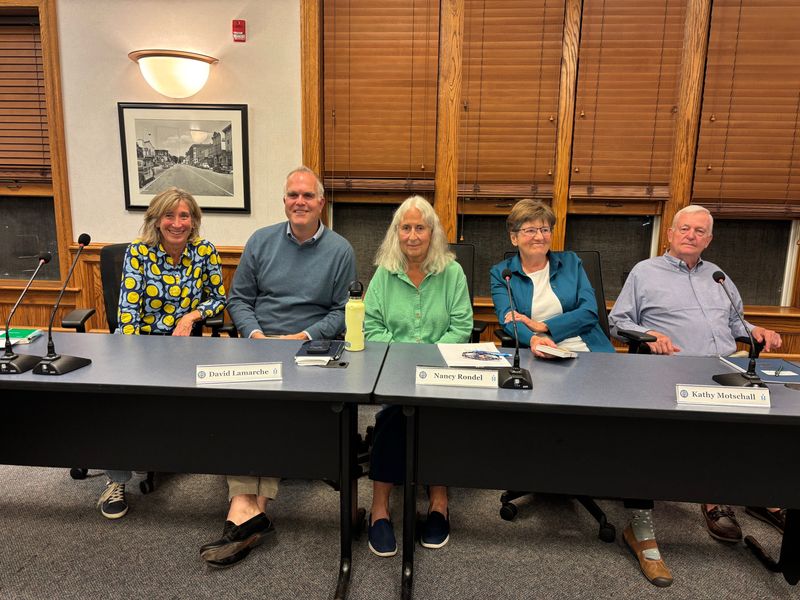
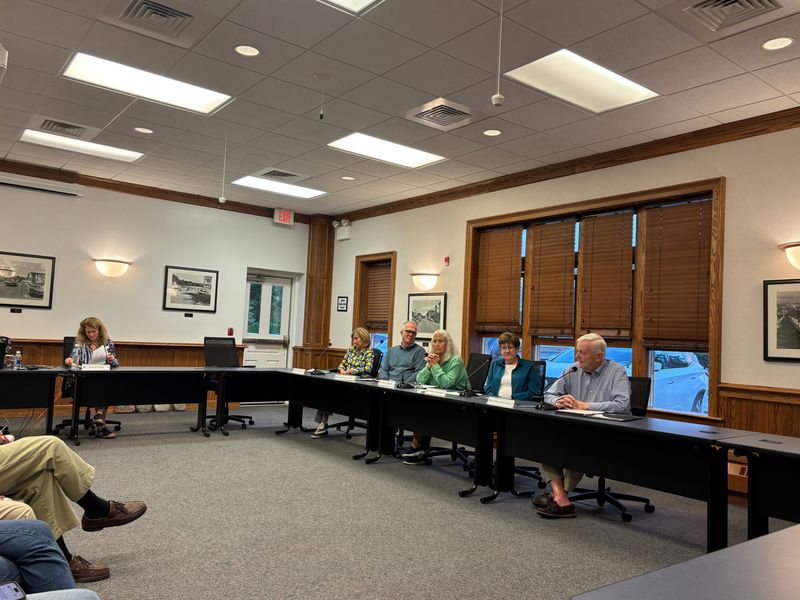
HARBOR SPRINGS — The five candidates running for seats on the Harbor Springs City Council met at city hall on Wednesday, Sept. 24 for a public forum.
The Nov. 4 ballot has five names vying for two seats, including Jeanne Benjamin, William (Bill) Donohue, David Lamarche, Kathy Motschall and Nancy Rondel.

On Wednesday, the candidates took part in a forum hosted by the Harbor Springs Area Chamber of Commerce. The chamber’s executive director Bonnie Kulp served as moderator.
Each candidate was given two minutes to answer each question. The candidates were asked about civility within government, housing issues, the city’s zoning code, budgets, parks and more.
The News-Review has selected three questions to highlight, but the full forum can be viewed on the City of Harbor Springs YouTube page. Some responses have been edited for clarity and length, and answers are presented in alphabetical order by last name.
Who’s running for council?
Jeanne Benjamin is a lifelong resident of Harbor Springs who previously served on the city council, Downtown Development Authority and Zoning Board of Appeals. She said she is running for council because she loves Harbor Springs, but the opposing sides within the city “doesn’t sit well.”
William (Bill) Donohue grew up in Evanston, Illinois and moved to Harbor Springs in 1982. He said he has real-world business experience to bring to the table. He is running because his children and grandchildren love Harbor Springs, and he wants to be involved in making sure their children and grandchildren love it, too.
David Lamarche, originally from the metro Detroit area, said he was from a resorter family that visited Harbor Springs during the winter season. He moved to the area full time in 2014, and said he is running because he wants to help bridge the gap in divisiveness in the city.
Kathy Motschall, who currently serves on the city council, has lived in Northern Michigan for 38 years, and Harbor Springs since 2011. She said she is a retired CPA, and spends many hours, sometimes days, studying upcoming agenda items to ensure she is prepared for meetings, talking with city staff and community members to ensure she has all the information she needs.
Nancy Rondel has lived in Harbor Springs since 1979 and she’s voted in the city since 1980. She served for four years as a member of city council, also serving on the tree board and planning commission at that time. She said she thinks it’s important for people serving within the city government to listen to and represent constituents, rather than operating under personal agendas.
Q: This past year or two, a few have brought division and personal attacks into local discourse. How would you help restore civility and constructive dialogue?
Benjamin: I have to say that where I work at J.McLaughlin downtown gives me the opportunity to talk to a lot of different people and get a lot of different feedback, and so I think a lot of this happens outside of a city council meeting. I think a lot of it happens just because you are out talking to people and listening to different ideas and coming to compromising. And I think some of the best decisions come out of that. So I think the fact that there are what appears to be polarizing sides, a lot of what people are saying are the same things. It’s just getting the right people together to talk through the ideas and from those ideas I think better decisions will be made. So, I think it doesn’t have to happen in a city building and it doesn’t have to happen even as a way of something on the agenda. It is ideas and it’s putting everybody together. We’re all here together. Whether you live downtown or West Traverse or you’re here for the summer, whatever it is, we’re all here for the same reason and we all love it here.
Donahue: Well, first of all, one person can’t change it. On top of that, when you have competing interests that are passionate about it, they tend to talk past each other rather than find a place in the middle. What I would do is I would listen carefully to all sides, make what I considered an intelligent decision, vote my conscience and let the chips fall where they may.
Lamarche: I think divisiveness is a big issue for me and I think if you let it fester, it can undermine the character that we seek to maintain. I think how we talk to each other is often just as important as what we say to each other. I also think that there is the tendency if you rely on social media for your information or your commentary that things can get very corrosive, so I try to avoid that. I think the solution is to talk to each other, to have more personal contact. And I do think that there’s room for amending or changing the structure of city council meetings, even if it’s maybe on a quarterly basis, doing something that involves more dialogue between council and citizens.
Motschall: Obviously that’s the tough question. I think we all recognize that. What I could say is as an accountant I try to approach all issues rationally and calmly. I have also learned to be more responsive to others’ perspectives during the last two years on council and I will continue to do that. I think it’s possible that more emphasis on the potential change in citizen comment rules may be helpful and a clearer understanding of what everyone’s roles are at a council meeting. I intend to be available in the public as I have been in the past, meeting and greeting people. I try to be as visible in town as I can and I’m willing to answer questions anytime I can.
Rondel: That bothers me a lot. It’s probably one of my biggest concerns in the city day-to-day right now. I watched it deteriorate over the four years I was on council. So I think it’s extremely important that we figure out how to change that course. I think you have to be good listeners. You have to come to meetings prepared. We are mandated to listen to everybody by the Open Meetings Act and I’m more than fine with that. I expect the same type of respect for the council or the board as I give to the public, where people don’t interrupt. They don’t jump up and talk. They follow the rules of public comment. I think that’s all very, very important. I would encourage everyone to use the resources that are in this town for transparency — and there are many of them — and to please remember to speak to the facts rather than just how they feel about things because I think that the business of the city depends on a lot of the facts.
Q: How will you balance the needs of year-round residents, seasonal visitors and working families?
Benjamin: I think everybody deserves a voice. I think we have been a community of second home owners, or summer residents, and the locals. … So, we’ve always found a way to stick together and help each other out. So, I think in the environment, we’re back to that whole thing that we are now. I think just as you said, everybody’s voice counts and we’re all here together and everybody has something to give and should be here to help everyone out. It shouldn’t be us against them. It shouldn’t be somebody being more important. It shouldn’t be that anybody’s more important. We all deserve the same voice.
Donahue: With a town this size, and what we have 1,257 voting members I think in this town, the answer lies in appreciating what both sides have. Let’s remember that the summer people generally pay a significant premium in their taxes, appreciated. The people that live here year-round and make the city work are just as important and appreciated. There’s no magic phrase that will change it. It’s just a true appreciation of what each group brings to the city and it’s all valuable.
Lamarche: I did a little research. The national rate of second home ownership is under 5% and we’re at 62%. (Note: According to the 2024 City of Harbor Springs Economic Development Strategy draft, 68% of homes in Harbor Springs are marked as non-homestead.) I think we really need to think outside the box on this one. We need to, I think, as the stewards of Harbor Springs, the people that live here and vote here, we owe an obligation to those second homeowners to give them due consideration to understand how much they contribute to this community. I also think anybody with a Harbor Springs mailing address ought to have some skin in the game and their voices ought to be heard. So I do think that it’s a matter of making sure that everybody sees the value that everybody contributes. I think if we didn’t have the second homeowners, it wouldn’t be the same place. If we didn’t have the year-round citizens, it wouldn’t be the same place. And we are a municipality, so we need to give them all due consideration.
Motschall: It is tricky and we’ve thought about this during a lot of issues that we’ve been discussing over the last couple of years. I will sit with two stakeholders — property owners and voters in the city. That’s my main concern. I live in the city year-round myself, obviously, and I think it’s very important to have neighbors and to have friends around and so all year. It can be a very quiet place in the wintertime here and I would love it if there were more people. In that sense, I would like to encourage people to live here and be here full time.
Rondel: I certainly am a proponent of hearing everyone’s voice, all stakeholders. So, that isn’t just people that live here or own property here. It’s also our employees and other people that give to the city and depend on the city. But I do believe that the voters are the ones that put the council at the table. So I think in our government structure, our voters are the ones that do that for council people. That does not mean that property owners and other stakeholders aren’t important to me — they’re very important. They help to drive our economy, they make our city what it is, and I certainly believe that. But when we’re talking about decisions for the city government, I think we need to keep in mind that the voters are the ones that vote the council in. And that is really who their responsibility is toward to look out for. That’s just part of the way our government is set up. So all of them are important to me. Obviously, I have friends in all those circles, people I care about a lot. But in this city government, I think the voters are very, very important.
Q: If you could change one thing in the zoning code, what would it be and why?
Benjamin: I am in favor of being able to live in an accessory building, in a garage apartment. That was outlawed for so long. When I was on city council, I was living in a garage apartment, illegally. So then I was on planning commission and that was my question always, was I don’t understand why you can’t do that. I do think that that would police itself. I do think this worry of even workman housing or co-living or however you want to word that, I think there is something to all of that. There should be an opportunity for people to be able to live in Harbor Springs affordably and that could be the only way it’s possible. If there’s a way to do it that makes everybody happy, but I think it would police itself.
Donahue: The city spoke clearly last year and that was we don’t want to change the zoning and what’s going on now is that the planning commission is clearly trying to accomplish that even though we said no. The one thing I would change is I would stop the planning commission dead in their tracks.
Lamarche: I’d like to see a little more continuity and common sense. It seems like it’s kind of a patchwork quilt of different zoning. Something that makes it a little more straightforward when people are looking to build or remodel.
Motschall: Well, I think there’s a lot about the zoning code that’s currently in effect that needs to be changed. It is a very old document, somewhere between 20 and 50 years. It needs serious updating in terms of accessibility and readability and being able to understand it. I would personally like to see ADUs, accessory dwelling units, I would like to see that expanded and be more available. I, as a person that lives alone, I might want to build a garage apartment so I can have a caregiver live there so I can stay in the city in the house that I love.
Rondel: I can’t target just one thing. I do have a concern with the amount of say that neighbors get to say about what else their neighbors can do even when it’s within the parameters of the zoning code. That’s hard for me to understand why that’s OK when someone owns their piece of property, they have the right to do something, but the neighbors get to weigh in about it. That’s a concern, and we’re hearing that in all that’s going on now. I would like to see smaller lots, more of that because that will drive more affordable housing, and I think that’s one of our big issues here. That is one way government can help in the private sector to get some more.
— Contact reporter Karly Graham at kgraham@petoskeynews.com. Follow her on X, formerly known as Twitter, at @KarlyGrahamJrn.
This article originally appeared on The Petoskey News-Review: Candidates running for Harbor Springs City Council take part in Q&A forum
Reporting by Karly Graham, The Petoskey News-Review / The Petoskey News-Review
USA TODAY Network via Reuters Connect