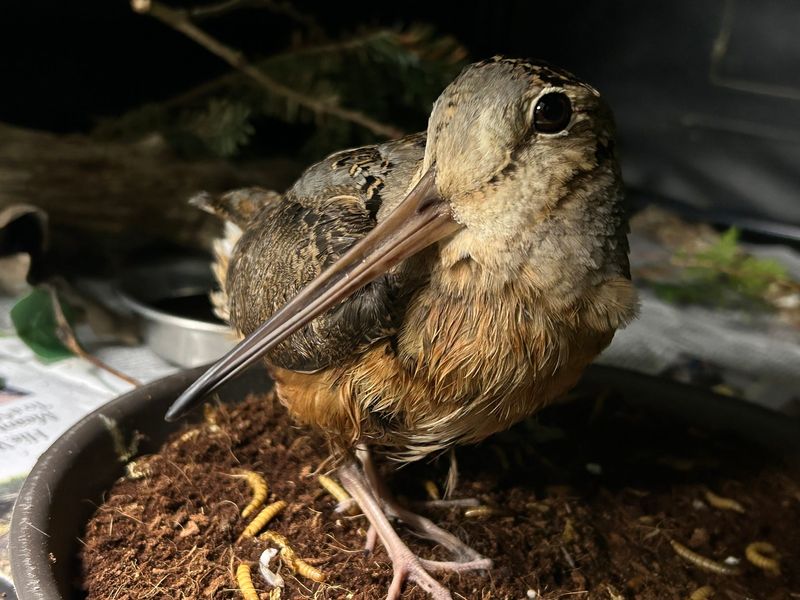
A bird known for its funny walk and dazzling sky show during mating, the woodcock, is also known for something else: its propensity to be injured or killed by striking windows during its annual spring and fall migrations.

In multiple large cities, such as Philadelphia and Baltimore, the woodcock is one of the top five bird species found killed or injured in window collisions, according to the U.S. Fish and Wildlife Service.
“Collisions are all too common for American woodcocks, especially during migration periods, when they pass through large urban areas,” said Stephanie Egger, a biologist with the U.S. Geological Survey’s Bird Banding Lab.
The Bird Center of Michigan, a Saline-based nonprofit wildlife rehabilitation center dedicated to helping injured and orphaned birds and educating the public, is seeking volunteer citizen scientists in downtown Detroit to keep their eye out for injured woodcocks and document and report their locations.
Campus Martius, a chronic hotspot for woodcock collisions
Marissa Jardine, clinic manager and licensed wildlife rehabilitator for the Bird Center, said the focus on the woodcock arose from the “astonishing number” of injured woodcocks they were receiving from Detroit, 73% of them in recent years from the Campus Martius area downtown.
Woodcocks, perhaps because of their long beaks, tend to suffer more significant trauma to their heads, and particularly their eyes, in window collisions, Jardine said. “They are severe injuries that we don’t commonly see in other species,” she said.
The ability of woodcocks to survive a window collision is mixed and commonly comes down to the severity of their eye trauma, she said.
“At least half come in with such severe eye trauma that the globe is ruptured, so they are blinded. And that’s not the quality of life, so they don’t make it. But there are others that we are able to get their head injuries recovered. They are able to make their way back into the wild. After pain medication, anti-inflammatories, cage rest, and lots of earthworms, they are able to get back on their way.”
A funky walker, a dramatic flyer
The American woodcock measures 10-12 inches in length, weighs 4-10 ounces, and has a wingspan of 16-19 inches, with females generally larger than males. It’s a small, plump shorebird with a distinctive long, straight bill, short legs, and a rounded head with large eyes well back on its skull.
The woodcock bobs back and forth in a rocking motion as it moves, giving the appearance that it is dancing in a conga line to some silent inner rhythm.
But it’s during its mating ritual, when males do their sky dance, that the birds, also known as timberdoodles, shine. According to the Cornell Lab of Ornithology, the male woodcock’s evening display flights are one of the magical natural sights of springtime in the East. He gives buzzy “peent” calls from a display area on the ground, then flies upward in a wide spiral. As he gets higher, his wings start to twitter. At a height of 200–350 feet, the twittering becomes intermittent, and the bird starts to descend. He zigzags down, chirping as he goes, then lands silently (near a female, if she is present). Once on the ground, he resumes peenting, and the display starts over again.
Woodcocks live primarily in the eastern half of the contiguous United States, year-round in the Southeast and migrate to warmer climates in the winter from the Northeast, including the Great Lakes region, before returning in the spring. The woodcocks are nocturnal migrators, meaning they fly at night. That may contribute to their propensity for window collisions, Jardine said.
“The bulk of collision cases that come in during the Spring are birds migrating nocturnally,” she said. “They are seeing the light from downtown, and it causes them to become disoriented, and they end up flying into the glass buildings.”
What to do after finding an injured bird
Jardine suggested anyone encountering an injured woodcock put a towel or sheet over the bird and place it in a box without food or water, and then contact a licensed wildlife rehabilitator — which for downtown Detroit likely means the Bird Center in Saline. The Michigan Department of Natural Resources has a list of licensed wildlife rehabilitators that can be accessed at michigan.gov/dnr and searching “wildlife rehabilitators directory.”
“We do rely on rescuers to bring birds to us,” Jardine said. “We don’t have the resources to go out and do rescue. At any given time during our busy months, we have about 400 birds in care and only so many staff and interns here to help.”
Those who have found an injured or orphaned bird are asked to text a photo of the bird, the county location, and a brief description of the situation to 734-761-9640. Bird Center officials require speaking to a staff member first before bringing a bird to the Saline facility.
Citizen scientists could provide data that spurs change
The Bird Center is also seeking volunteer citizen scientists to walk the streets around Campus Martius during the remaining spring weather that the woodcocks are migrating back north, documenting injured or dead birds and their location and reporting it to the bird center.
“What we are hoping to do with this data is talk to the building owners of these buildings to come up with solutions or ideas to help reduce these collisions,” Jardine said. “For example, participating in a lights-out initiative where they are turning their lights off during Peak migration time to help reduce the number of collisions.”
Those local to Detroit interested in participating are asked to email the Bird Center at clinic@birdcentermi.org.
Contact Keith Matheny: kmatheny@freepress.com.
This article originally appeared on Detroit Free Press: Beloved woodcocks susceptible to window strikes. How to help
Reporting by Keith Matheny, Detroit Free Press / Detroit Free Press
USA TODAY Network via Reuters Connect