CHEBOYGAN – Another long branch came floating down the river, heading right toward them. They stood ready to stop it. They had to.
“This is the kind of stuff right here that we’re pulling out,” said Paul Dunn of the Department of Natural Resources, pointing to a stack of wooden debris. “Everything from logs, to docks, to garbage.”

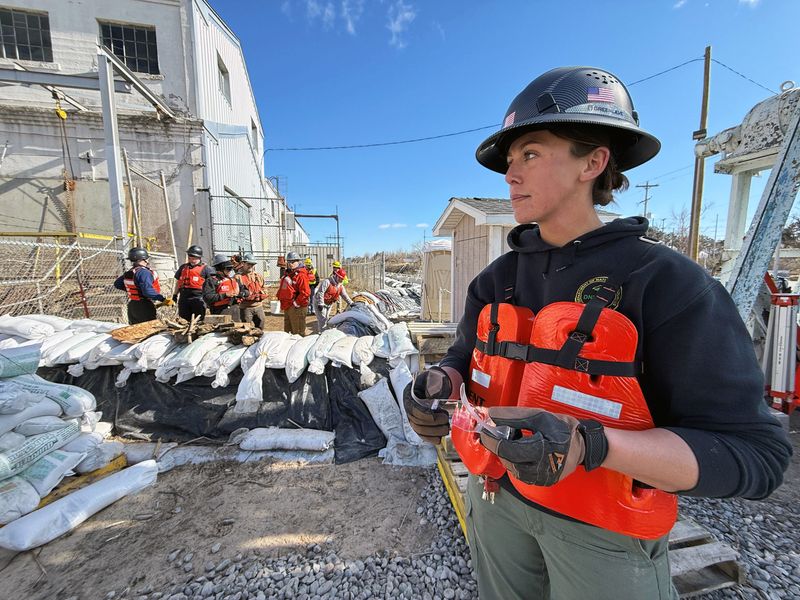
He was standing with about a dozen other workers at the base of the hydroelectric powerhouse alongside the Cheboygan Dam on April 20 — ground zero of what looked to be a impending catastrophic flood just a week ago. Their boots were muddy and their hands were dirty after shifts of 12 and 16 hours.
Most of them had been brought in from elsewhere in the state. Their job was to help keep the water flowing through the powerhouse.
Last week, as a hard winter’s snowmelt and a drenching spring rain began flooding watersheds in the northeast part of the Lower Peninsula, the Cheboygan River rose dangerously fast, prompting the state to warn residents they might need to evacuate if it worsened. At the time, the water had risen to within a foot of the top of the dam. Within a couple of days, it was barely 5 inches from the top and still rising.
If the dam failed, parts of Cheboygan might’ve never been the same.
Pumps were quickly brought in to divert some of the fast-rising water. Gates were opened on the dam to let more water flow though. And most importantly, after days of frantic efforts, the turbine inside the privately owned hydroelectric powerhouse next to the dam was restarted on Friday, April 17, after three years of lying dormant, helping push millions more gallons of water down the river, away from Cheboygan and into Lake Huron.
It just might’ve saved the city.
“That was critical,” said Mike Janisse of the DNR Incident Management Team during a town hall meeting held Sunday, April 19, at the Cheboygan Opera House. “If we didn’t get that powerhouse on board when we did, we would be in the water.”
Since then, the water level has been on a slow, but reassuring downward trajectory. As of Monday, April 20, it was down to almost 8 inches below the top and holding steady, thanks to a massive effort to keep it that way.
“It didn’t happen in one action,” said Patrick Ertel, 48, a DNR public information officer on the scene. “It was one pump added here, one pump added there. So it’s almost like survival by a thousand Band-Aids, as opposed to death by a thousand cuts. And so that’s been what’s the most impressive to me, is the concept of all of these people are doing small pieces that assembled into a giant, successful puzzle.”
One of those critical jobs came down to a single person.
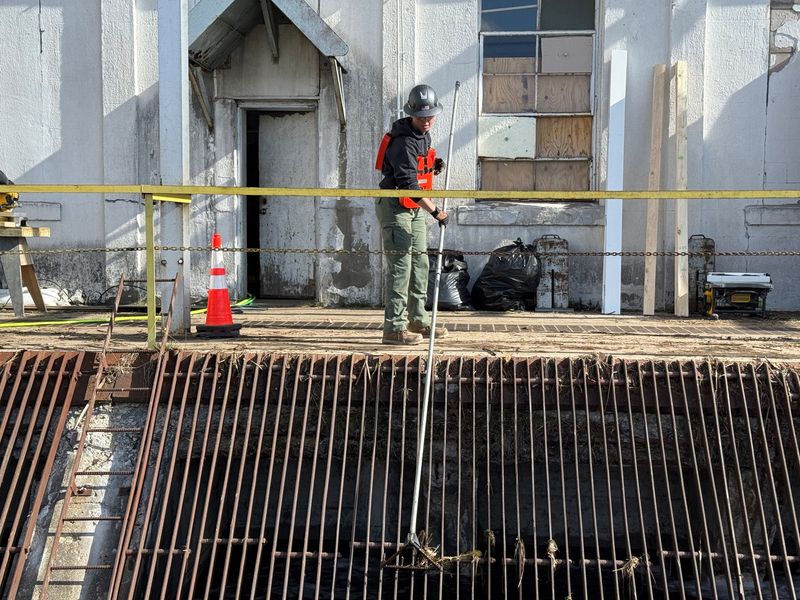
Ever since the turbine was restarted, workers have had to stand above the large grates through which the river enters the hydroelectric plant, lowering a long metal rake to drag out whatever debris floats their way. Because even with all the frantic pumping, even with the turbine’s help, the water level still remains dangerously high.
Every stick, every log, every piece of someone’s swept-away boat dock that comes floating down the river, hits those grates and blocks the flow of water through the plant, potentially causing the water to rise again.
And that means someone with a rake in their hands must stand there 24 hours a day to help save the city.
“It’s a steady raking process because what happens is one blade of weeds, second blade of weeds, third blade of weeds, all of a sudden, it all starts to limit the conveyance,” Ertel said. “So, the more obstruction you have in the grates, the more you start to build up. You have to keep these clean.”
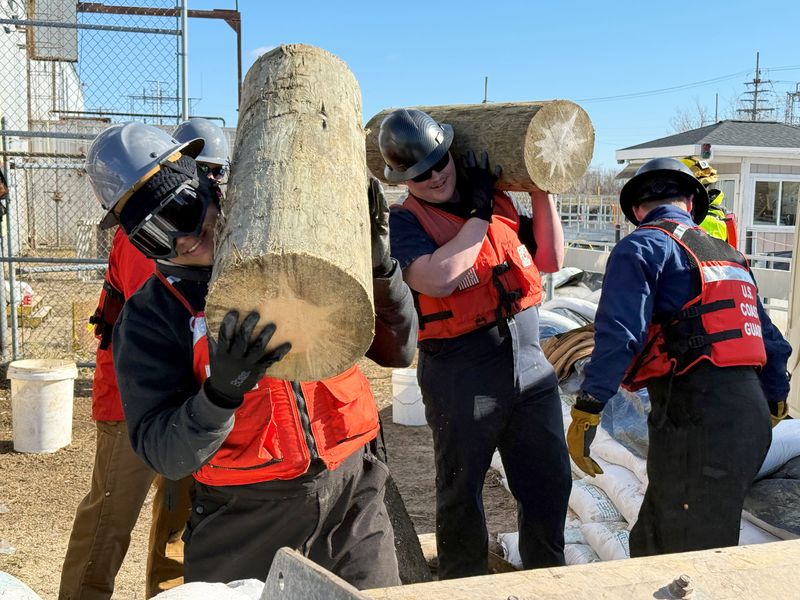
A few feet away, several U.S. Coast Guardsmen were hauling heavy rounded logs over their heads, away from the dam. They were pieces of a telephone pole, of all things, that came down the river. Not long after, a an even-thicker wooden dock piling came floating their way, too.
Now that the powerhouse is back online, there’s guarded hope in town that the worst just might have been averted. Two of the three dams upstream are now functioning normally. The sun was shining and doing its part to evaporate some water. And more rain wasn’t expected for a while.
“We are cautiously optimistic,” Ertel said. “We’ve handled this situation, and the water’s beginning to recede. We’ve got to keep our fingers crossed for the weather, that we don’t continue to get big rain events, because the water is not going away anytime soon. It going to be weeks or months until we can really start to make progress on getting water back to normal levels.”
It’ll be weeks or months until the workers can go home, too. And among them will be someone standing by the powerhouse, holding a rake.
One of them was Logan Pawlowski, 27, a Parks and Recreation ranger with the DNR who’s from Cheboygan. “This is my own town and I’ve never seen anything like this happen before,” she said. “I’ve got a lot of friends up there in Black Lake and their houses are flooded, and it’s sad to see. My friends and neighbors are all so spooked about the whole thing. I’ve got people texting me all the time. They’re like, ‘Oh my gosh, Logan, thanks for doing this.’ ”
She reached the rake into the water and dragged out more branches that were blocking the grates.
“You never know what’s going to happen, but I feel, so far, so good,” she said. “A few days ago, I got scared — the water got pretty high, and this turbine wasn’t running yet. But I feel a lot better now. You never know what’s going to happen, but so far, everything is going as it should, knock on wood.”
All over town, someone printed and placed signs saying, “Thank you to all the workers coming to our dam rescue!” Just days before, residents had watched as homes upstream at Black Lake got destroyed by flooding, while officials told them they might be next. Now, many of them were stopping workers around town just to express their gratitude.
“I’ve got a lot of ‘Thanks for coming up’ and ‘Thanks for helping out’ and ‘We appreciate all the work you’ve done,’” said Braden Berridge, 24, a DNR fire officer from Mount Pleasant. “One lady made a comment, said, ‘Thanks for saving my house.’ It’s really nice to have the support.”
Steve Zorn, 48, a DNR field officer from McBain, experienced the same gratitude when he arrived.
“I had to stop at a local shop and get some supplies, and the guy there came out and he said, ‘My house is on the water, and I appreciate everything you’re doing,’ ” he said. “When we first got here, the guy came over from the gas station, said, ‘Hey, you’re working on the dam?’ I said ‘Yeah.’ He shook my hand, said ‘Thanks.’ It’s nice. Makes you feel good.”
That sense of growing relief was slowly beginning to be felt among the workers alongside the river, too.
“It’s interesting because people are so honed in on what they have to do, that we often miss opportunities to celebrate, because we’re already moving on to the next thing we need to be working on,” Ertel said. “But there are moments where each of us as individuals have been overcome with emotion of, ‘Oh my gosh, we did it.’ ”
The sun glinted off the onrushing water as the workers moved debris. A mallard floated placidly down the river past them. A mother goose sat on her nest along the bank right next to the dam, watching the workers. And another long branch came floating down the river.
John Carlisle writes about Michigan. His stories can be found at freep.com/carlisle. Contact him: jcarlisle@freepress.com. Follow him on Twitter @_johncarlisle, Facebook at johncarlisle.freep or on Instagram at johncarlislefreep.
This article originally appeared on Detroit Free Press: How crews kept the Cheboygan Dam from failing as river levels surged
Reporting by John Carlisle, Detroit Free Press / Detroit Free Press
USA TODAY Network via Reuters Connect