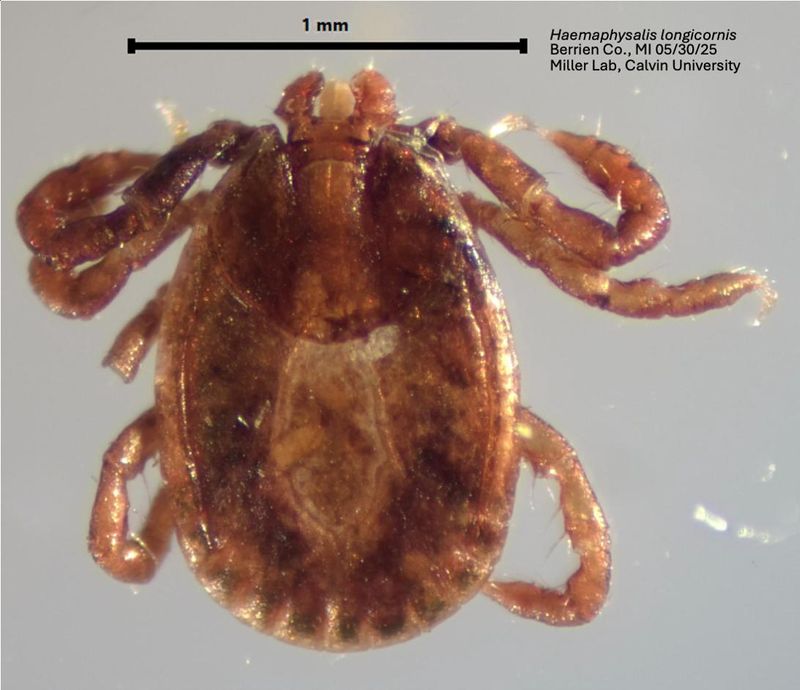
The Michigan Department of Agriculture and Rural Development (MDARD) announced the first detection of the Asian longhorn tick at Grand Mere State Park in Berrien County Friday, according to a news release from the state.
The two Asian longhorn tick nymphs were found through routine tick and surveillance efforts, the news release said.

Shortly after, the results were sent to the U.S. Department of Agriculture’s National Veterinary Services Laboratories and confirmed on June 11.
The tick poses a potential disease risk to all mammals and birds and also poses an extreme risk to livestock cattle, officials said. They are urging owners to work with their veterinarian to treat their animals for ticks, perform regular tick checks, and keep pastures and lawns mowed and clear of brush to help keep their animals safe and healthy.
“This discovery highlights the value of the contributions from our academic partners and the necessity of our continued collaboration to protect animal health throughout Michigan,” State Veterinarian Dr. Nora Wineland said in a release.
“By knowing this species of tick is in our state, we will increase our educational outreach to producers, animal owners, and animal health professionals so we can all do our part to safeguard animal and public health.”
Here’s what to know:
How did Asian longhorned tick get to Michigan?
While the Asian longhorned tick is native to east Asia, it was first detected in New Jersey in 2017. Since then, the species has spread to 21 other states in the eastern United States. The ticks can be transported through the movement of animals, people and equipment.
Why do ticks prompt a health risk?
Even though this tick is not known to carry Lyme disease, they are capable of causing tick borne diseases affecting humans and animals, although the diseases have not been confirmed outside of a laboratory setting in the United States.
When is tick season?
Tick exposure can occur year-round, but ticks are most active during warmer months from April to September, according to the Centers for Disease Control and Prevention.
What does the Asian longhorned tick look like?
Asian longhorn ticks are light brown in color and can easily be mistaken for other tick species, the news release says.
Adult females grows to the size of a pea when full of blood; other stages of the tick are very small, about the size of a sesame seed.
What can I do to protect myself?
According to MDARD, to protect animals from ticks:
This article originally appeared on Farmers Advance: Asian longhorned ticks confirmed in Michigan. What to know
Reporting by Jalen Williams / Farmers Advance
USA TODAY Network via Reuters Connect