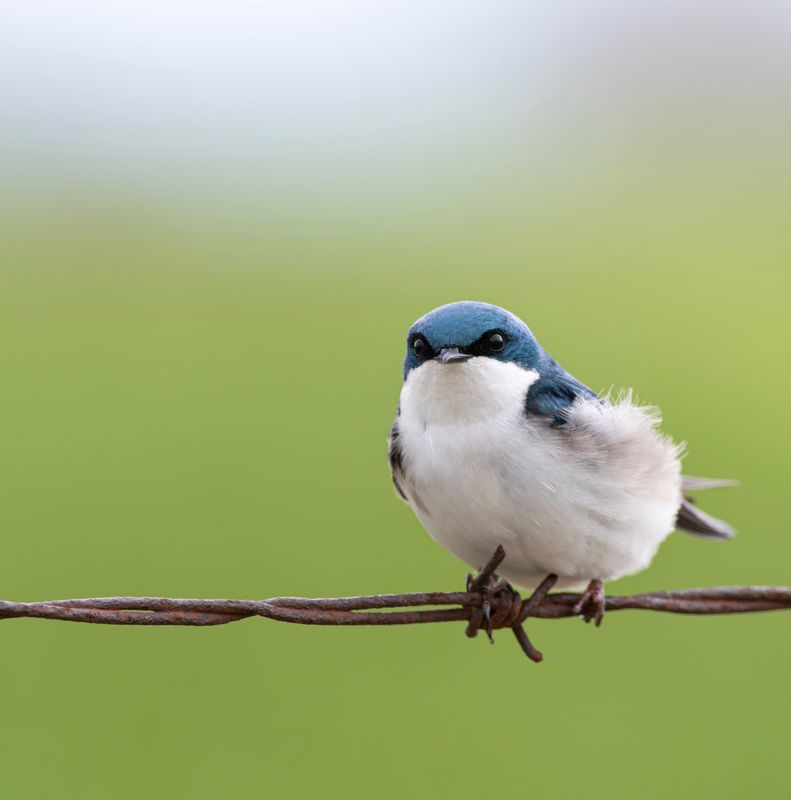
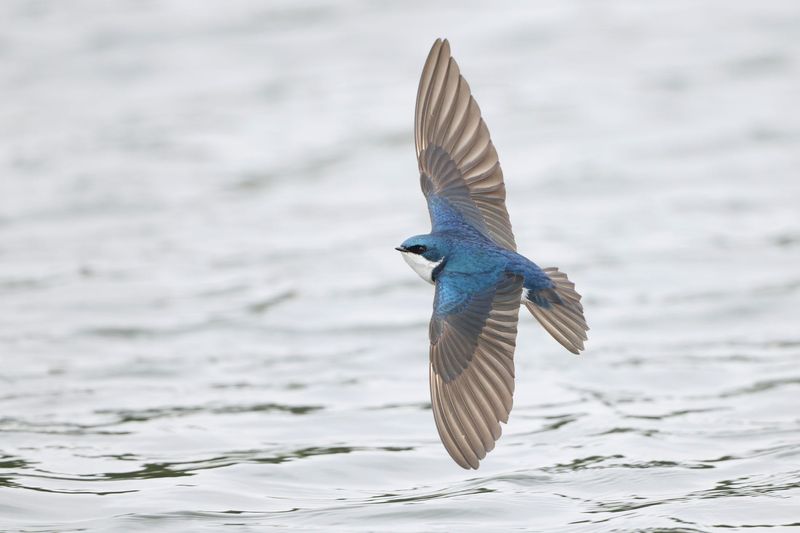
Tree swallows at a Great Lakes bird observatory are shrinking, a troubling finding that University of Michigan researchers said is tied to crashing insect populations in the region and world.
Tree swallows are small songbirds that primarily eat insects. As the amount and diversity of insects declined at the Long Point Bird Observatory in Ontario, so did the size of the observatory’s tree swallows as well as the number of eggs they lay, the U-M researchers found in a study to be published this week in the journal Proceedings of the National Academy of Sciences.

Without as many insects to eat, the birds are experiencing “something closer to malnutrition,” said Charlotte Probst, a doctoral candidate in the U-M School for Environment and Sustainability who led the research.
“We are seeing in real time how low insect abundance is negatively impacting the health and chance of survival of these birds,” said Matt Fuirst, a Birds Canada research ecologist and Long Point Bird Observatory manager.
Bird Canada monitors birds on Lake Erie shore
Probst and her colleagues used data collected by Bird Canada ecologists at the Long Point Bird Observatory to study the changes in tree swallows since 1977.
Ecologists at the observatory on Lake Erie’s north shore have been monitoring tree swallows since 1960, Fuirst said. They track things like the birds’ reproduction success, nesting habits and food supply.
Observatory workers also have spent decades measuring the type and amount of insects they see at the site, said. Insect biomass has declined by a staggering 62% over the last 50 years.
The decline is apparent to Fuirst. Giant clouds of midges descend on Long Point Bird Observatory during summer and fall. Tree swallows and other birds that eat insects feed on them.
“Those still happen, but they used to be way bigger masses of insects,” he said.
Together, the data on tree swallows and insect availability created an “incredible” resource for their study, Probst said.
“Having that sort of long-term insect diversity and biomass data is really rare,” she said. “It was really special we were able to test this.”
Why losing insects harms birds
It was not a surprise to find that tree swallows were becoming smaller over time, since that is a common trend among animals, especially birds, Probst said.
The U-M study unravels whether the shrinking is driven by climate change or biodiversity decline. Researchers found that the birds’ size and their reproduction rates were more impacted by insect availability than by temperature.
The finding should raise alarm bells about the cascading effects of losing insects, Probst said. As insects are killed by habitat loss and pesticides, less food is available at the base of the food web. That puts animals like birds at risk.
The earth is experiencing an “unprecedented” level of species loss across the globe, according to the international research organization Intergovernmental Science-Policy Platform on Biodiversity and Ecosystem Services, which developed a global biodiversity assessment in 2019.
The report found 1 million plant and animal species were headed toward extinction by 2029. That includes about 10% of the earth’s 5.5 million insect species, the report said.
“Climate change is happening. It’s important and we need to study it and we need to understand the consequences of it,” Probst said. “At the same time, we’re in a biodiversity crisis and habitat degradation seems to be one of the most important factors driving population declines in different animal species. We really need to understand how these two factors are interacting through time instead of just focusing on one or the other.”
How to protect insects and support birds
Probst said insect declines at Long Point Bird Observatory ramped up in the 1990s, which is when more people started using powerful neonicotinoid pesticides. Those pesticides can run off farms into waterways, where they pose threats to bugs that don’t feed on crops.
“It seems like a promising avenue (for further research), so I think we’re interested in looking at that to try to see if there are correlations between heavy neonicotinoid use and heavy insect declines or bird declines.” she said.
There is slight good news in finding that insect declines are causing birds to shrink and lay fewer eggs, Probst said. Combating climate change requires a global effort, but individual and community actions can make a big difference on local insect populations.
“If you’re an individual or a city or a state and you want to do something to help protect the birds in your area, it seems like starting with these strategies to restore insect abundance, like increasing native plants and improving water quality, could be a promising way to do that and at much shorter time scales,” Probst said.
ckthompson@detroitnews.com
This article originally appeared on The Detroit News: As insects die off, birds are shrinking at this Lake Erie observatory
Reporting by Carol Thompson, The Detroit News / The Detroit News
USA TODAY Network via Reuters Connect
By Carol Thompson, The Detroit News | USA TODAY Network