Miami — When General Motors Co. committed to join Formula One under its Cadillac flag in January 2023, it joined other luxury makers, including Mercedes, Audi and Aston Martin, enthusiastic about F1’s development of a new, electrified, 50-50 hybrid V-6 powertrain to debut this year.
But drivers despise the new powertrain for its girth, complexity and safety concerns.

“It’s just destroying the racing,” said Aston Martin’s Lance Stroll, normally one of the paddock’s most reticent drivers. “We’re far away from proper F1 cars, and pushing flat out without thinking about batteries and all this stuff. I saw (onboard laps) from … the V-8 era and then what it looks like versus now … the character of the cars, and just how much more intense it looked, and how much more exciting it looked back then compared to now. I think that it’s sad.”
Stroll’s comments are echoed by drivers up and down the pit lane who pine for the purity of past, nimble, V8-powered racers and express disdain for the electrified powertrain they’re using.
The 350 kW electric system — which shares half of a 2026 F1 car’s 1,000-plus horsepower — needs to be consistently regenerated to make a lap, which has led drivers to mock the new 2026 drivetrain as an expensive version of Nintendo’s Mario Kart video game in which players chase power-boost icons.
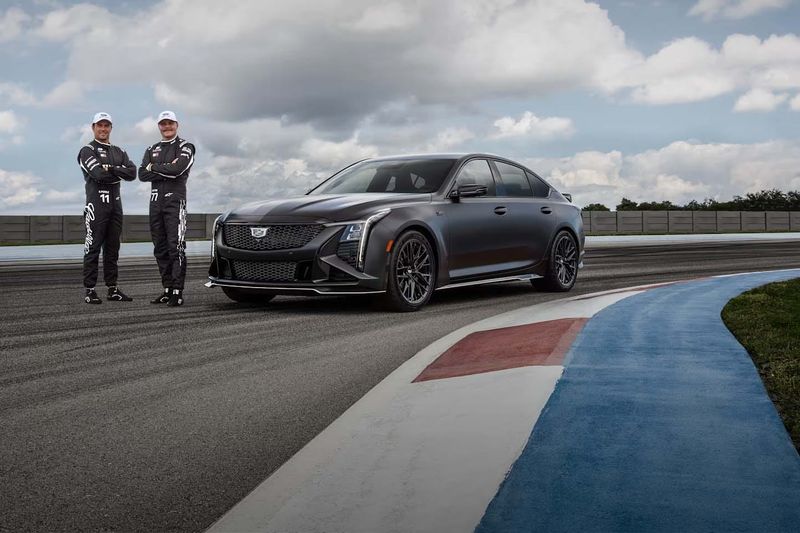
In the midst of the controversy, GM CEO Mary Barra chose F1’s Miami Grand Prix this weekend to debut Cadillac’s latest V8-powered internal combustion beast: the CT5-V Blackwing F1 Collector Series 1.
“We’re demonstrating that we’re going to deliver over the long term by having … a broad portfolio of internal-combustion-engine vehicles and a broad EV portfolio,” Barra said Friday at the Autosport Business Exchange-Motorsport Network business forum inside the Miami GP’s Hard Rock Stadium.
Tattooed with F1 logos, the “CT5-V Blackwing F1Collector Series (channels) the energy and innovation of Formula 1 into a road-ready sedan that feels every bit as special as our entry into the sport,” GM President Mark Reuss raved.
To hear the drivers tell it at the Miami Grand Prix, they would much prefer that good ol’ Cadillac V-8.
“It was cool. The noise was, was pretty special,” said McLaren driver Oscar Piastri at a press conference Thursday when asked about his recent test of the V8-powered McLaren F1 car that won the 2008 World Championship. “Just the feeling you get from … driving a naturally aspirated V-8 was cool.”
Like its peers, Cadillac has made a 180-degree turn from 2023 to be a brand of diversified ICE and electric drivetrains after the lukewarm reception that electric vehicles have received in the consumer market, both in the U.S. and abroad. Automakers and their government partners have backed off EV mandate plans to satisfy driver demand.
The controversy is an opportunity for manufacturers like GM that are working on their own power units to satisfy the next generation of F1 regulations coming in 2029 (GM is using a Ferrari-sourced drivetrain until then).
Under the direction of veteran powertrain genius Russ O’Blenes, GM and its F1 partner, TWG Motorsports, have created GM Performance Power Units LLC, which is reportedly working on two paths: 1) one heavily electrified like the current hybrid power unit and 2) a V-8 engine powered by sustainable fuels.
Under the latter proposal, Formula One should still meet its ambitious zero-carbon goals while satisfying drivers and fans with the thrilling sounds of V-8 engines that have defined brands like Cadillac, Mercedes, Audi and McLaren for decades.
“The new F1 power units will run on advanced sustainable fuels thanks to intense research and testing from Formula 1 and partner ARAMCO,” F1 says on its website about the emerging fuel tech. “This means that no new fossil carbon will be burned, with carbon instead to be derived from non-food sources, genuine municipal waste, or even out of the atmosphere.”
As electric models meet resistance from consumers, other performance makers like Porsche are pursuing so-called synthetic fuels as an option for retail cars as well. The life cycle of the CT5-V Blackwing F1 Collector Series 1 — the most powerful Blackwing yet with 685 horsepower — could be extended regardless of government emissions rules if it used synthetic fuel.
The intense driver campaign against the hybrid power unit has dominated press conferences — and appears designed to influence the next generation of engines.
“We’ve had some nice meetings with F1 and the FIA (F1’s sanctioning body),” said Oracle Red Bull-Ford driver and four-time World Champion Max Verstappen, who has led the driver protest, even threatening to quit the sport. “I think that’s a starting point, hopefully for the future in a few years’ time. I really hope that for the future drivers as well, there’s more input to come from the drivers to the organizers in general.”
The decision to get half of an F1 car’s 1,000-plus horsepower from a 350-kW electric system was made in the summer of 2022, just months before GM committed to the sport.
“It is true the political landscape has changed and back when we discussed the current regulations, the automotive companies who were very involved told us that they’re never going to make another (new) internal combustion engine again,” FIA single-seater technical director Nikolas Tombazis told Autoport this week. “They were going to phase out and by whatever year they were going to be fully electrical. Obviously, this hasn’t happened.”
Drivers have pushed back on a decision that has made cars heavier, more complicated — and a safety risk as the regeneration of energy (so-called super-clipping) has caused huge closing speed disparities on track, cited as the cause of a horrific crash March 29 during the Japan Grand Prix.
The cars’ weight has ballooned to 1,750 pounds — 400 pounds more than the 2008 V8-powered rocket ships.
“(Drivers and F1) sat down together and tried to obviously improve the situation,” said Williams F1 driver Carlos Sainz of efforts to reform the current-gen car since the late March 29 crash. “I don’t believe we will come up with a magic bullet here that will suddenly change everything, but I think all the changes are sensible and hopefully going to make things a bit more enjoyable from our part.”
Weighed in Williams team boss James Vowles: “I’d love a V-8. I miss those days.”
Beyond the power unit controversy, Barra said the F1 experience has been enjoyable for Cadillac in its first, teething year.
“We went through a period of time where we lost our way (with Cadillac),” the CEO said. “So for the last eight years, we’ve been really working hard to get the product right. But then you have to make sure people understand where the product is today, and F1 is really the top, and so we thought it was appropriate for Cadillac to be here. We have to earn our way, every race. We are committed.”
Henry Payne is auto critic for The Detroit News. Find him at hpayne@detroitnews.com or @HenryEPayne.
This article originally appeared on The Detroit News: As F1 drivers blast electrification, GM’s Barra signals flexibility
Reporting by Henry Payne, The Detroit News / The Detroit News
USA TODAY Network via Reuters Connect