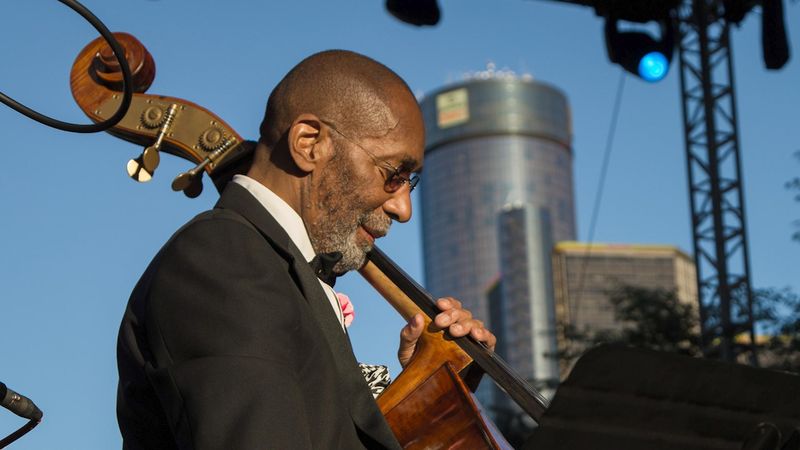
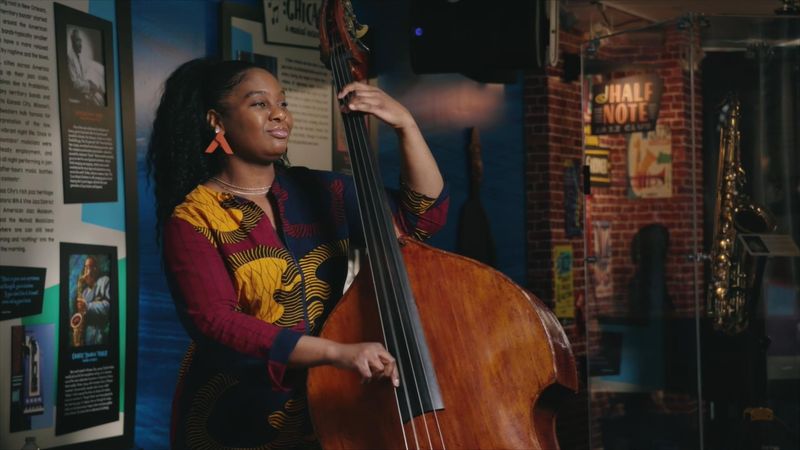
Detroit has gone by many names over the year, the most common being the Motor City.

But let’s add another:
“For years,” Robert Hurst said, “we were the music capital of America.”
He was talking in “Best of the Best: Jazz from Detroit” the remarkable documentary that will open the final Lake Michigan Film Festival (7 p.m. Thursday, Feb. 26, at Studio C in Meridian Mall). And others agree.
“That’s what we’re about,” Rodney Whitaker says in the movie. “We make cars and we make jazz musicians.”
Many of those musicians depart. Whitaker worked with Terence Blanchard and Roy Hargrove, Hurst was in Branford Marsalis’ “Tonight Show” band.
But others didn’t. “For every great musician who moved away, there’s another one who stayed,” said Mark Stryker, one of the film’s producers.
And ones that came back. Now Hurst teaches at the University of Michigan; Whitaker heads the jazz program at Michigan State University.
“He’s a wonderful player and he’s basically all about passing it on to the next generations,” said Daniel Lowenthal, the film’s director.
In some ways, the project goes back a decade, to when when Stryker took a buyout from the Detroit Free Press. He wrote “Jazz from Detroit,” which won an award as the best jazz book of 2019.
That’s when a friend said it should be a movie, and knew the people to do it.
Lowenthal has been a jazz fan, ever since growing up in Newark. His partner, Roberta Friedman, is from New York, but discovered the music when she had a store in Pasadena, California. Cal Tech students (guys like Sheldon in “Big Bang Theory”) came in to listen to her jazz records.
The couple jumped into the project — just as Covid hit. “There were parts we couldn’t use, because everyone was wearing masks,”Friedman said.
But they managed to shoot enough film to land a $15,000 grant from Michigan Humanities. Bigger grants were coming — led by the Kresge and Erb foundations — but that state one “was absolutely critical,” Stryker said. If it weren’t for that “the film would not exist.”
Soon, they were crossing the country to do interviews. That included stars from Detroit — Ron Carter, Kenny Burrell, Barry Harris, Elvin Jones, Endea Owens, Don Was, Geri Allen, etc. — and admirers from elsewhere.
All offered praise. “Detroit is soulful, Detroit is vibrant,” Owens said. “It’s tough, it’s kind, it’s a melting pot of creativity.”
The film goes back to the start of the auto industry; from 1910-20, it says, the city’s Black population increased sixfold. A middle-income Black neighborhood grew, alongside a thriving nightclub district.
Detroit drew top acts — Ellington and Basie and such — but also developed its own stars. The Grinnell Brothers piano company was a big factor; so, eventually, was the music program at Cass Tech. Two future jazz-bass greats, Carter and Paul Chambers, were in the same Cass home room.
Entwined in this, the film says, were layers of bias. Redlining kept Blacks out of many parts of town. One freeway destroyed the Black neighborhood; another shattered the entertainment district. The Gotham Hotel, a favorite of the Black elite, was denied a liquor license and later was condemned.
Sheila Jordan, a white jazz singer, tells the story of the time a Detroit cop saw her having a picnic with a Black man. If his daughter had done that, the cop said, he would have pulled out his gun and shot her.
Throughout it all, Blanchard says in the film, Detroit’s Black musicians soared. “These are the best of the best in our culture and in the world.”
For five years, filmmakers scrambled to get interviews on time (Jordan, for instance, died in August at age 96). They also gathered old film and photos.
“We had a very creative archivist who also loves jazz,” Lowenthal said.
Landing the music rights was “a nightmare,” he said. “Underlying music rights might be owned by four people, three of them dead.”
Still, they worked it out. The film lists 82 songs and soars with great sounds.
It’s been at festivals in Germany, Romania and beyond, plus a big splash before a packed crowd of 900 at the Freep Film Festival in Detroit. “They gave us a standing ovation and threw a party for us,” Friedman said.
Later, the film was shown as a fundraiser for East Lansing’s jazz festival. “Everyone said, ‘I want my friends to see it,’ “said Susan Woods, founder of the Lake Michigan and East Lansing festivals.
So now it’s getting another local shot, with the filmmakers there to talk with the audience. The final LMFF will get off to a musical start.
This article originally appeared on Lansing State Journal: A portrait of Detroit jazz opens final Lake Michigan Film Festival
Reporting by Mike Hughes, For the Lansing State Journal / Lansing State Journal
USA TODAY Network via Reuters Connect