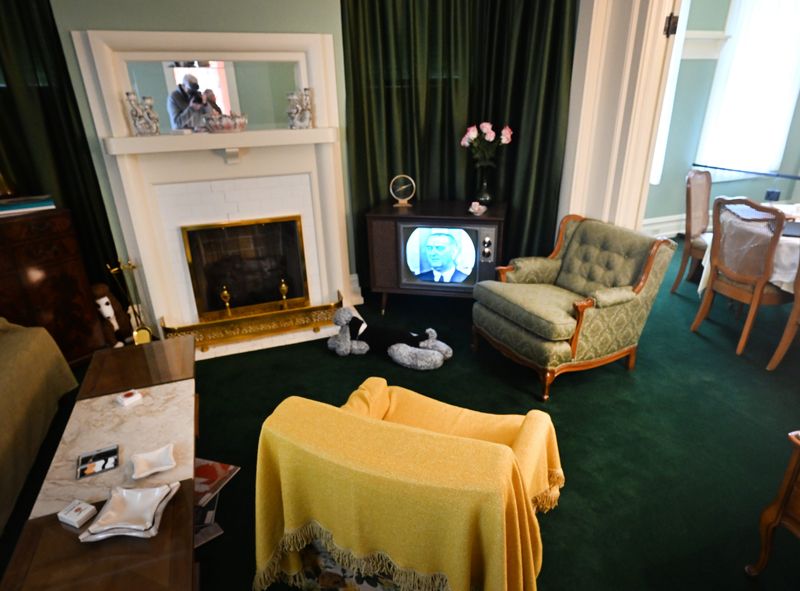
After more than 40 years, Dearborn’s Greenfield Village is adding a new historic home.
On June 12, the 80-plus-acre outdoor living history museum — part of The Henry Ford museum complex — will open the Dr. Sullivan and Mrs. Richie Jean Sherrod Jackson Home to the public. The Selma, Alabama, house served as the base for Martin Luther King Jr. and other civil rights activists in their work to ensure voting rights for Black Americans.

The 2,000-square-foot, arts and crafts bungalow is in the Village’s Porches & Parlors district on Maple Lane between the William Holmes McGuffey Birthplace and the George Washington Carver Memorial.
“(The Jackson Home) is the story of one family’s involvement in the National Movement for Voting Rights in the United States,” said Amber Mitchell, The Henry Ford’s Curator of Black History. “It is a story that talks about how ordinary, everyday people can make a difference in all kinds of ways, and … how those differences then make an impact in ways that we still feel today.”
Sullivan and Richie Jean Sherrod Jackson were close friends of the Kings. They opened their home in the 1960s to civil rights activists planning the Selma-to-Montgomery marches, protesting racial discrimination in voting, which eventually led to the Voting Rights Act of 1965.
Patricia Mooradian, president and CEO of The Henry Ford, said the Jackson Home supports the museum’s collection strategy to acquire items related to social transformation, such as its Rosa Parks bus.
“It aligns with our mission,” she said, “but I think more than that, the story has to be preserved.”
The museum has fundraised more than $16 million of the $30 million cost of the addition, which supports the house’s reconstruction and preservation, educational programming and an endowment.
Set in 1965, the home represents the most recent time in American history represented at Greenfield Village. It is also the only structure to have its own attached exhibit, which visitors must walk through before entering the house through the back door — the door King would have used during his visits for added protection.
Mitchell said the exhibit provides the necessary context for visitors to fully understand and appreciate the house’s role. It also provides extra space to showcase Jackson family items from the home.
“We had to not only be able to explain who the Jacksons are and why would Dr. King come and stay at this house, but what was going on in the world that required a voting rights movement,” she said. “Why is it that African Americans did not have the right to vote in Alabama, and in other places in the country, even though on paper they did? And, most importantly, what did it take to actually create the environment in which a Voting Rights Act could be passed in the United States?”
The addition has been four years in the making. Jawana Jackson, the only child of Sullivan and Richie Jean Sherrod Jackson, contacted the museum in 2022 to see if they’d be interested in acquiring the home, which had been in her family since it was built in 1919. Jawana Jackson had been living in the home until her mother’s death in 2013, then opened it as a museum in 2014.
“(Jawana) has no siblings, she has no children, and she knew that she had to do something to preserve this house…” Mooradian said. “She promised her parents that she would do what she could to keep this story alive, and that’s why she called us.”
The journey from the South was no easy feat. The home was cut in half and transported north with specially made flatbeds, requiring permits, escorts and around-the-clock security.
Mooradian said the 1,000-plus-mile move took two trips: the first taking nine days, and the second — more expedited — took four days. The house was then kept in a warehouse and updated with a new roof, repaired walls and floors, and connected plumbing and electrical systems. Central heating, air conditioning, fire protection and security were added. It was also retrofitted to withstand a northern climate.
It was then restored to look as it would have in 1965, during its peak use in the Civil Rights Movement. Part of the process involved removing drywall to reveal the layers of paint, wallpaper and tiles on top of the original plaster; they found shadows on the walls that helped them to replace the cabinets to their exact measurements.
Additionally, they referenced old photos and Jawana Jackson’s book “The House by the Side of the Road: The Selma Civil Rights Movement,” to replicate the paint colors and source old décor. Much of the furniture, however, is original, including the maple dining room table around which the civil rights leaders made their plans.
“We did not want to lose the essence of this house, because it’s very palpable when you walk in here,” Mitchell said. “(It’s) not only the feel of people living in the warmth of this home but also the important things that we would find behind the walls.”
With last month’s Louisiana v. Callais Supreme Court ruling, which struck down part of the Voting Rights Act, Mitchell said the Jackson Home opening is both timely and challenging.
“How do we create an exhibit that is evergreen when the story of the vote in the United States is one that is always about expanding and contracting access?” she said. “I don’t have an answer to that question. This exhibit will never really be finished.”
The Jackson Home arrives as the United States celebrates its 250th anniversary, a move Mooradian said was intentional.
“This is part of our democracy, and there are many, many instances over the course of the history of the United States, where freedom is being defined, redefined, challenged, fought for, and that story continues,” she said. “This is a big part of that.”
Mitchell said the Jackson Home is a story for everyone who is concerned about democracy in the United States.
“If you are an American citizen who votes or wants to vote, or will vote, you should care about what happened in this home. If you are striving to be a citizen, and you want to better understand how (we got) to where we are right now, you want to know what happened in this home…,” she said. “And … if you want to understand how people come together to create change…, you want to understand what happened in this home.”
The Jackson Home opens June 12 at Greenfield Village, 20900 Oakwood Blvd., Dearborn. For details, visit www.thehenryford.org.
This article originally appeared on The Detroit News: A historic home from Alabama is becoming a museum in Dearborn
Reporting by Erica Hobbs, Special to The Detroit News / The Detroit News
USA TODAY Network via Reuters Connect