For Pattie Townsend, paying for the “simple things” like a haircut or snacks are too pricey for her monthly allowance.
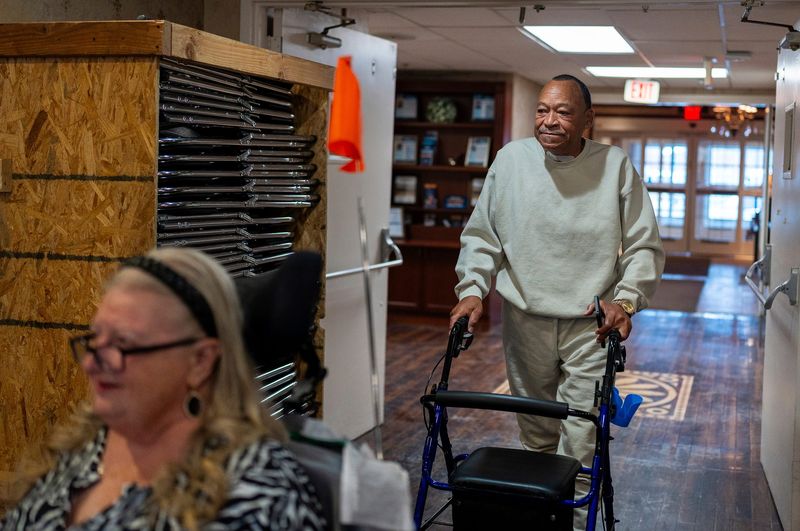
Tyrone Fitzpatrick has relied on friends and family to pay for the gauze pads and gel to care for his tracheostomy when his nursing home ran low.

And Mel Joslin spends a third of his monthly allowance on soap, lotion and other personal items. The dry air and the soap at the Ishpeming nursing home where he lives irritates his skin.
“I don’t have any money at the end of the month to do anything with,” he said.
Thousands of Michigan nursing home residents, who use Medicaid to cover their care, rely on a $60 monthly personal allowance — an amount that state and federal officials haven’t increased in decades.
While Medicaid covers the cost of things like nursing services, meals, a room/bed and some personal hygiene items, it does not pay for many other basics, like a haircut, clothing, shoes, special meals and reading material or a grandchild’s birthday card.
Three in five Michigan nursing home residents rely on Medicaid, which has limits on income and assets to qualify for coverage.
Across Michigan, nursing home residents are speaking up, saying they want the state to fund an increase, said Alison Hirschel, director of the Michigan Elder Justice Initiative.
“When people are on Medicaid, an unmarried person would generally turn over all of their income except $60 per month to the nursing home,” Hirschel said. “People just can’t take care of all the things they need to take care of.”
Eric Einhart, president of the National Academy of Elder Law Attorneys’ board of directors and partner at Russo Law Group P.C. in New York says the personal needs allowances for nursing home residents are frustratingly low and should be increased in states across the United States. The median monthly allowance provided by states was $70 as of January 2026.
“Being able to buy a cup of coffee that you like or the shaving cream that doesn’t give you a rash … is important, especially when you’re forced to essentially be destitute in order to qualify for these programs,” he said.
What is a personal needs allowance?
The personal needs allowance (PNA) is the amount of money a nursing home resident can keep from their monthly income to pay for personal items or services if their stay is covered by Medicaid, with additional allowances such as for spouses, dependents and Medicare premiums. To qualify for Medicaid, residents must have limited assets and contribute most of their income toward their care.
Personal needs can include items like a cell phone, credit card bills, or even buying a gift for a friend or family member, all would need to be paid out of a nursing home resident’s monthly allowance.
Townsend says the little she has each month, doesn’t last long. A landline is not provided in her room at a West Bloomfield nursing home. That makes a cell phone “an absolute necessity” to keep in touch with doctors, family and friends.
The personal needs allowance was set by the federal government in 1972 at $25 and increased to $30 in by the Omnibus Budget Reconciliation Act of 1987. States can choose to supplement the amount.
Michigan’s $60 personal needs allowance has not increased since at least 1994. Adjusted for inflation, that’s about $133 in 2025 dollars.
In 2026, the median amount available to nursing home residents by state was $70, according to data compiled by the American Council on Aging. Alaska provides the maximum monthly benefit, $200, and Alabama provides the minimum, $30.
There are some circumstances where Michigan nursing home residents receive more than the standard $60 set by the state and in other cases less.
For example, veterans eligible for an improved pension from the U.S. Department of Veterans Affairs (VA) receive $90 per month. When a nursing home resident receives Supplemental Security Income (SSI) and Medicaid pays for at least half of their stay, the monthly benefit for personal needs is $37 ($7 of which is supplemented by the state).
There were about 40,528 people who were eligible for the $60 personal needs allowance at Michigan nursing homes in fiscal year 2025 — a total cost of $11.8 million (state and federal combined). The state’s share was about $4 million, according to the state health department.
The average number of people that received $37 monthly for personal needs in fiscal year 2025 at Michigan nursing homes was 2,241 at a cost of $188,216 to the state.
A number of states have higher personal needs allowances than $60, Hirschel said: “It is really time to address that.”
Residents push for an increase
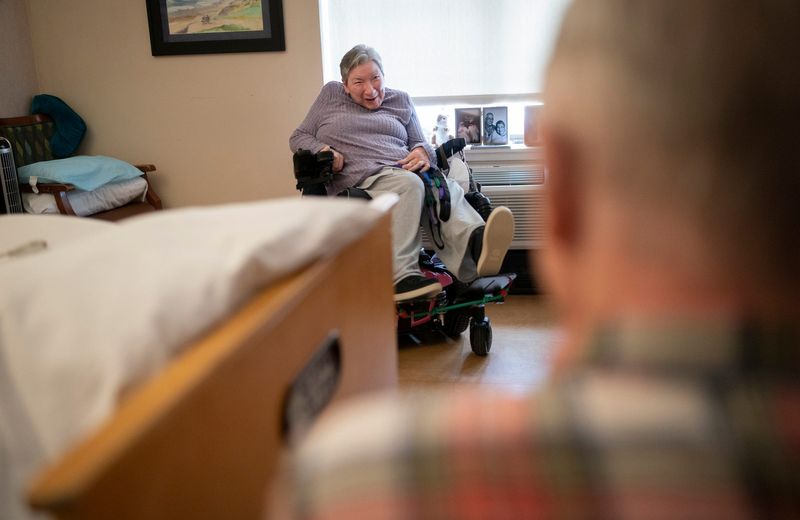
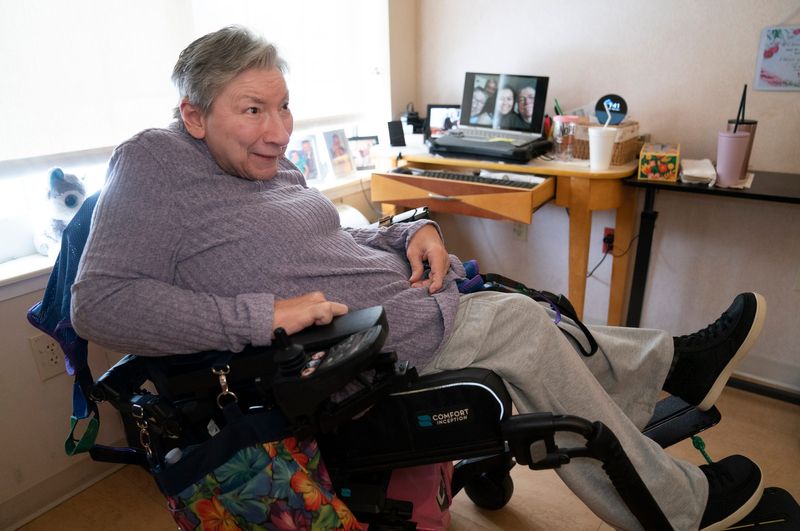
Pattie Townsend, 65, and her husband Warren Townsend, 71, live across the hall from each other at Medilodge of West Bloomfield. She was born and raised in Detroit, he in River Rouge. They were married 40 years ago in May and moved into the nursing facility in 2020. They each receive $37 each for their monthly needs.
Townsend identified clothing as one of many expensive items difficult to purchase or keep where she lives.
“I cannot afford to buy clothes and rely entirely on donations or family,” she said in an email to the Free Press. “Clothing is frequently lost or ruined in the facility laundry, which is a significant burden.”
The most recent health inspection report for the facility, which changed ownership from SKLD to Medilodge last year, corroborates her concerns. The November 2024 report described residents’ accounts of missing shirts, pants, socks and a dress among other items, sometimes without replacement, and being given clothing that belonged to other people. A representative for the nursing home declined to comment.
Townsend is the vice president of the resident council where she lives, but also takes part in the statewide resident council, developed by the Michigan Long Term Care Ombudsmen Program in August 2024. The Michigan Long Term Care Ombudsman Program is a government-funded statewide program with 40 local ombudsmen, who advocate for residents’ rights in nursing homes, licensed homes for the aged and adult foster care facilities.
Fitzpatrick, 68, who also attends the statewide meetings told the Free Press that fear of staff retaliation keeps many nursing home residents from participating and voicing their concerns on issues like increasing the personal needs allowance.
“Because of that fear, when it comes to signing things, when it comes to participating, it’s like they fear repercussions,” he said.
“That’s something that is supposedly not tolerated here, but the flip side of that is that we know that it happens. We know that the residents are retaliated against.”
Fitzpatrick, who is president of the resident council at Rivergate Terrace, says a lot of residents are just trying to find ways to make ends meet at the Riverview nursing home where he lives.
He hasn’t received a personal needs allowance since moving in during the COVID-19 pandemic in 2021, when he was told Social Security had overpaid him.
“Believe it or not, even though we are in the nursing home, all needs are not met,” Fitzpatrick said.
Joslin, 70, uses a refurbished Dell desktop computer, with a Lenovo monitor and an HP Inc. keyboard to attend statewide resident council meetings on Zoom and put together material for the local resident council at the Marquette County Medical Care Facility, where he serves as president. It took him about five months to scrape up enough money from his $60 monthly allowance to buy the used computer for $214.67, he said.
Earlier this year, Joslin mailed a packet of letters from nursing home residents at his facility to his state representative requesting a raise in the personal needs allowance.
“Our goal is to get the personal needs allowance raised to $125,” he stated in his letter typed to the state representative. “The residents of Marquette County Medical Care are finding it more challenging than ever to navigate our personal expenses and have the freedom to purchase items that lend to a higher quality of life when we only receive sixty dollars per month.”
“It all boils down to dignity,” Joslin told the Free Press.
Some states tie amount to inflation
As of January, nursing home residents in 14 states and the District of Columbia saw an annual increase in their personal needs allowance compared with last year. A number of states like Arizona, Colorado, Minnesota, Nevada, New Hampshire, North Dakota and Washington make annual cost of living adjustments to the monthly amount to prevent inflation from eroding residents’ purchasing power.
South Carolina, doubled its monthly allowance from $30 to $60 last year. Ohio raised the personal needs allowance from $50 to $75 effective Jan. 1.
In Congress, a bill introduced last fall, seeks to change the minimum personal needs allowance from $30 to $60 in the United States.
“Increasing the PNA (in Michigan) would require additional Medicaid funding, since any increase reduces the amount residents contribute toward their cost of care and shifts those costs to the program,” Lynn Sutfin, spokesperson for the state health department, wrote in an email to the Free Press.
Heading into the new year, states are reporting difficulties financing Medicaid, said Alice Burns, associate director of KFF’s Program on Medicaid and the Uninsured. Lower general tax revenues from pandemic-era cuts, loss of enhanced federal funding and upcoming cuts of nearly a trillion dollars in Medicaid funding has put a strain on state budgets, she said.
Burns said KFF, a nonpartisan health policy research group, is watching how states respond, including whether states are cutting Medicaid or looking to expand eligibility. And, although some Medicaid funding decisions fall along political lines, expenses involving long-term care like the personal needs allowance typically have bipartisan support.
“We all know that everything’s getting more expensive. So $60 a month, it’s just not enough,” said state Sen. Kevin Hertel, D-St. Clair Shores, chair of the Senate Health Policy Committee.
“If you’re going to increase the benefit, you have to make sure you have the money ongoing to continue to pay for that benefit. And that’s always the challenge,” he said.
Contact information for local ombudsmen can be found on the Michigan Long Term Care Ombudsman Program website: mltcop.org or by calling 866-485-9393. For information about the statewide resident council, contact a local ombudsman or email Mltcop@meji.org.
Kristi Tanner is a data reporter. Contact her at ktanner@freepress.com
This article originally appeared on Detroit Free Press: Michigan’s $60 personal needs allowance hasn’t changed in decades
Reporting by Kristi Tanner, Detroit Free Press / Detroit Free Press
USA TODAY Network via Reuters Connect