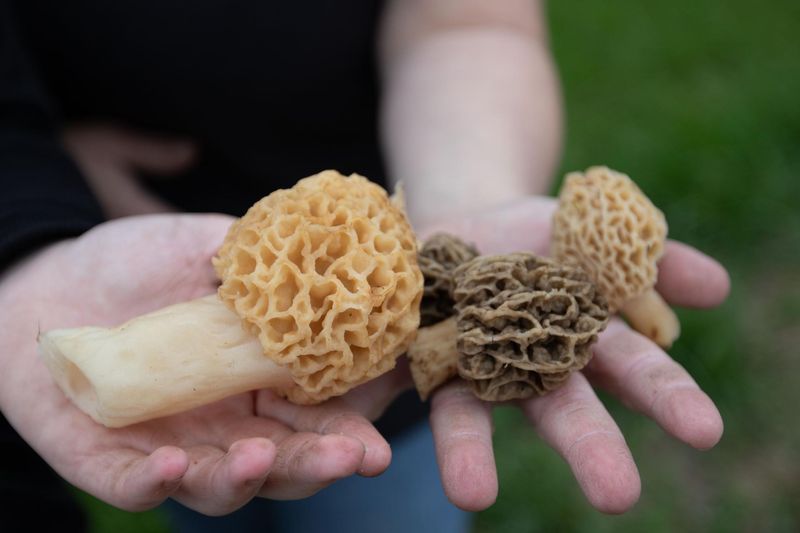
As temperatures begin to climb across Michigan, morel enthusiasts soon will be heading into the woods to search for the tasty mushrooms.
Like nearly all wild mushrooms, morels require certain conditions, including temperature and moisture, to grow, the Michigan Department of Natural Resources said. Some years spring provides good conditions to produce morels, while others result in smaller yields.

Warm and wet conditions are ideal for morel growth, while cold and dry conditions can result in a failure of the crop.
Regardless of where they are found, morel mushrooms have become a springtime delicacy in Michigan and can become the star of numerous recipes, highlighting their earthy, nutty flavor.
If you decide to head out and start morel hunting this spring, here’s what you should know about morel mushrooms in Michigan.
What are morel mushrooms?
The white morel is the most common morel mushroom and is often called the white or gray morel. Its color varies from light cream to gray and to yellowish-brown depending on its habitat and age.
Other species include black morel, half-free morel and burn-site morel. Detailed information about species can be found on the DNR’s website.
False morels are known as nonedible look-alike species and should not be eaten. The easiest way to check whether a mushroom is a false morel, is to check if the cap connects to the stalk. Free hanging varieties should not be eaten, the DNR warns.
Where can I find morel mushrooms in Michigan?
Morels can be found throughout Michigan, including both the Upper and Lower Peninsula.
Morels can be unpredictable as to where they will grow from year to year, Joshua Nowicki wrote on the Pure Michigan website. They can be found in fields, forests, along the edges of paved roads, and in landscaping wood mulch.
“Once you have a location, the hunt really begins,” Nowicki said.
When is morel hunting season?
The month of May is typically “morel month,” According to Michigan’s DNR, but the actual fruiting period is from late April until mid-June — depending on the location and the species of mushroom.
Is there an online map for finding morels?
No, there is no map to morel patches. And many morel lovers hate to share their favorite picking locations.
However, large burn sites in forested areas tend to be ideal for morel mushroom hunting in Michigan and the DNR has created a “Mi-Morels Map” showing large burn areas that have occurred within the past couple of years.
Grassy and other non-forest areas are not as likely to produce morels, the DNR said.
What should I bring with me when I head out morel hunting?
A detailed mushroom identification book can be helpful for those who are just starting their morel hunting adventure, or they can travel with someone who has experience with finding morel mushrooms.
What’s a good way to prepare morel mushrooms?
The DNR provides tips for choosing, collecting and handling mushrooms:
What are some recipes I can make with morels?
“Morels have a distinct flavor unlike any other, and won’t taste like supermarket mushrooms. The flavor is delicate and easily diminished by overseasoning,” the DNR said.
Morel mushrooms tossed with a little flour and sautéed in butter is perhaps the simplest way to enjoy the seasonal delicacy.
Other recipes can include morels with pasta, made into a cream sauce or as a pizza topping.
Want to collect wild mushrooms and sell them?
The Midwest American Mycological Information offers a workshop program that, if successfully completed, will qualify you as an expert mushroom identifier who can then legally sell wild-foraged mushrooms in Michigan, the USDA said.
Once completed, the Michigan Department of Agriculture and Rural Development will provide certification for people to lawfully broker select wild-foraged Michigan mushrooms.
Michigan’s Food Code requires that mushroom species picked in the wild must be obtained from sources where each mushroom is individually inspected and found to be safe by an approved mushroom identification expert.
MAMI offers an online map showing the growing season of Michigan mushrooms as well as which species are edible.
This article originally appeared on Lansing State Journal: It’s nearly morel season. What to know about the tasty springtime Michigan mushroom
Reporting by Brad Heineman and Dan Basso, Lansing State Journal / Lansing State Journal
USA TODAY Network via Reuters Connect