

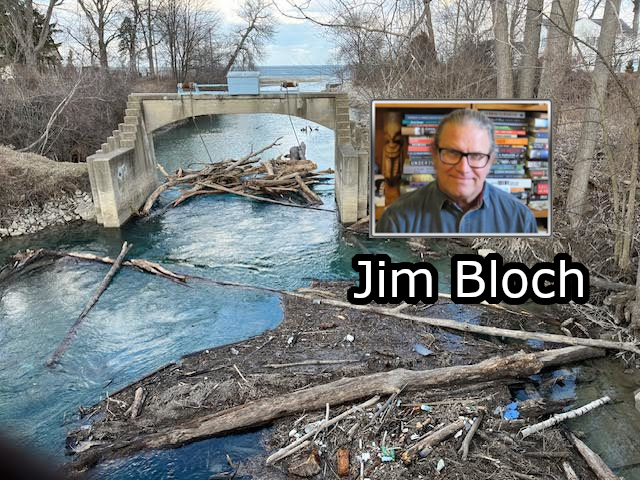
By Jim Bloch

“I’m not sure how we can call ourselves the ‘Maritime Capital of the Great Lakes’ if the Black River Canal is still closed,” said Port Huron City Manager James Freed, addressing the city council at its regular meeting March 9.
Maybe the title is a misnomer.

For the canal to open, its Tainter gate needs to be replaced at an estimated cost of $5.6 million. The city cannot afford the price tag. It needs Fort Gratiot Township and Port Huron Township to contribute a million dollars each to the project, or about 40 percent of the cost.
Freed made a pitch to the Fort Gratiot Township board of trustees at its regular meeting March 16, requesting the $1 million contribution.
The board of trustees failed to act on the matter.
“No action taken to approve expending up to $1,000,000.00 for the Black River Canal Project Plan 2026…”, according to the minutes of the meeting.
The board said it would review the bids for the work and “look into a fair and equitable cost share plan.”
Freed will make an identical request to the Port Huron Township board at its regular meeting April 6.
Ten Fort Gratiot residents spoke against the township paying the million dollars. Another four sent emails or letters opposing the contribution. Resident Connie Neese said the city will derive more than 60 percent of the benefits of the project in the form of increased tourism and water quality.
Only two residents spoke in favor of the paying for the new gate.
Flood damages gate
In January 2024, a flood triggered by an ice jam on the Black River in Port Huron caused water to backup and reverse its normal direction in the Black River Canal, flowing from the river along the canal to Lake Huron instead of from Lake Huron along the canal to the river. The rush of water doubled the width of the canal and carried all sorts of debris, including fallen trees, into the Tainter gate, damaging the moveable dam used to regulate water intake from the lake. The Tainter gate is situated west of the mouth of the canal, just east of Gratiot Avenue. The force of the water and the debris sheered the gate off the pins that hold it in place.
The water levels in the canal rose about five feet because of the ice jam, all of it rushing toward Lake Huron and causing significant erosion along the banks of the canal.
“It flowed like a rapid river,” said Freed at the time. “I’d never seen it that way.”
The canal connects the southwestern shore of Lake Huron and the southeastern reaches of the Black River. It was dredged in 1912 to flush the polluted waters of the Black River into the St. Clair River.
The Tainter gate was installed in 1937.
Today, the main uses of the canal are recreational. Boaters use the canal as a shortcut to the lake. The canal, the Black River, the St. Clair River and Lake Huron between the two waterways form a wedge-shaped 10-mile loop for aquatic travel: Kayakers and canoeists may enter the Black River from St. Clair River, head generally northwest to the canal then east to Lake Huron and south back to the St. Clair River. It is a part of the Island Loop Route National Water Trail.
The fix
The damaged Tainter gate is still in place, acting as dam to prevent sand from the lake filling in the canal. If the sand moved through the gate and west beyond Gratiot Avenue, it would cost millions of dollars to dredge, Freed said.
“The Tainter gate is not fixable,” Freed said.
The city has spent $400,000 in engineering and securing the canal after the flood. Freed showed a newly designed Tainter gate that would be 10-15 times stronger than the damaged gate. Freed said it would be able to withstand a 100-year flood. The eroding canal banks between the gate and Gratiot Ave. will be armored. Because the city owns so little land on each side of the canal, the armoring would be held in place by a steel frame between the two seawalls, under the bottom of the canal, not by tiebacks. The frame would prevent the two seawalls from collapsing inward.
Bidding is underway and bids will be opened by the end of the month. Theoretically, the project could start in May.
Money is the main stumbling block.
“The city of Port Huron does not have the ability to pay for this on its own,” Freed said.
Assuming the townships agree to participate, the city’s share of the cost would be bonded over 25 years, and a $325-375 special assessment would be applied to property owners on the Black River in the city. That would cover about half the amount. The rest would come from the city’s general fund.
Both townships are sitting on large rainy-day funds and can afford the cost, said Freed.
“The project will not be started or completed until the townships agree to help,” Freed said. “We will not go alone.”
Federal and state grants are not available in sufficient amounts for the project; there is “no rescue boat coming,” Freed said.
Despite his claim, at its regular meeting March 23, the Port Huron City Council approved the submission of a federal grant application “under the Fiscal Year 2027 Appropriation
Program in the amount of $6,500,000 with a local match of $545,140 for a total project cost of $7,045,140 regarding the necessary renovations and stabilization of the Black River Canal to reduce or mitigate risks from natural hazards, disasters, flooding, erosion and watershed protection.”
Jim Bloch is a freelance writer based in St. Clair, Michigan. Contact him at bloch.jim@gmail.com.
