

By Jim Bloch

The Black River Canal might be a necessity, but it comes at the cost of a luxury.
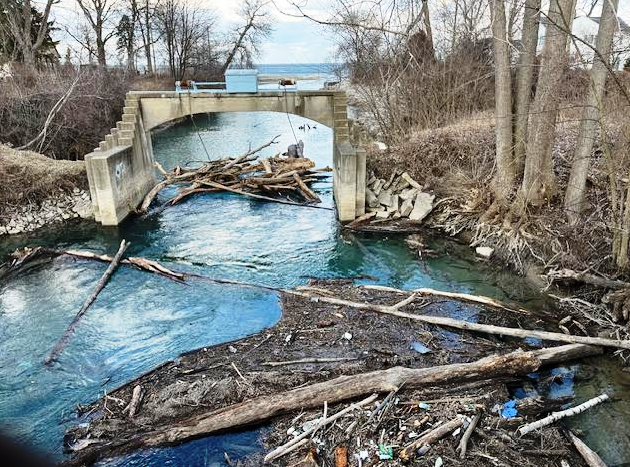
Repairing the Tainter gate, which helps control the buildup of sand in the canal, comes with a hefty price tag. Floods last winter sent tree trunks and debris crashing into the structure and damaged it.

“The canal and Tainter gate project is now estimated to be somewhere between $3.5 million and $5 million,” said City Manager James Freed, addressing the city council at its regular meeting July 8.
The city council voted unanimously at its regular meeting July 8 to hire DLZ, a company specializing in engineering, surveying and construction, for $231,335 to prepare bid documents for a replacement gate and lifting mechanism and separate bid documents to install the gate, construct the needed erosion control devices, including steel sheet piling if necessary, and replace a water main that runs under the canal between the Tainter gate and Gratiot Avenue.
“The Tainter gate alone is looking like a $1.5 million project,” said Freed, as heard on the recording of the meeting posted on the city’s website.
The city closed the canal to marine traffic this summer.
“This is a very unique situation,” said Freed. “No one else has a canal like this in the state of Michigan.”
Freed is hoping that the uniqueness of the canal and Tainter gate will propel the state to participate in the funding the repairs.
The canal was excavated in 1912 as a mechanism to use the waters of Lake Huron to flush the polluted Black River into the St. Clair River. The 6,000 foot canal runs due west from the lake to the Black River. The Tainter gate was built and installed in 1937 500 feet west of the Lake Huron with the goal of controlling the buildup of sand and sediment in the canal, a particular threat during strong winds out of the east.
Residents along the Black River have been complaining about stagnant waters ever since the gate was damaged.
“Everything is moving full speed ahead and we’re working with the state (for the necessary permits),” said Freed. “The mayor and I met with legislative leaders, our state rep, state senators. We will be preparing a state aid request.”
DLZ meanwhile will “prepare a bid package for the design, manufacturing, and delivery of the replacement gate and lifting mechanism. The lifting mechanism has a long lead time and is the critical path for this project,” said Manoj Sethi, president of DLZ, in a letter to Brent Moore, the engineering manager for the city. The company maintains an office in Port Huron as well as more than two dozen cities in Michigan and the Midwest.
“I have a meeting with township supervisors coming up to brief them about the costs as well,” said Freed.
Like the city’s water and waste water treatment plants, Port Huron Township and Fort Gratiot Township contribute to the annual maintenance costs – largely dredging — of the canal.
The company will perform a “detailed survey that will extend from the east side of the Gratiot Avenue bridge to 100 ft east of the Tainter Gate.”
DLZ will also design erosion control along banks of the canal between the Gratiot Avenue bridge and the channel armoring that took place in 2023.
“We want to fix this and fix it for the long term,” said Freed.
Jim Bloch is a freelance writer based in St. Clair, Michigan. Contact him at bloch.jim@gmail.com.
