

By Jim Bloch

The Boddy Construction Company, of Port Huron, has won the contract to dredge the Black River Canal in Port Huron this year with the low bid of $124,500.
The city council voted unanimously at its regular meeting Jan. 8 to award the work to the company.

“This project consists of dredging the mouth of the Black River Canal at Lake Huron,” said City Manager James Freed in his memo to Mayor Pauline Repp and the council. “The mouth of the canal has the potential to be dredged every spring and late summer due to the wind and waves filling the mouth in with sand. The dredging is a permitted activity through permits issued by the Michigan Department of Environment, Great Lakes and Energy and the United States Army Corps of Engineers.”
Raymond Excavating Company, of Marysville, submitted the second lowest bid at $134,500. S.A. Torello, Inc., of Port Huron, was third at $178,000. Anglin Civil, LLC, of Livonia, was high at $585,000.
“Note that the two townships are paying more on an annual basis,” said Freed, as heard on the recording of the meeting posted on the city’s website. “This is a do-not-exceed cost. We hope we will never spend this amount.”
Last August, Port Huron and Fort Gratiot townships each agreed to pay for 25 percent of the annual dredging costs of the canal up to $15,000 per year. The city of Port Huron will pick up 50 percent of the costs of the dredging — and any amount in excess of the annual cap amount.
“Though not its primary purpose, the Black River Canal has come to serve as a vital link for watercraft traveling from the Black River to Lake Huron,” said Freed in his memo. “(T)he City contracts each year to have the mouth of the canal dredged to maintain flow in the canal and access for watercraft.”
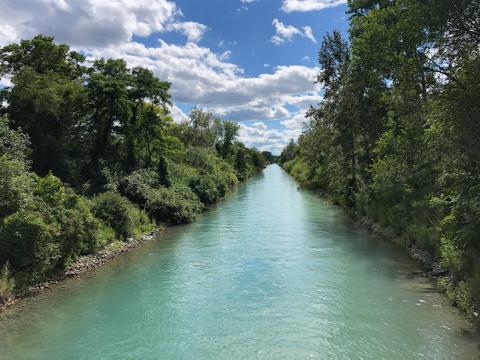
The canal connects the southeastern reaches of the Black River and the far southwestern shore of Lake Huron. The canal was dredged in 1912 in an effort to flush the polluted waters of the Black River into the St. Clair River.
Today, the canal, the Black River, the St. Clair River and Lake Huron between the two waterways form a roughly wedge-shaped 10-mile loop for aquatic travel: Kayakers and canoeists may enter the Black River from St. Clair River, head generally northwest to the canal then east to Lake Huron and south back to the St. Clair River. It is a part of the Island Loop Route National Water Trail.
“In 2023, EGLE and the USACE amended our permits to allow for the dredged material to be disposed of in three separate locations,” said Freed. “Those locations are as follows: Zone 1: Lakeside Beach; Zone 2: Conger Street Area – Lake Huron from Holland Avenue to 820 feet south; and Zone 3: Gratiot Street Area – Lake Huron from the Black River Canal to Lakeside Beach.
“Previous permits only allowed for disposal of dredged material in Zone 1 and 2. Zone 3 was added at the request of property owners between Lakeside Beach and the Black River Canal.
“Multiple disposal areas also allow flexibility if property owners withdraw their written agreement, or property ownership changes. Based on the volume of dredging that took place in the past couple of years, the contractor has the potential to dredge approximately 1,500 to 7,300 cubic yards of material each time they are authorized by the City to dredge.”
The dredging typically takes place between the Tainter gate just east of Gratiot Avenue — a moveable dam-like structure used to control the flow of water out of and into the canal — and Lake Huron.
“Under the permit, dredging is not recommended during the months of May, June or July due to critical spawning, migration and recreational use,” said Freed. “(H)owever, in past years, the City has received approval to dredge during these months when navigation had been either extremely limited or entirely prevented due to wind and waves redepositing sand at the canal entrance.”
High lake levels over the past few years, coupled with high winds, have hastened the build-up of sand in the mouth of the canal.
“The recommendation of the low bid to City Council includes estimated disposal amounts in all three zones,” said Freed. “Actual location of disposal will be determined prior to the start of dredging activities. A breakdown of the low bid by zone is shown below. Please note that other cost related to the low bid, such as mobilization and temporary access roads are not included in the costs shown below, therefore, the total bid amount will be different than the sum of the amounts shown below. Zone 1: $51,000; Zone 2: $30,600; Zone 3: $24,750.00.”
In 2023, the city dredged four times at a cost of $106,305, removing more than 12,500 cubic yards of sand.
In 2022, the city dredged three times at a cost of nearly $100,000, removing 9,700 cubic yards of sand.
In 2021, the city dredged three times at a cost of more than $65,000, removing 6,700 cubic yards of sand.
The mayor missed the meeting, out with COVID. The final vote was 6-0.
Jim Bloch is a freelance writer based in St. Clair, Michigan. Contact him at bloch.jim@gmail.com.
