

By Jim Bloch

The 300-foot steel steamer Western Reserve, which sank Aug. 30, 1892, in Lake Superior in 600 feet of water, has been found by the shipwreck hunters of the Great Lakes Shipwreck Historical Society, based at Whitefish Point.
The society announced the discovery March 10.

The vessel, the first steel-hulled ship on the lakes, was found on the lakebed 60 miles northwest of the point.
“Only one survivor, Wheelsman Harry W. Stewart of Algonac, Michigan, lived to tell the tale,” said Corey Adkins, the society’s communications director, in his press release.
Years later, Stewart himself became a freighter captain.
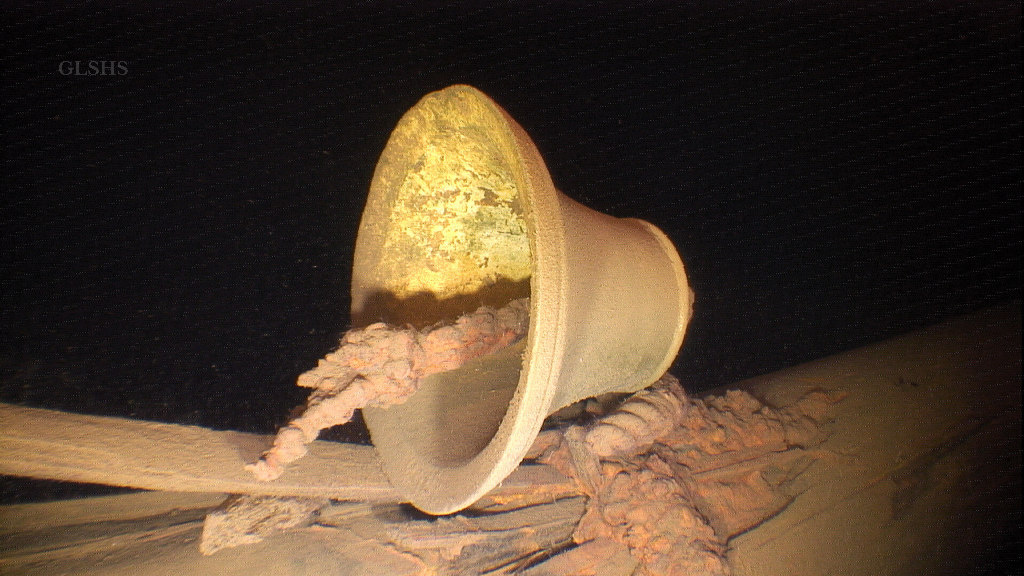
The shipwreck hunters located the bulk carrier last summer using side-scan sonar technology aboard their research boat David Boyd. The investigators later used a remotely operated underwater vehicle to probe the wreck and confirm its identity. The Western Reserve had broken in two. The bow section of the ship rested on the stern section.
“Knowing how the 300-foot Western Reserve was caught in a storm this far from shore made an uneasy feeling in the back of my neck,” said Darryl Ertel, director of marine operations for the society, in a statement. “A squall can come up unexpectedly … anywhere, and anytime.”
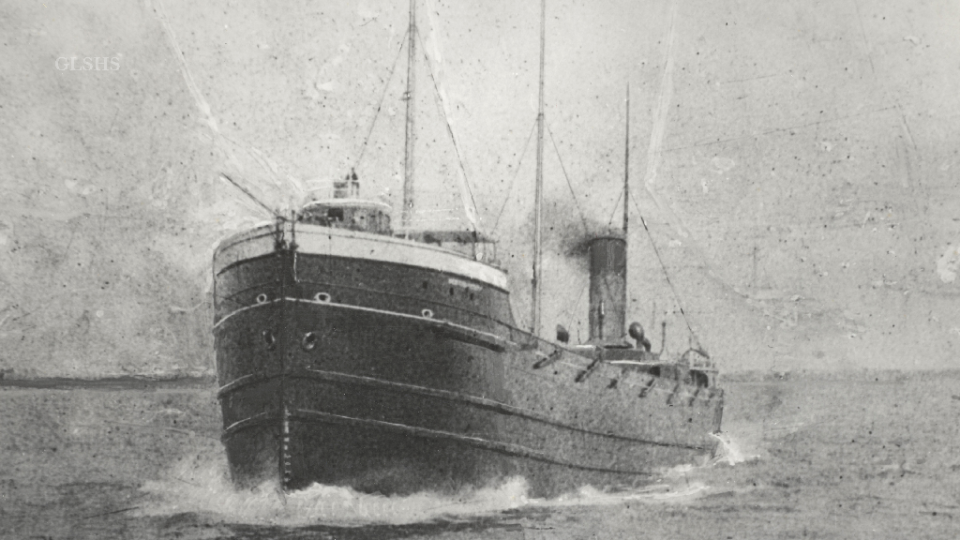
The bulk carrier was built by the Cleveland Shipbuilding Company at a cost of $200,000 and launched Aug. 20, 1890. The ship had beam of 42 feet two inches and depth of 21 feet. Peter Minch, whose family owned the company, designed the ship and was aboard with his family when it sank.
“He invented the type of ship that killed him,” said James Heinz in “The Wreck of the Western Reserve,” Chapter 2 of The Steinbrenner Story, published by the Wisconsin Marine Historical Society, June 23, 2023. Minch’s sister Sophia married a Steinbrenner,
the family that went on to own the American Ship Building Company and later the New York Yankees.
The steel hull allowed the vessel to carry more cargo and made it faster. One newspaper of the times called it the greyhound of the inland seas, according to the press release.
The carrier had been upbound from Sault St. Marie, heading for Minnesota, when the storm reared up around 9 p.m., snapping it in two. It sank in 10 minutes.
The bulk carrier Western Reserve.
Stewart was asleep in his bunk when the Western Reserve broke up, just like sole survivor Dennis Hale when the Daniel J. Morrell went down in 1966 in Lake Huron off the tip of the Thumb. The Morrell and the Carl D. Bradley before it – in 1958 off Gull Island in northern Lake Michigan — broke in two.
Heinz said the Reserve “sank because ‘hogging,’ a condition when a ship headed directly into a heavy sea finds itself supported in the middle by a big wave with the bow and stern suspended in the air.” The bow and stern, each 50 feet out of the water, pulled down on the middle, breaking it in two.
The 21-man crew and six passengers boarded two lifeboats, 17 in the wooden boat, 10 in the steel raft. The steel boat capsized immediately.
The passengers in the wooden boat included Minch, his wife Florence, son Charley, age 10, and daughter Florence, seven, his wife’s sister and her niece. With the help of the wind, barreling out of the north, they managed to row the boat to within a mile of shore, 10 miles from Whitefish Point. Then it too sank.
For a few minutes, Stewart heard the screams of the women, children and men in the icy water. Then everything went silent except for the wind and waves. He managed to swim ashore, sprawling on the driftwood-strewn beach in a state of near-unconsciousness for at least an hour. Then he half-crawled the 10 miles to the station.
Stewart wore a “heavy knit close-fitting jacket which he says alone saved him.”
“On Sept. 1, 1892, an exhausted, soaking wet (Stewart) staggered into the isolated U.S. Lifesaving Service station at Whitefish Point,” wrote Heinz.
Darryl Ertel and his first mate and brother Dan had searched for the Western Reserve for two years.
“Every shipwreck has its own story, but some are just that much more tragic”, reflected Bruce Lynn, GLSHS executive director, in a statement. “It is hard to imagine that Captain Peter G. Minch would have foreseen any trouble when he invited his wife, two young children and sister-in-law with her daughter aboard the Western Reserve for a summer cruise up the lakes.”
Jim Bloch is a freelance writer based in St. Clair, Michigan. Contact him at bloch.jim@gmail.com.
