

By Nathan Layne
BEDMINSTER, New Jersey, Aug 15 (Reuters) – Two years after Republican presidential candidate Donald Trump staged a New Jersey press conference flanked by grocery staples to spotlight inflation under Democrats, food prices are still rising despite his pledge to bring them down. The gap between promise and reality now looms as a vulnerability for Republicans ahead of November’s midterm elections.

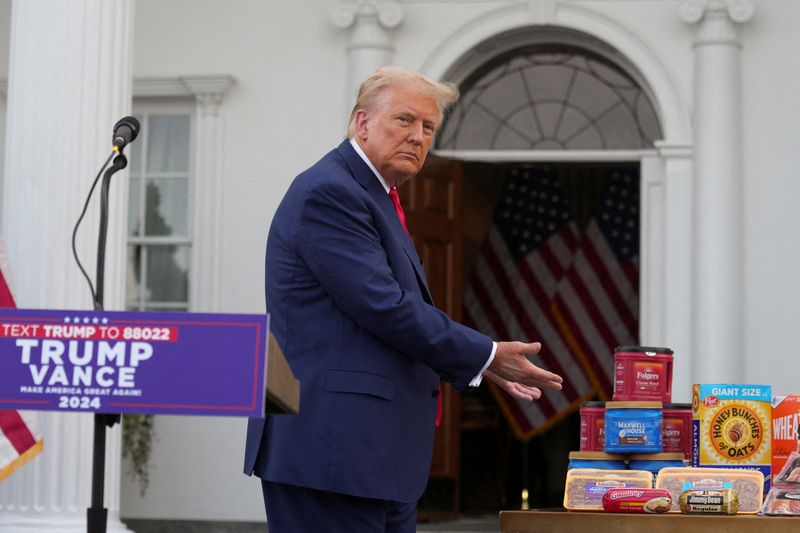
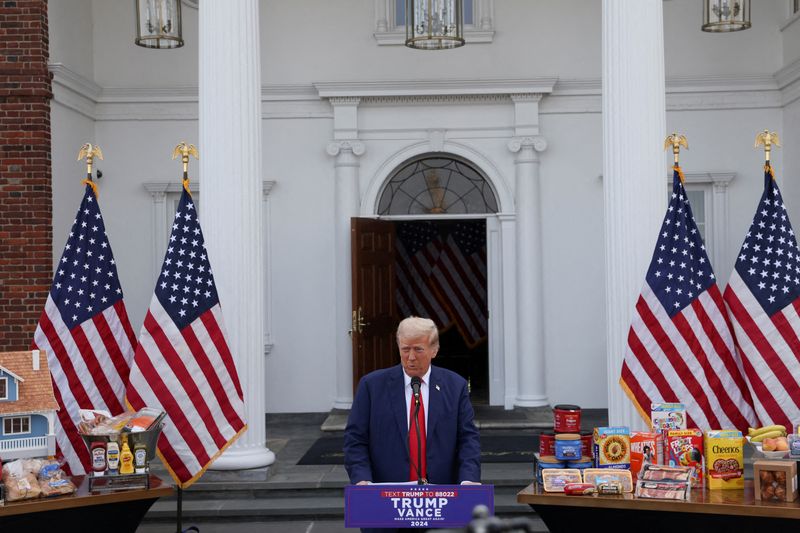
Standing between tables piled high with fruit, beef, cereal, milk and other household staples at his Bedminster golf club on August 15, 2024, Trump blamed the Biden administration for sharp increases in groceries. The spectacle, complete with charts showing higher prices, was aimed at undercutting the Democratic nominee, Kamala Harris, and highlighted Trump’s central promise: he alone could tame inflation and lower the cost of living.
Two years on, higher gasoline and grocery prices are squeezing household budgets and turning the cost of living into the top issue for American voters. Voters now give Democrats a slight edge over Republicans in who they view as better stewards of the economy for the first time in nearly a decade, according to Reuters/Ipsos polling.
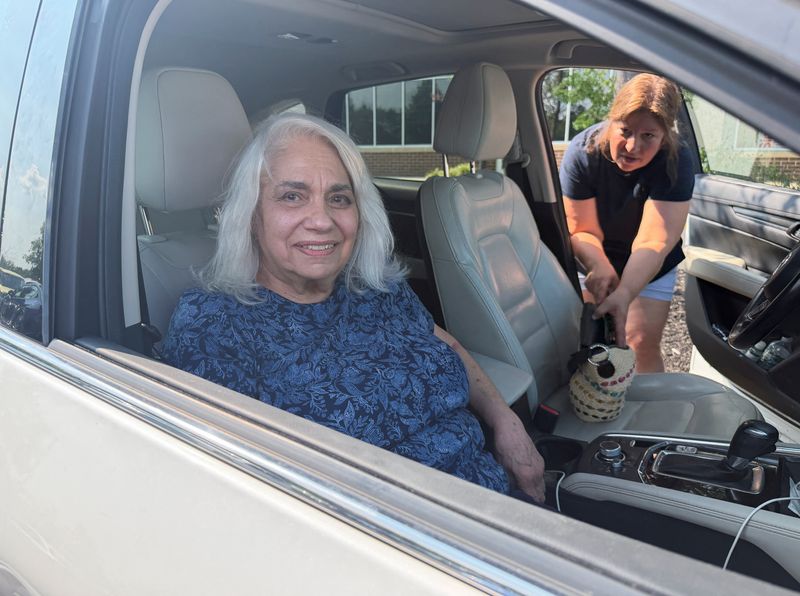
Sheila Carney, a 68-year-old Trump voter, punctuated her frustration with an expletive as she unloaded $70 worth of groceries into her car outside a supermarket not far from Trump’s Bedminster club. The haul was modest: some meat, detergent and a 12-pack of iced tea.
For Carney, the receipt was evidence that the affordability concerns Trump has sometimes dismissed as a Democratic “hoax” remain a daily burden for many Americans.
“This is real. He can say it’s not, but it is,” said Carney, a hospital administration assistant who has delayed retirement while helping pay off her son’s student loans. “He hasn’t brought anything down.”
A Reuters analysis of 26 grocery categories tracked by the Bureau of Labor Statistics and featured in Trump’s Bedminster display found prices have risen 3.4% in the first 19 months of his second term.
That’s less than a quarter of the pace recorded at the same point in former President Joe Biden’s term, but still falls short of Trump’s pledge to lower prices, as surges in coffee, beef and apples have more than offset declines in items including eggs and butter.
A White House official pointed to data on Wednesday that showed U.S. consumer prices barely increased in July from the month before as evidence that inflation is under control.
“The July CPI report is further proof that President Trump’s long-term agenda is delivering: prescription drug and auto insurance costs continue to fall, real wages are rising, and beef prices have cooled while other household essentials like eggs, poultry, and dairy remain low,” the official said.
LACK OF ENTHUSIASM
A registered Republican, Carney said high grocery and gasoline prices due to the Iran war were among the reasons she had grown disillusioned enough to consider sitting out the midterms, underscoring recent polling suggesting Republicans are less enthusiastic about voting than Democrats.
Carney was one of 17 Republicans and independents Reuters interviewed in New Jersey’s 7th Congressional District, a battleground that includes Bedminster and where swing voters and turnout could prove decisive. The race pits Republican incumbent Tom Kean against Democrat Rebecca Bennett, who has sought to capitalize on voters’ frustration over the cost of living.
More than half of those interviewed said they were either undecided or leaning toward Bennett. While grocery prices weighed heavily on many voters, complaints about Kean more often centered on his months-long disappearance from public view earlier this year, which he later attributed to depression.
Their views on the economy mirror those of other Trump supporters Reuters has interviewed in recent months who, despite standing by the president, say financial pressures have dampened their enthusiasm for voting in November. That ambivalence presents another potential challenge for Republicans and raises the stakes for the party’s get-out-the-vote operation.
Francesco Trebbi, a public policy professor at the University of California, Berkeley, recently co-authored research finding that Trump drew stronger support in the 2024 election in counties where inflation outpaced income growth, eroding households’ purchasing power.
With real wages rising only marginally and lagging the pace of broader economic growth, Trebbi said it is likely that pattern will reverse in November.
“I expect the same anti-incumbent shift to happen in 2026, this time possibly weakening Republicans,” he said, describing grocery shopping as a “psychologically salient” reminder of the squeeze on household finances. “Each time one does it, it is the equivalent of a campaign ad against the incumbent.”
TRUMP SUPPORT
To be sure, presidents have limited influence over inflation, which is driven by a range of factors and more directly addressed by the Federal Reserve. And many Republicans appear willing to give Trump the benefit of the doubt, even as his tariffs and the Iran war have contributed to rising prices.
Bonnie Chandler, 64, plans to vote for Kean, saying she believed some companies were keeping prices elevated to make Trump look bad and that the growing influence of the Democratic Party’s progressive faction left her unwilling to consider its candidates.
“I’m going to vote Republican. I’m not a woke person. I’m not a communist. I’m not a socialist,” she said.
Lauren DeGirolamo, a 34-year-old Trump voter, said issues such as education and border security mattered more to her than grocery prices, which she believes have stabilized under Trump following steep increases during the Biden administration.
“I feel grocery prices are pretty much at level with where they were during Biden. I know some of the key things that I look for – eggs – have gone down,” she said, adding that she intended to vote for Republican candidates in November.
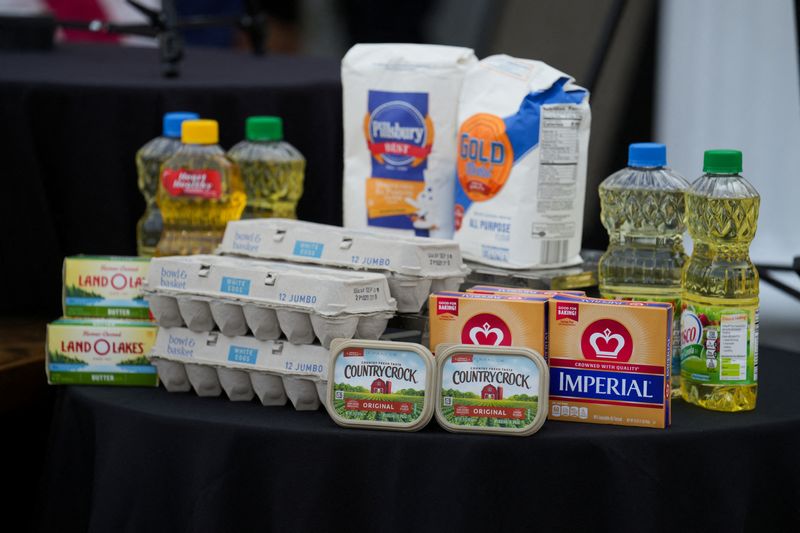
According to BLS data, egg prices have fallen nearly 40% under Trump, reflecting a market correction after avian flu-driven shortages triggered a surge that began during Biden’s presidency. Eggs are among six of the 26 categories showing falls since 2025, along with butter, bacon, and cooking fats and oils.
Yet most of the items Trump displayed at Bedminster are now pricier, some by a lot. Uncooked beef has jumped 19.2%, fresh fish and seafood 8.6%, apples 14%, and coffee nearly 23%.
HITTING CLOSE TO HOME
A Reuters/Ipsos poll that concluded earlier this month found Trump’s net approval rating on his handling of the cost of living was at -47%, down from -6% at the start of his term. It is his weakest issue by a wide margin, trailing his ratings on the economy (-35%) and immigration (-16%).
Bennett told Reuters that if elected she would seek to undo Trump’s tariffs, rein in the Iran war, and restore food stamp benefits to help families struggling to afford groceries.
The issue hits close to home, said Bennett, a military veteran and married mother of two daughters. “This is not an abstract concept to me,” she said. “For example, beef is very expensive, so we don’t buy beef anymore.”
Whether Kean, whose campaign did not respond to requests for comment, can hold on to his seat may depend on voters like Margaret Derkach, who typically votes Republican but is now considering switching her vote if economic conditions don’t improve.
“The cost of living, as far as homes, apartments and food – the necessities – they have gone up. It’s shocking, shocking,” said Derkach, 84, after shopping at discount grocer Aldi.
Though she said Trump “inherited a mess” from Biden, Derkach added, “I am undecided right now. I have to see.”
(Reporting By Nathan Layne in Bedmnister, New Jersey, Dan Burns in New York, and Jason Lange in Washington; editing by Ross Colvin and Alistair Bell)


By Nathan Layne | Reuters | © Copyright Thomson Reuters 2026.
