

By Alexandra Valencia and Yury Garcia
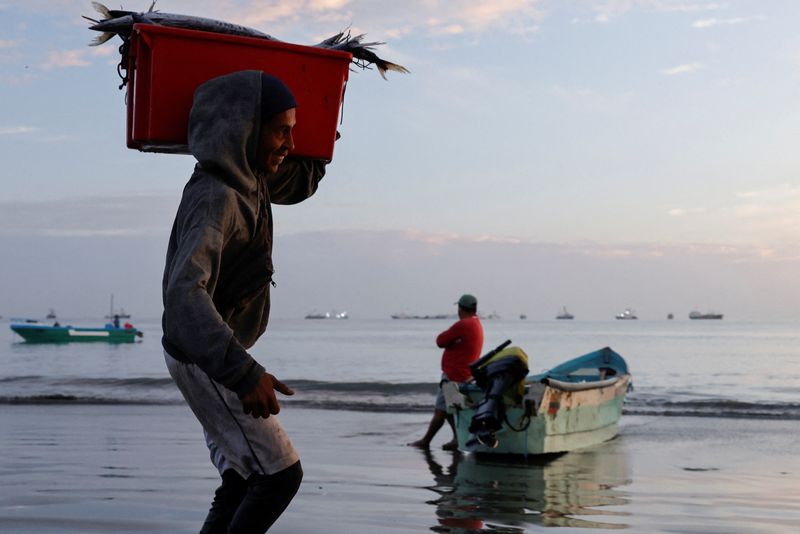
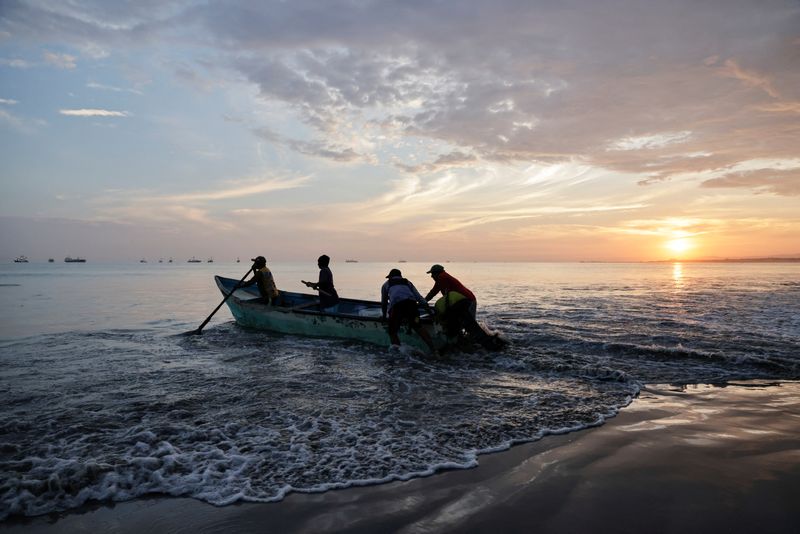
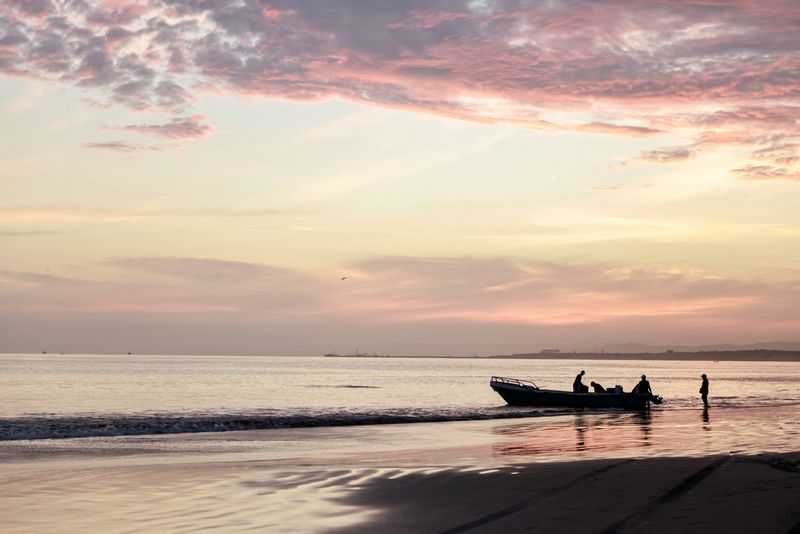
JARAMIJO/SAN MATEO, Ecuador, August 15 (Reuters) – At first light on Ecuador’s Pacific coast, small fishing boats fan out from the villages of San Mateo and Jaramijo, their bows pointed toward deeper waters and the promise of a good catch. Other boats come in from the rolling surf to battered coves, where crews unload baskets of tuna and swordfish and traders rush to inspect the day’s haul.

The scene belies the dangers some fishermen face pushing out into these waters. Onshore, drug cartels have turned the small ports of Ecuador’s Manabi province into a cocaine-trafficking hub, extorting local fishermen who are prized for their navigation skills. The cartels present an impossible choice: earn more than a year’s legal income smuggling drugs, or face extortion, threats and violence.
Offshore, the violence comes without warning – from U.S. airstrikes on alleged “narco-terrorists.” The U.S. military has destroyed 67 vessels and killed more than 220 people since last September, as part of Operation Southern Spear.
The U.S. government has claimed responsibility for those attacks and deaths. Two others it hasn’t claimed – but that bear all the hallmarks of U.S. strikes – involved fishing vessels from Manabi province, according to Reuters interviews with three survivors from one attack and a dozen survivor accounts gathered by the Permanent Committee on Human Rights, a local advocacy group. The Washington Post reported this week that the boats were struck as part of a covert CIA program.
Fisherman Simon Villacreses was among the 16-person crew of the Negra Francisca Duarte II that launched from Manta, the largest town in the province. At sea on March 17, they heard the buzz of a drone overhead just before a strike hit near the galley, setting the boat ablaze. Some crew dove into the Pacific while others jumped into two smaller motorized boats, according to Villacreses and two other survivors.
The crew headed for what they thought was a nearby tuna vessel. Instead, the men said, they were met by armed English-speaking men in military-style uniforms.
“They started pointing guns at us. They took us aboard, put hoods over our heads and tied our hands behind our backs,” said Villacreses, 52, who suffered a head injury in the attack.
The crew was then transferred at sea to a Salvadoran navy vessel, which took them to El Salvador, offered medical treatment, and flew crew members back home on commercial flights, according to the survivors and the rights group.
A similar sequence of events played out nine days later with another drone attack on a boat called the Don Maca, from the same region. At least eight fishermen from a third vessel, the Fiorella, have been missing since January. Two Fiorella crew members who were on a separate, smaller boat told the Permanent Committee they saw smoke coming from the main boat’s last known location.
Three security experts interviewed by Reuters said the United States was almost certainly responsible for the attacks, given the U.S. Southern Command’s ongoing boat-strike campaign in the area.
Since last year, the United States, Ecuador and El Salvador have announced they are stepping up maritime counter-narcotics cooperation in the eastern Pacific, a key cocaine corridor for northbound shipments. The effort includes intelligence-sharing, surveillance and coordinated interdictions.
The U.S. Department of Defense directed questions about the strikes to the U.S. Southern Command, which declined to comment citing “operational security and force protection reasons.”
Ecuador’s President Daniel Noboa did not respond to Reuters’ request for comment and the military said information about drug enforcement was classified. El Salvador’s navy did not respond to comment requests but said in a March 23 Facebook post that it had rescued 16 shipwrecked Ecuadoreans.
Villacreses remains so shaken by the experience he has yet to return to sea.
“Maybe I’ve given up fishing for good,” he said.
EXTORTING $1,200 IN ‘FEES’ TO KEEP FISHING
The Negra Francisca was usually anchored in San Mateo, a port town where most residents live in poverty.
In recent years, two of Ecuador’s most powerful criminal organizations — Los Choneros and Los Lobos — have expanded in coastal areas, forcibly recruiting fishermen for smuggling, according to Ecuadorean anti-narcotics officials, provincial police and residents.
The United States last year designated the two organizations as terrorist groups. Both are connected to Mexican drug-trafficking organizations; Los Choneros is aligned with the Sinaloa cartel while Los Lobos has ties to the Jalisco New Generation cartel.
Police and local people said fishermen who don’t cooperate are often forced to pay ‘fees’ of $1,200 per fishing trip — three or four times their earnings in an average month, locals say — or risk retaliation against themselves and their families.
If they do transport cocaine, they can earn as much as $40,000 a trip, according to fishermen in San Mateo and Jaramijo, their relatives and police. Asked about the alleged extortion, Ecuador’s national police said: “Some fishermen are forced to take part in these activities, exposing themselves both to law enforcement action and reprisals from the criminal organizations.”
Ecuadorean police estimate about 300 Jaramijo residents have been jailed in U.S. and Salvadoran prisons on drug-trafficking charges over the last five years.
Maria Mero, who is married to a fisherman from the Fiorella, said some men were cutting back on trips because of threats from traffickers and military strikes. “The fishermen don’t even want to go out now,” she said.
Other fishermen told Reuters they fish at night or alter routes to avoid extortion attempts. A San Mateo fisherman said he had paid extortion fees four times. In return, he said the gang provided coordinates of a route he was allowed to sail and urged him to keep his lights on so he wouldn’t be approached for another payment. Smaller boats fishing closer to shore are charged less and given a type of ID to show they’ve paid the extorted fees, he said.
BANANA BOATS AND TUNA TRAWLERS
The joint drug-enforcement efforts of the United States, El Salvador and Ecuador coincide with Southern Spear, the U.S. airstrike campaign, and Operation Pacific Viper, a parallel U.S. Coast Guard crackdown.
While the Southern Command has published night-vision videos of targeted boats bursting into flames, it has generally only disclosed casualty figures and limited information about survivors.
Leonel Pilay, 21, who was injured along with Villacreses in the March 17 attack, said the crew wasn’t running drugs and its boat had been boarded and searched by Ecuador’s Coast Guard hours before the drone strike.
“We are fishermen,” he told Reuters. “The Ecuadorean coast guard boarded us, searched us, found nothing.”
The crew of the Don Maca also reported being struck by a drone in Ecuadorean waters, according to accounts gathered by the Permanent Committee on Human Rights. They told a similar story – being picked up by people they believed to be Americans and turned over to a Salvadoran navy boat before they, too, were repatriated.
Mike Vigil, the former international operations chief of the U.S. Drug Enforcement Administration, said there was “abundant evidence” that the U.S. Southern Command carried out the boat strikes from the survivors’ testimony and what he called a “distinctive military footprint.”
He noted that Ecuador’s Navy doesn’t have the drone technology to conduct strikes.
Renato Rivera, a senior analyst at the Geneva-based Global Initiative against Transnational Organized Crime, and Wagner Bravo, former head of Ecuador’s army, agreed that it was likely the U.S. conducted the strikes on the two boats because of their location, the ongoing U.S. campaign of attacks on alleged drug boats and the lack of any other actor in the region capable of such airstrikes.
‘EVERYONE IS REPLACEABLE’ IN THE COCAINE TRADE
The United States and Ecuador say high-seas interdictions are critical to fight drug traffickers, and both countries have celebrated major seizures this year. Defense Secretary Pete Hegseth said Southern Spear would “secure our Homeland from the drugs that are killing our people.”
The U.S. Coast Guard said its parallel anti-narcotics campaign had resulted in the seizure of 91,000 kg of cocaine and arrests of 160 suspected traffickers through April. A joint operation of the Coast Guard and Ecuadorean navy in March recovered 760 kg of cocaine from an Ecuador-flagged tuna vessel, about 6% of the total seized offshore of Ecuador in the first half of 2026.
But such efforts are unlikely to slow cocaine trafficking as long as the cartels have a large pool of fishermen to recruit and extort, said Vigil, the former DEA official. “Blowing up these boats is not going to stop anything,” he said.
And despite the cartels’ increased use of small fishing vessels, the vast majority of cocaine shipments continue to move through big commercial ports, said Michelle Maffei, an organized-crime expert at the University of Guayaquil in Ecuador.
“The current government, together with the United States, is placing too much emphasis on go-fast boats,” she said. “The fact that they are drawing more fishermen, more people living in poverty and more vulnerable people into this activity is not going to stop simply because they are dropping bombs at sea.”
The drug traffickers can simply replace those who are killed or arrested.
“Organized crime understands a central reality,” she said. “Everyone is replaceable.”
(Reporting by Alexandra Valencia in Jaramijo and Yury Garcia in Guayaquil, Editing by Julia Symmes Cobb and Suzanne Goldenberg)
By Alexandra Valencia and Yury Garcia | Reuters | © Copyright Thomson Reuters 2026.
