By Gayatri Suroyo and Ananda Teresia
JAKARTA, May 20 (Reuters) – Indonesia’s central bank raised its policy interest rates by a larger-than-expected 50 basis points at a policy review on Wednesday, as it works to support the rupiah currency which has fallen to a series of record lows in recent days.

Raising rates for the first time in two years, Bank Indonesia (BI) lifted its benchmark 7-day reverse repurchase rate by 50 basis points to 5.25%, double the size of hike expected by economists in a Reuters poll.
It also raised the overnight deposit facility and lending facility rates by the same amount, to 4.25% and 6.00%, respectively.
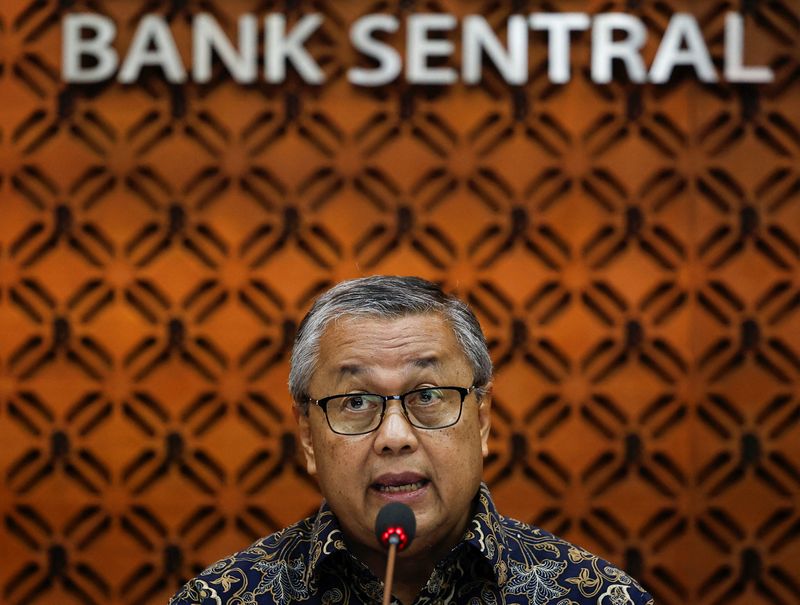
“The increase is a further step to strengthen the stabilisation of the rupiah exchange rate amid global volatility due to the Middle East war, as well as a pre-emptive measure to keep inflation within the target range in 2026 and 2027,” Governor Perry Warjiyo said in an online press conference.
The rupiah has repeatedly hit new record lows against the dollar recently with investor concerns about the economic fallout from the Iran war compounding unease over Jakarta’s spending plans, the independence of its central bank and transparency in the capital markets.
“We think the bold 50 basis point hike by BI not only shows the shift of priority to FX stability but also displays BI’s maintained credibility and independence,” said Rangga Cipta, chief economist of Mandiri Sekuritas.
“The chance for another hike is there depending on the rupiah, but we don’t think it’s the beginning of a long hiking cycle as domestic investment remains weak and GDP growth is still below potential.”
Warjiyo said BI would make sure banking liquidity remained ample to cushion the impact of the rate rise on economic activity.
RECORD LOW AHEAD OF DECISION
The rupiah hit a record low of 17,745 per dollar in morning trade on Wednesday. It was trading at around 17,600 per dollar soon after the BI decision, and has fallen by about 6% against the U.S. dollar so far this year to rank among the worst performing currencies in emerging Asia.
Indonesia’s foreign exchange reserves have declined by $10 billion in the year to April, partly due to intervention by BI to defend the rupiah.
Warjiyo said the central bank’s rate hike, market intervention and moves to attract capital inflows would help stabilise the rupiah. He said dollar demand was high at present because companies were repatriating dividends and repaying foreign debt, while there was also consumer demand related to the annual Muslim hajj pilgrimage to Mecca.
“We believe there will be big inflows coming in that will meet the FX demand,” he said. “This is why we believe the exchange rate will stabilise in June and will tend to strengthen in July and August.”
Earlier on Wednesday, President Prabowo Subianto unveiled ambitious targets for next year’s fiscal deficit and economic growth, and vowed to strengthen institutions.
The government has so far shielded most consumers from rising fuel prices by increasing subsidies, which helped keep inflation in April at 2.42%, comfortably within BI’s target range of 1.5% to 3.5%.
Warjiyo said while inflation was low, there were pressures from rising global energy costs, and so BI was strengthening its policy mix to ensure inflation would stay within target until 2027.
BI maintained its 2026 economic growth forecast for Southeast Asia’s largest economy at a range of 4.9% to 5.7%.
(Reporting by Gayatri Suroyo and Ananda Teresia; Writing by John Mair; Editing by David Stanway)