By Sarah Kinosian and Karin Strohecker
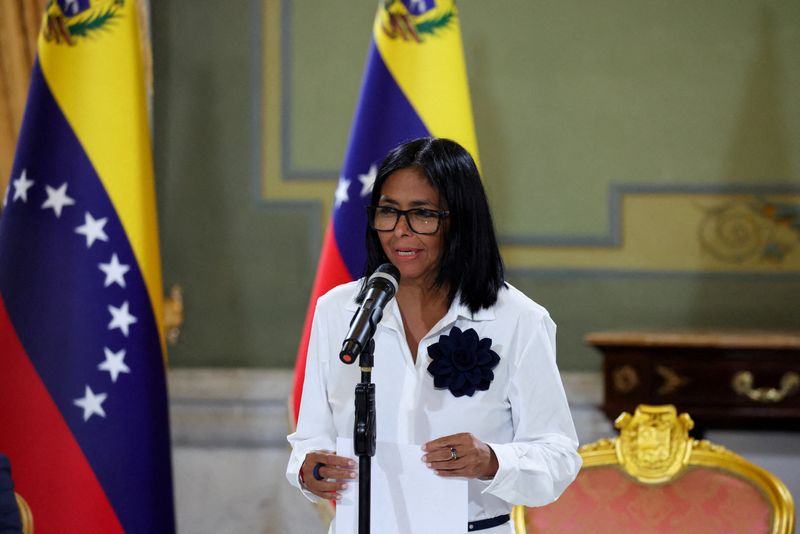
CARACAS/LONDON, May 27 (Reuters) – When interim Venezuelan President Delcy Rodriguez’s administration announced the oil-rich country was embarking on an overhaul of its more than $150 billion in debt, it committed to transparency, an approach that would mark a break with previous governments.

But the appointment of U.S. firm Centerview Partners as adviser this month has awarded one of the most coveted debt roles in decades without a formal competitive process, according to eight people with knowledge of the hiring, raising questions among investors and officials about fairness and transparency. Centerview, a relative newcomer to sovereign restructurings that has expanded over the past decade by poaching talent from Lazard and other firms, stands to gain prestige and earn tens of millions of dollars in fees.
As Venezuela’s adviser, Centerview will be tasked with hammering out the government’s financial strategy and leading talks on its debt, which the country defaulted on under former President Nicolas Maduro in 2017. At stake are billions of dollars Venezuela owes to creditors earmarked for a writedown, whose size will be crucial in determining the sustainability of the country’s finances and its economic health.
Adding to concerns about the debt restructuring are questions about the role played by an investor, Mauricio Claver-Carone, in clinching Centerview’s hire, according to seven of the people.
Claver-Carone was briefly a Latin America envoy in the first administration of U.S. President Donald Trump and for about four months in the second, but has no current official role.
TRUSTED, AMERICAN FIRMS WANTED: ADVISER
Claver-Carone told Reuters he had been helping the U.S. government implement and execute Venezuela policy since July. He said he vouched for Centerview when Rodriguez and other U.S. or Venezuelan government officials asked his opinion about the firm, while not endorsing it.
“How does an open process work in Venezuela? What else right now has an open bidding?” Claver-Carone said when asked about the lack of a formal competitive process, adding that the Venezuelan government had spoken with other firms. “We want American firms that can work with the U.S. government, that have worked with the U.S. government, that can be trusted.”
A spokesperson for the firm said, “Centerview was hired by Venezuela because our team is the world leader, with unique experience working on the largest sovereign-debt restructurings and no conflicts of interest.”
Claver-Carone was “not involved in our pitch for the business and we don’t have any financial or other relationship” with him, the spokesperson added.
Venezuelan officials did not respond to a request for comment.
A U.S. State Department spokesperson said Claver-Carone is an expert with contacts in the region and “as a good U.S. citizen, routinely consults and shares his perceptions with U.S. officials.”
This account of how Centerview clinched the assignment is based on interviews with sources in the government, diplomatic and financial spheres who are close to the situation and spoke with Reuters on condition of anonymity due to the sensitivity of the matter. The Washington Post earlier reported aspects of Claver-Carone’s role and Centerview’s hiring.
MADURO CAPTURE OPENED OPPORTUNITIES
The U.S. capture of Maduro on January 3 set the stage for reopening the Latin American country, home to the world’s largest proven oil reserves, after years of crippling sanctions and deepening economic crisis.
Washington’s licensing powers and dominance in global finance and energy markets give it broad leverage over the country’s economy, shaping investments and trade flows.
Scores of investors and advisers have travelled to Caracas to scout for opportunities.
The city’s five-star hotels are brimming with investors discussing deals ranging from real estate to furniture and rare earth minerals.
While memorandums of understanding are being signed, it is unclear how many become contracts amid uncertainty over the rule of law and high asset prices, four lawyers and financial advisers told Reuters.
Centerview executives met with officials in Caracas as early as February and returned several times through May, three of the sources said.
Led by veteran banker Matthieu Pigasse, Centerview’s team includes Charles Albinet and Hamouda Chekir, bringing decades of experience in sovereign debt restructurings, including advising nations from Argentina to Congo Republic to Greece, the largest-ever sovereign debt restructuring.
Often dubbed “left‑leaning” in the press, Pigasse, 58, is a high-profile French banker whose clients have included blue-chip companies L’Oreal and Kering. A self-described punk music fan, Pigasse in France owns media holding Combat and retains a stake in newspaper Le Monde.
In recent weeks, Pigasse has appeared in several media outlets, positioning himself against what he describes as the growing influence of a right‑leaning media network in France.
Asked to comment on how Centerview was chosen, Pigasse told Reuters: “I have known Delcy Rodriguez and worked with her for the past 15 years.”
SOME RIVALS NOT FORMALLY APPROACHED
Pigasse got his start at leading firm Lazard, where he, Chekir and Albinet advised governments.
Yet major debt advisory players – including firms such as Lazard, Rothschild and Alvarez & Marsal – were not approached formally to compete for the Venezuela mandate, according to four sources.
Hiring an adviser without a formal selection process is unusual, according to three of the people.
Officials for Lazard, Rothschild and Alvarez & Marsal declined to comment.
Some point to the role played by Claver-Carone, now managing partner of LARA, the Latin America Real Assets Opportunity Fund. LARA invests in energy, infrastructure and industrial assets across Latin America and the Caribbean.
But appearing to act with the blessing of the U.S. government despite having no formal role is raising concerns among investors and Venezuelan politicians, said the people.
Claver-Carone said his business partner, Jessica Bedoya, a former colleague when he headed the Inter-American Development Bank, had met with Rodriguez on U.S. policy relationships and security issues.
Now that the U.S. is re-establishing diplomatic relationships, Claver-Carone said he hoped his role would soon end.
Claver-Carone said he has no financial interests in Venezuela or in Centerview.
Bondholders are expecting Venezuela to continue moving quickly and seek an agreement with creditors by the end of 2027.
(Reporting by Sarah Kinosian in Caracas and Karin Strohecker in London; Additional reporting by Libby George, Mathieu Rosemain; Editing by Elisa Martinuzzi, Christian Plumb and Rod Nickel)