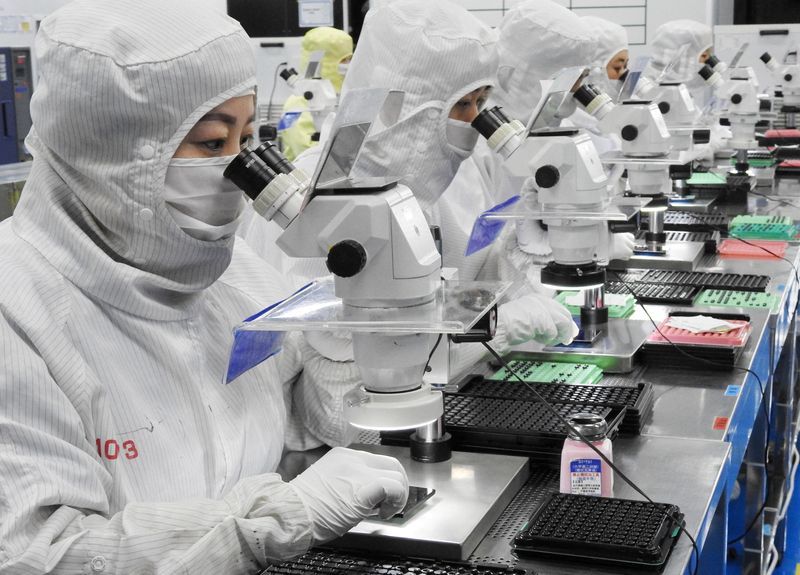
BEIJING, April 29 (Reuters) – China’s factory activity likely grew at a slower pace in April as rising cost pressures stemming from the Middle East conflict test Beijing’s reliance on manufacturing to underpin economic growth.
The official manufacturing purchasing managers’ index (PMI) is expected to drop to 50.1 from 50.4 in March, according to the median forecast in a Reuters poll of 27 economists.

The April PMI reading, based on a National Bureau of Statistics survey of companies and set to be released on Thursday, will offer a fresh gauge of how the world’s second-largest economy is faring as the U.S.-Israeli war on Iran jolts energy markets and disrupts supply chains.
Economic data for the first quarter suggested that spillover from the war was relatively contained, cushioned by ample strategic oil reserves, a diversified energy mix and robust global demand for China-made electronics.
Gross domestic product grew 5% in the first three months, hitting the upper range of Beijing’s annual growth target, despite a slowdown in goods exports in March. Profits at China’s industrial firms grew in March at their quickest pace in half a year.
The run of upbeat data has eased pressure on policymakers to rush major stimulus despite persistent weakness in domestic demand and the job market.
Credit ratings agency Moody’s echoed that view on Monday, revising China’s outlook to “stable” from “negative”, citing resilient economic and fiscal strength.
China’s central bank last week kept benchmark loan prime rates unchanged for the 11th consecutive month, as momentum at the start of the year and a pick-up in inflation reduced the need for fresh monetary easing to support the broader economy.
But as the Iran war drives up input costs and threatens the global growth outlook, China’s manufacturing sector may not be able to stay insulated.
Factory-gate prices in China reversed a 41-month deflationary streak in March, with prices surging in energy-intensive industries such as non-ferrous metal mining. However, inflation driven by higher costs rather than stronger demand poses risks to growth, and according to ANZ analysts is “not friendly to the economy.”
In a meeting earlier this week, China’s top leaders said the country’s economy achieved a strong start in 2026 but also faced difficulties and challenges. They pledged to strengthen energy security while pursuing technological development and greater self-sufficiency.
(Reporting by Yukun Zhang and Joe Cash; Polling by Rahul Trivedi and Renusri K in Bengaluru and Jing Wang in Shanghai;Editing by Shri Navaratnam)