By David Milliken and Suban Abdulla
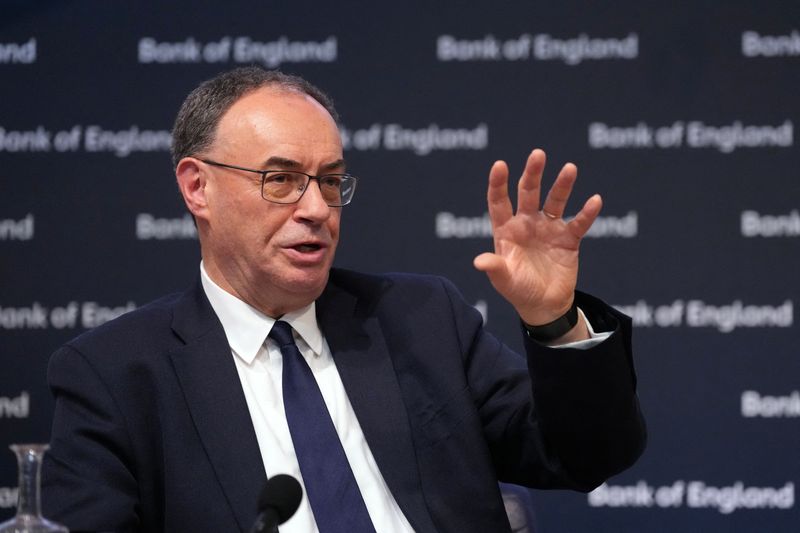
LONDON, June 2 (Reuters) – Bank of England Governor Andrew Bailey said on Tuesday it was important to get UK inflation back to target and give households confidence about the central bank’s ability to do so.

Asked if having inflation above 2% for most of the 2020s meant the BoE had to rethink its price-targeting framework, Bailey said: “We have to focus more on how we manage the path back to target, and … ultimately get there because we’ve got to give the public confidence that the target is for real.”
Bailey, speaking at his annual appearance before the House of Lords’ Economic Affairs Committee, also said the answer to target misses was not to raise the inflation target to 3%.
British consumer price inflation fell to 2.8% in April and the BoE expects it to near 4% by the end of 2026, assuming energy prices fall gradually over the course of the year.
Under the central bank’s more adverse scenario, where energy prices increase further and there are widespread price rises for other goods and services, it forecast inflation could exceed 6% in early 2027, although that is still well below the peak of more than 11% reached in October 2022.
“It is enormously frustrating … I was expecting that I would be able to be here this afternoon, we would be at the inflation target, and I think the evidence bears out that we would have been. (But) we’re not, and I think the overshoot is pretty much entirely due to events in the Gulf,” Bailey said.
But there were some signs in figures published on Monday that the energy price shocks from the Middle East conflict may have less of a lasting impact than initially looked to be the case.
Public expectations for inflation in the coming years softened in May after reaching the highest since 2023 in March, although they are still higher than before the conflict.
Bailey voted to keep interest rates unchanged at 3.75% in April, when he was among an 8-1 majority, and last week said higher market interest rates gave the BoE time to decide if it needs to raise rates in response to the inflation shock from the Iran war.
Investors on Tuesday saw a roughly 90% chance that the BoE will keep borrowing costs unchanged this month, and were pricing in one or possibly two rate hikes by the end of the year.
(Reporting by David Milliken and Suban Abdulla; additional reporting by Muvija M; Editing by Hugh Lawson)