By Isla Binnie and Chuck Mikolajczak
NEW YORK, April 16 (Reuters) – Global stocks rallied to a fresh record on Thursday as the announcement of a ceasefire between Israel and Lebanon boosted sentiment, but oil prices also rose as global supply buffers continue to dwindle with the key Strait of Hormuz still blockaded.

U.S. President Donald Trump announced that Lebanon and Israel had agreed on a 10-day ceasefire, saying the next meeting between the U.S. and Iran may take place over the weekend. Negotiators have scaled back some of their ambitions for those talks, two Iranian sources told Reuters, as the U.S. Navy is also now preventing Iranian vessels from transiting the strait.
Israel has been waging a parallel campaign against Iran-backed militant group Hezbollah in Lebanon. Trump, in a post on Truth Social on Thursday, said that Israeli and Lebanese leaders had agreed to begin a 10-day ceasefire.
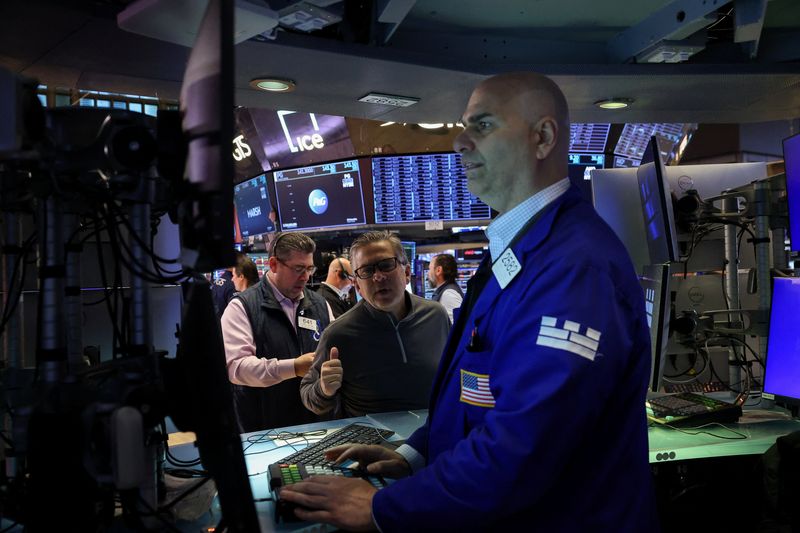
U.S. stocks advanced, with the S&P 500 and Nasdaq Composite closing at records for the second consecutive session, led by a 1.6% increase in the S&P 500 energy index. The Nasdaq has now climbed for 12 straight sessions, its longest winning streak since July 2009.
MSCI’s gauge of stocks across the globe rose 3.26 points, or 0.3%, to 1,064.19 after hitting an intraday record of 1,065.59, while the pan-European STOXX 600 index edged down 0.05%.
A PULLBACK IN THE OFFING?
The market’s surge has some investors believing that equities are due to retrench a bit.
“The war is still the single most important driver of the market. It would be very unusual for us to break through to new all-time highs like we did yesterday and not stall here and probably go back and retest,” said Robert Phipps, a director at Per Stirling Capital Management in Austin, Texas.
“The rubber band was very stretched to the downside. It has snapped back and is no longer stretched to the downside.”
Crude futures have bounced all over the place in recent days, often swinging on the latest optimistic pronouncement from Trump over an imminent end to the conflict that would see the Strait of Hormuz – used to move one-fifth of the world’s oil and gas supply – reopened.
On Thursday, oil climbed, with U.S. crude settling up 3.7% to $94.69 a barrel, while Brent settled at $99.39 per barrel, up 4.7%.
The Dow Jones Industrial Average rose 115 points, or 0.2%, to 48,578.72, the S&P 500 gained 18.33 points, or 0.3%, to 7,041.28 and the Nasdaq Composite climbed 86.69 points, or 0.4%, to 24,102.70.
U.S. beverages giant PepsiCo gained 2.3% after surpassing quarterly profit estimates. Healthcare company Abbott Laboratories, brokerage Charles Schwab and insurer Travelers all lost ground after reporting results.
The U.S. dollar rose, retracing some of its recent losses, after weekly U.S. initial jobless claims were lower than expected last week. The index, which measures the greenback against a basket of currencies including the yen and the euro, rose 0.22% to 98.22.
The index had declined for eight straight sessions through Wednesday, giving up most of the gains it had enjoyed as the war increased its appeal as a safe haven.
Gold prices were little changed. Spot gold edged up 0.02% to $4,790.79 an ounce while U.S. gold futures rose 0.08% to $4,803.70 an ounce.
(Reporting by Isla Binnie in New York and Marc Jones in London; additional reporting by Sinéad Carew in New York, Editing by Hugh Lawson, Andrew Heavens, Nia Williams and David Gaffen)