By Gianluca Lo Nostro and Akash Sriram
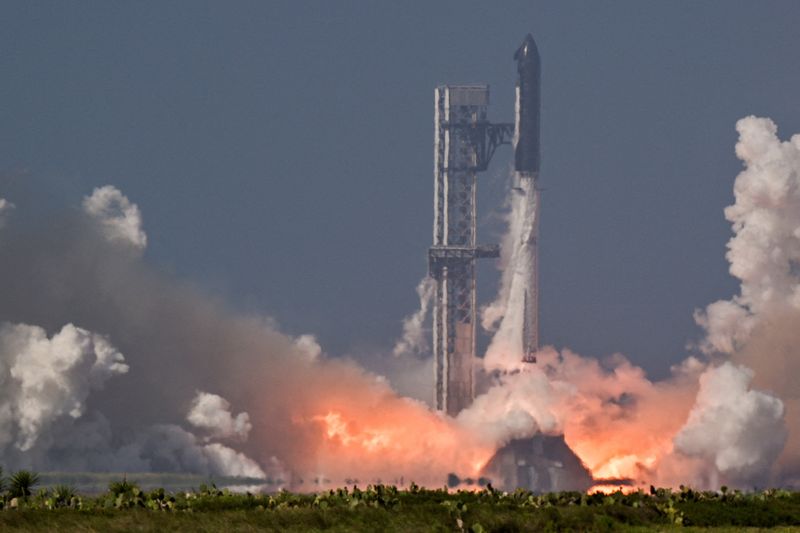
May 27 (Reuters) – SpaceX’s upgraded Starship launch on Friday delivered enough progress to keep the momentum intact behind Elon Musk’s $1.75 trillion IPO, while warning that full reusability of the rocket remains a work in progress.

Starship is critical to lowering SpaceX’s launch costs, expanding its Starlink satellite business – its cash engine – and supporting future undertakings such as space-based computing, deployment of orbital AI data-center satellites and human missions to the moon and potentially Mars.
“SpaceX did not need perfection from this Starship flight. It needed proof that the upgraded vehicle is moving in the right direction, and that is largely what investors saw,” said Mark Vena, CEO at SmartTech Research.
The company has spent more than $15 billion developing what it hopes will become a fully reusable rocket capable of carrying far larger payloads than existing launch systems.
SpaceX’s 12th test flight of a Starship prototype since 2023, and the first of its V3 iteration, was successful on most counts on Friday. It deployed a clutch of mock satellites and executed a controlled splashdown of the spacecraft in the Indian Ocean. But it failed to achieve a controlled landing of the Super Heavy booster, which tumbled into the Gulf of Mexico.
Even an imperfect test can strengthen the investment case if it demonstrates measurable progress toward full reusability, Vena said.
Investors, analysts and fund managers are heavily bullish on the IPO, betting that Musk, known for turning high-risk engineering bets into dominant businesses, will deliver the highly ambitious promises he has made in SpaceX’s IPO filing.
“Full reusability is the key to unlocking dramatically lower launch costs,” said James Bruegger, chief investment officer at British investment firm Seraphim Space. “That’s where the real value lies.”
The company itself has warned that delays in development or cost targets could hinder deployment of next-generation satellites and AI infrastructure as they drive up costs, echoing concerns from a few investors that Starship could get trapped in a cycle of fixes and fresh failures, never quite proving an end-to-end working system.
“What we saw with the Starship launch is that it reduced the bear case risk that the Starship is stuck in a failure loop. So it doesn’t completely eliminate the execution risk,” said Jesse Nacht, a research associate at MarketVector Indexes. “Unless something were seriously catastrophic, I don’t think it would change expectations all too much.”
‘LUKEWARM SUCCESS’
Antoine Grenier, partner and head of space consulting at Analysys Mason, said “lukewarm success” was a good outcome, and possibly the best one.
“Total failure would have been problematic, total success would have triggered enormous IPO excitement,” he said.
Grenier added the seven-month gap since the previous flight meant SpaceX needed to launch before the IPO because not doing so “would have raised more questions” for investors evaluating the company’s execution pace.
A roadshow for the widely anticipated IPO is set for June 4, and if successful, the offering could raise as much as $80 billion, making it the largest ever.
Investors are increasingly evaluating SpaceX not just as a launch and satellite company, but as a future AI infrastructure provider.
Musk on Tuesday defended the trajectory of xAI, noting the three-year-old company is still in its infancy compared to rivals OpenAI and Anthropic, while vowing that its models “will be great.”
For now, analysts said SpaceX remains some distance from proving Starship can operate reliably and economically at scale.
“Obviously, SpaceX will need to demonstrate a successful launch, payload deployment, orbits and touchdown of the booster and the vehicle in order to enable deployment of the system at scale to construct a megaconstellation of orbital data centers,” said Austin Moeller, managing director of equity research at Canaccord Genuity.
(Reporting by Gianluca Lo Nostro and Akash Sriram; Editing by Sayantani Ghosh and Jamie Freed)