By Fred Fuller

I discovered an interesting local story when Dennis Adams, who attended a family history presentation I gave to the Capac Historical Society in February, asked me about a man he had heard was buried in the West Berlin Township Cemetery in St. Clair County. I had mentioned in my talk that two of my great-great-grandparents were buried in that cemetery. Dennis said he was told by a sexton at the cemetery that a man buried there had supposedly saved George Armstrong Custer’s life during the Civil War Battle of Gettysburg. I told Dennis I’d look into the story if he gave me the details, which he did later in a phone message.
As you probably know, George Armstrong Custer was the infamous Indian fighter who died in “Custer’s Last Stand,” at the Battle of the Little Bighorn in Montana in 1876. Custer was born in Ohio, but his family moved to Monroe, Michigan, when he was young, and he lived in Monroe for much of his childhood. He married a woman from Monroe, Elizabeth Bacon, who, for many decades following his death, promoted his myth as a hero, in books, articles, and speaking engagements.

Custer’s road to fame began during the Civil War (1861-1865). Due to his brash and aggressive military tactics, he rose quickly through the ranks to Brigadier General in command of the Michigan Cavalry Brigade, known as the “Wolverines.” At the age of 23, he was one of the youngest generals in the Union Army. He led cavalry charges at Gettysburg that helped win that crucial battle. And he began a lifelong pursuit of publicity. He’s been called one of the first “media personalities.” In recent years, however, history has not judged him kindly, recognizing the atrocities he committed during the Indian Wars out West in the late 1870s.
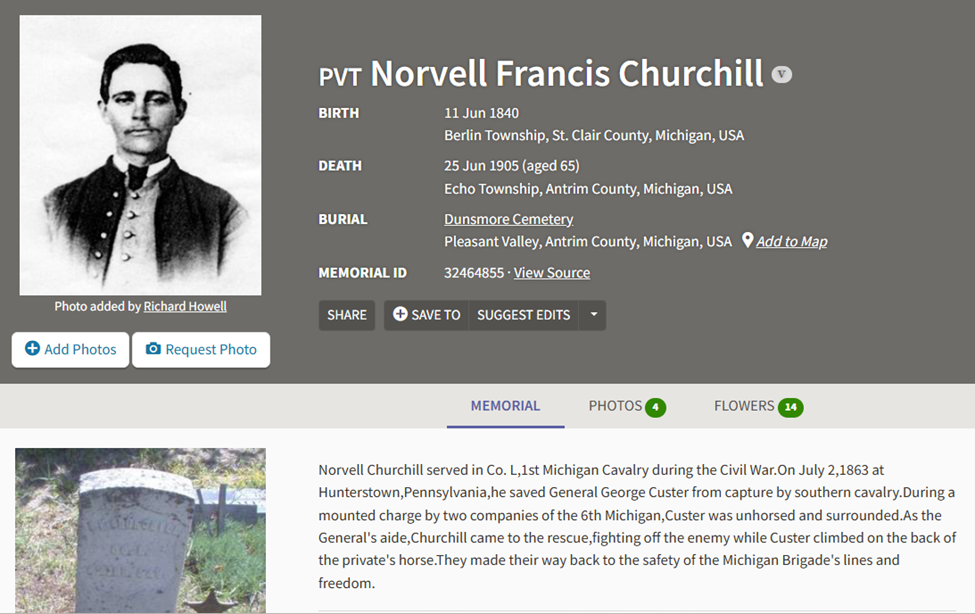
It turns out the man who saved Custer’s life, Norvell Francis Churchill, is not buried in the West Berlin Cemetery, but he was born in Berlin Township, and his parents and several siblings are buried there. After the Civil War, Norvell homesteaded 160 acres in Antrim County, Michigan, which was partially a benefit from his military service, so he is actually buried in Antrim County.
Norvell’s parents, David Churchill and Zoe Edgerton, are buried in the West Berlin Cemetery, as are other members of their families, including four other children: Warren D. Churchill, Louisa A. Churchill, Judson N. Churchill, and an infant, Cyrus Churchill.
Judson N. Churchill, Norvell’s brother, also fought in the Civil War and died of typhoid pneumonia at the army regimental hospital in Murfreesboro, Tennessee, on January 11, 1865. Another brother, Peter A. Churchill, was discharged from the Union Army for disability at Murfreesboro on May 22, 1865. He eventually moved to Tuscola County, where he’s buried. A third brother, Nelson Churchill, also served in the Civil War, enlisting just as it ended in 1865. He’s buried in Lansing, Michigan.
This story became even more interesting to me when I read that Judson Churchill and Peter Churchill enlisted in Company H of the Reorganized Fourth Michigan Infantry in 1864, at Pontiac. That sounded familiar. It turns out they were in the same company as my great-grandfather from Capac, Joseph Locke!
It is apparently true that Norvell Churchill saved General Custer’s life. The story is recounted in numerous histories. Norvell was the only one of the Churchill brothers who joined the cavalry, and he served in the Michigan Brigade under Custer. On July 2, 1863, at the Battle of Hunterstown in Pennsylvania, on the road to Gettysburg, Custer led a small company of the Michigan Cavalry in a charge against a much larger unit of Confederate cavalry. Norvell Churchill was Custer’s orderly at the time and was part of that charge. There are various versions of the story. Most say that Custer was baiting a trap with his attack, and he retreated with the Confederates in pursuit, leading them back to where the rest of his brigade was waiting to ambush them. But Custer lost half his men to Confederate gunfire in this retreat. His own horse was hit, and he fell to the ground with it. Now, Custer was on foot, with the Confederate cavalry bearing down on him. Norvell Churchill galloped back to help him. According to most accounts, Norvell blocked an enemy’s saber swung at Custer and then shot the attacker. He then pulled Custer onto the back of his horse and rode back to the rest of the Michigan Brigade, which ambushed the Confederates and caused them to retreat, suffering many casualties.
How might history have been changed if Norvell Churchill had not rescued Custer? Custer would likely have been killed or, at the very least, have been captured. Custer’s additional heroics the following day at the Battle of Gettysburg would not have happened, and the outcome of that crucial battle might have been different. Furthermore, Custer’s fame and his role in the Indian Wars would have probably been different if he’d been a prisoner and not a Civil War hero, and of course, non-existent, if he’d died during the Civil War.
I found most of this information on FindaGrave.com, Ancestry.com, and Wikipedia. As I was finishing writing this and reading the Wikipedia article on Custer, I discovered one of its cited sources was St. Clair County’s own Mike Connell, freelance writer and former Port Huron Times Herald editor, who published a really good column entitled, “Custer and the Man Who Saved Him,” in the Times Herald on October 9, 2011. You can find it in a search on Newspapers.com.
Fred Fuller is a professional genealogist. His website is at www.HuronGenealogy.com.