By Fred Fuller

In the early 1800s, a number of wealthy Frenchmen were wandering in the North American wilderness, exploring and documenting what they found in this land that was so new to Europeans. John James Audubon is the best known. Another was Alexis de Tocqueville, who wrote the highly influential Democracy in America, and who traveled along the west edge of Michigan’s Thumb from Detroit through the area that is now Flint up to Saginaw, and wrote about it in his journal, later published as “A Fortnight in the Wilderness.”
A lesser-known contemporary of both these men was Constantine Samuel Rafinesque, an eccentric and controversial genius, self-educated in botany, zoology, geology, anthropology, and linguistics, who explored in America off and on between 1802 and his death in 1840. He wrote dozens of articles and books, in French, Italian, and English, and was the first to publish the scientific names of nearly 7,000 plants and animals. Some 60 plants that are native to Michigan were first named by Rafinesque.

Though he is not known to have wandered further north than Ohio, botanist Bill Collins, of Michigan’s Thumb Land Conservancy, says, “Some of the many plant species that Rafinesque named that occur in the Thumb region include Willow-herb (Epilobium ciliatum), Dwarf Raspberry (Rubus pubescens), Common Blue-eyed Grass (Sisyrinchium albidum), Bristly Greenbrier (Smilax hispida), and Star-flower (Lysimachia borealis). It is fascinating to know that while looking at a particular plant species, a botanist like Rafinesque, of decades and centuries gone by, not only laid eyes on the same species, but named it.”
Rafinesque was born in Constantinople in the Ottoman Empire to a French merchant and a German mother. He was raised in Marseilles, France, and by the age of 12, he had begun collecting plants for a herbarium. By 14, he had taught himself Greek and Latin because he needed to follow footnotes in the books he was reading in his paternal grandmother’s libraries. In 1802, at the age of 19, Rafinesque sailed to the United States with his younger brother.
At Rafinesque’s request, Thomas Jefferson appointed him in 1804 to take part in the Red River Expedition—one of the several western scientific expeditions that Jefferson organized in addition to the Lewis and Clark Expedition—but Jefferson’s letter of appointment didn’t reach Rafinesque before he had sailed for Sicily, so he didn’t take part in the expedition. He did, however, study the specimens collected by Lewis and Clark and assigned scientific names to several previously undocumented species.
Rafinesque met John James Audubon in Kentucky in 1818 and stayed at Audubon’s home for several weeks. However, they had a falling out when Rafinesque accidentally destroyed
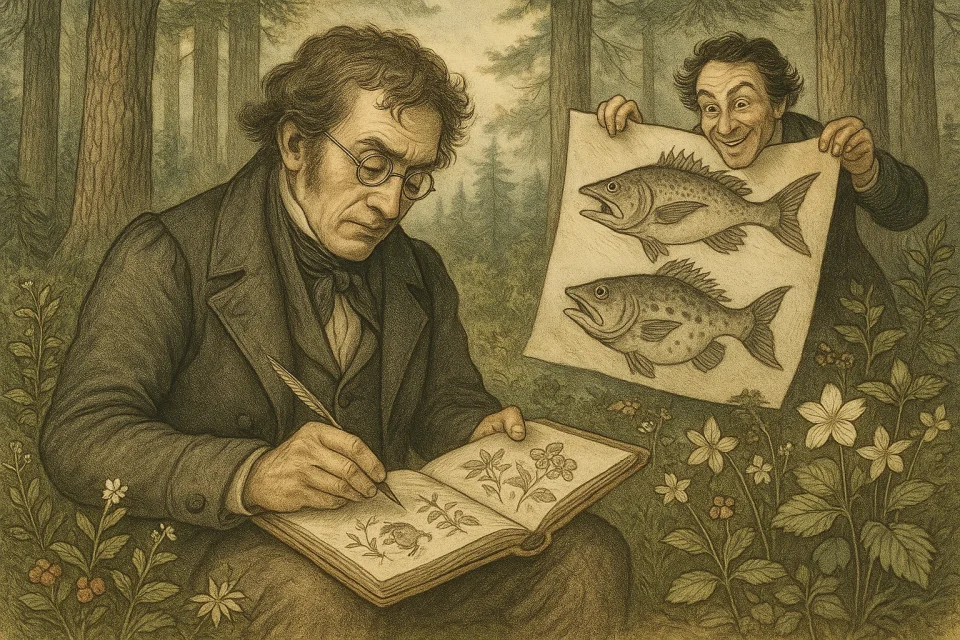
Audubon’s favorite Cremona violin by swinging it at flying bats, attempting to secure specimens of what he thought were new species. Audubon took revenge upon Rafinesque by describing and sketching several fish that were entirely fictional, which Rafinesque unknowingly named and published.
Rafinesque became a professor of botany at Transylvania University in Lexington, Kentucky, in 1819, but he left the university in 1826 after quarreling with its president. While at the university, Rafinesque made important discoveries about American prehistory by studying the ancient earthworks of the Adena and Hopewell cultures (the Moundbuilders) in the Ohio River Valley. He was the first to identify these as the “Ancient Monuments of America,” and he cataloged more than 500 such sites. He didn’t excavate them, but measured, sketched, and described them in manuscripts that became a basis for later archeological studies. He also studied the linguistics of Mesoamerica and made advances in deciphering ancient Mayan script.
In 1836, Rafinesque published the controversial Walam Olum, which contained creation myths and migration narratives of the Lenape people (also known as the Delaware Indians). Rafinesque claimed he had obtained cedar wood tablets and birch bark bearing Indigenous pictographs, together with a transcription in the Lenape language. Based on this, he produced an English translation of the stories. Rafinesque later said the original materials were lost, leaving his notes and transcribed copy as the only record. The Walam Olum remains controversial to this day. As early as 1849, Henry Rowe Schoolcraft, an ethnologist who worked extensively in Michigan, wrote that he believed the document might be fraudulent. Many scholars today believe it was a hoax, either by Rafinesque or upon him. But other scholars and many of the Lenape people believe the stories are authentic.
Rafinesque was brilliant, but undisciplined and unsociable. He was criticized by other scientists for what seemed like outlandish ideas and mistakes of overreaching. During his lifetime, he was a virtual outcast in the scientific community, and so was little recognized. But more and more in recent years, scholars are realizing how farsighted many of his ideas were.
One of Rafinesque’s theories was that ancestors of Native Americans had migrated across the Bering Sea from Asia to North America. This was part of the narrative in the Walam Olum.
He was also one of the first scientists to use the term “evolution” in the context of biological speciation. He described a version of the theory in a letter in 1832 and in a journal in 1833. Charles Darwin’s On the Origin of Species was not published until 1859. Darwin acknowledged the influence of Rafinesque’s ideas in the third edition of On the Origin of Species.
Rafinesque was also a poet. In 1836, he published a 248-page book entitled: The world, or, Instability. A poem. In twenty parts, with notes and illustrations. It can be read on the Internet Archive website. It is a tour de force about nature and philosophy that reminds me of Walt
Whitman’s Leaves of Grass, which was first published in 1855, nineteen years after Rafinesque’s poem.
Rafinesque died in Philadelphia in 1840, at the age of 57, from stomach and liver cancer. It has been theorized that the cancer may have been caused by his self-medicating for an illness with an herbal mixture that may have contained one or more species of ferns related to one now known to induce human gastric carcinoma.
Sources:
“Constantine Samuel Rafinesque”, Wikipedia (https://en.wikipedia.org/wiki/Constantine_Samuel_Rafinesque) James L. Reveal, “Constantine Rafinesque: Eccentric Genius” (https://lewis-clark.org/people/constantine-rafinesque)
Douglas F. Markle, “Audubon’s hoax: Ohio River fishes described by Rafinesque,” Archives of Natural History, Volume 24, Issue 3 (https://doi.org/10.3366/anh.1997.24.3.439) “Walam Olum”, Wikipedia (https://en.wikipedia.org/wiki/Walam_Olum)
C. T. Ambrose, “Darwin’s historical sketch – an American predecessor: C. S. Rafinesque” Archives of Natural History, Volume 37, Issue 2 (https://doi.org/10.3366/anh.2010.0002)
C. S. Rafinesque, The world, or, Instability. A poem. In twenty parts, with notes and illustrations
(Philadelphia, J. Dobson and in London, O. Rich, 1836) (https://archive.org/details/worldorinstabil00rafigoog)
C. Ambrose, “The curious death of Constantine Samuel Rafinesque (1783–1840): the case for the maidenhair fern”, Journal of Medical Biography, 1 August 2010 (https://www.semanticscholar.org/paper/The-curious-death-of-Constantine-Samuel-Rafinesque-Ambrose/91575d5866a84e02fc2d4ac725f002dd1a22f23c)