

Second reading of a new ordinance set for Feb. 1
By Barb Pert Templeton

After addressing the topic at many commission meetings last year, it appears Marine City officials are ready to make a decision on allowing recreational marijuana facilities in town.
The first reading of the new marijuana ordinance took place in October, specifically Chapter 160, Section 238 entitled “Adult Use Marijuana Facilities.”

At the commission’s most recent meeting on Jan. 18 City Manager Scott Adkins gave a recap on the topic. He said when it was last on the agenda, the first reading of a proposed ordinance including mapping.
Noting that there were lots of discussion over the maps, Adkins said the initial one proposed a 1,000-foot setback boundary requirement. A problem arose when the maps were printed because establishing allowable spaces using that 1,000-foot setback wasn’t possible.
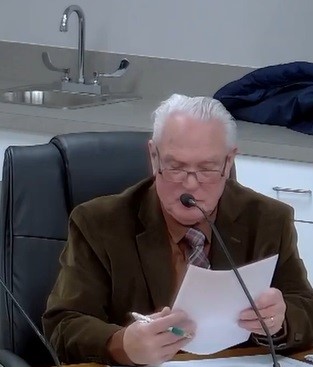
Commissioner William Klaassen voted against the commission doing a second reading of a new recreational marijuana facilities ordinance.
At that point the city went back to St. Clair County to get additional maps with 750-foot setbacks. Unfortunately, when those came in, they did not reflect a gain in additional properties so the city asked for maps with 500-foot setbacks, Adkins explained.
He said the commission now had before them new maps with the 500-foot setback requirement in place and they needed to decide what they wanted to do next.
Choices included just having the city attorney change the current ordinance to state 500-feet and have a second reading of the proposed ordinance, go another route all together or just do nothing and leave the original ordinance, that doesn’t allow marijuana facilities, in place.
“This gives you a couple of choices, this shows a fair amount of properties that would meet the allowable criteria on 500-feet,” Adkins said. “Course then it’s contingent upon persons taking it on themselves to move forward and look into those properties.”
Adkins added that the areas reflected on the map are in commercial zones and there’s a buffer in place to residential areas.
Why the distance change
Commissioner William Klaassen said when this topic was first introduced the distance was to be 1,000 feet why are they now looking at just 500-feet.
“A 1,000-feet did not allow us any properties that would have been within any zone so we asked the county to draw a map showing us 750-feet but that still allowed no properties,” Adkins said. “The 500 feet is the minimum that would show some allowable properties if the commission approves,”
“Five hundred opens up real space for the use; you don’t want to enact an ordinance that doesn’t allow the property to be used for the manner of the ordinance, “Attorney Robert Davis added.
He said the city is trying to design a turf-oriented ordinance that if there was land in a certain area that met the buffers it would be deemed a permitted use with no further action by the applicant except the application process itself.
“We weren’t putting a cap on the numbers, we were just saying if you’re in this box make your application,” Davis said.
Commissioner Brian Ross asked what if a developer wanted to sub-divide the land for a facility and Adkins said any of those issues have to conform to the master plan and be approved by officials.
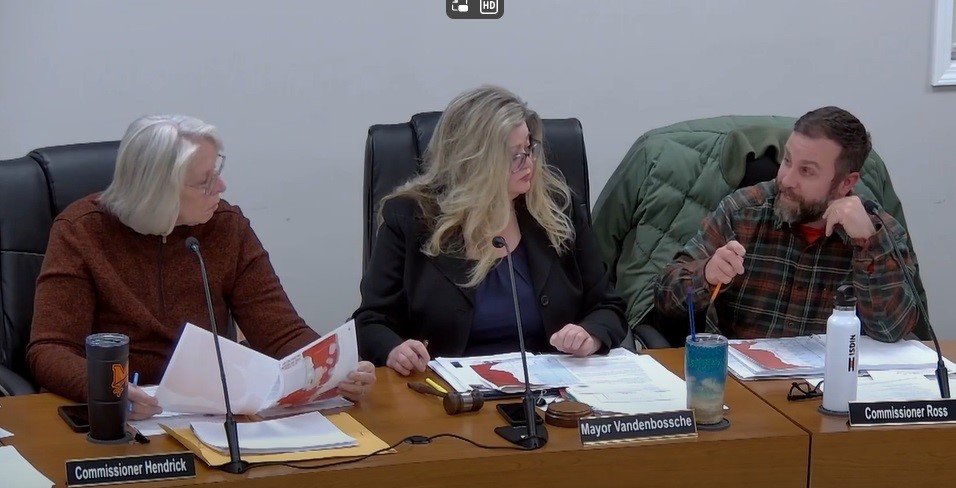
Mayor Pro Tem Lisa Hendrick and Commissioner Brian Ross (pictured here on the left and right of Mayor Jennifer Vandenbossche) posed a number of questions to City Manager Scott Adkins and City Attorney Robert Davis.
Davis also noted that the state application for a facility is very “robust” with heavy fee structures and very intense site plans. He said the latter includes all kinds of things from waste water, to trash, to venting, to parking – just to make sure things are in proper order along with enforcement mechanisms.
Mayor Pro Tem Lisa Hendrick then made a motion to modify the proposed new ordinance and bring it back for a second reading with a 500-foot zone use reflected. Commissioner Sean O’Brien supported the motion.
Ross wanted to make sure the 500-foot shown on the updated maps provided to the commission would be part of the ordinance, and he was assured that would be the case.
The motion passed 6 to 1 with Klaassen casting the only no vote.
Background on the issue
February 2023: Former City Commissioner Michael Hilferink, who has been a proponent of allowing dispensaries in town in order to bring additional revenue to the city, brought the topic to the commission and setup a town hall meeting. At the informational meeting he gave a brief presentation and explained that the recreational use of marijuana was approved by law in Michigan in 2018. The Feb. 20 meeting lasted nearly 90-minutes and had voices heard that ranged from don’t allow marijuana facilities in town, to allow them or some said put the issue on the ballot to let voters decide.
June 2023: Officials decide to take a proactive approach on whether to allow marijuana facilities in the municipality by putting it to a vote of the people. A majority of the commission approved a motion to have the city attorney draw up an actionable ballot initiative to allow facilities in the city. Hilferink made the motion and it was seconded by Mayor Pro Tem Lisa Hendrick. Commissioners Jacob Bryson and William Klaassen voted against the motion.
September 2023: City Attorney Robert Davis did a presentation on the matter at a Sept. 7 meeting of the commission. During that presentation Davis conceded that yes, the commission had voted to have the ballot initiative language developed but he has since learned that only the residents can undertake such an initiative. He said the commission now had a new ordinance he drafted and they needed to look at it, comment on things and decide what they wanted to do going forward.
Hilferink spoke out on this decision, accusing the attorney of flip flopping on the issue and wanted to know why the commissions’ vote to put the topic on the ballot was now off the table.
“People were on board with it being put on the ballot, people were on board with us having a townhall, why did we go through all that if we were just going to zone these out of existence; what changed between that townhall and Mr. Davis’ opinion in February versus Mr. Davis’ opinion in September, what changed?” Hilferink said.
Davis said he missed the June meeting where officials voted to put the issue on the ballot and he spent the summer doing research on the matter and found out the commission can’t launch a ballot initiative only residents can.
