

By Jim Bloch

When I met Elmore Leonard in 1984, I was working the 6 a.m.-2 p.m. shift as a cook at the old New York Sheraton at 56nd Street and Seventh Avenue in New York City and trying to finish writing a baseball murder mystery called “Seams in the Dream,” which featured a private investigator whose office sat above the Checker Cab Company on Trumbull, across from Tiger Stadium.
Leonard was building his reputation as the country’s preeminent thriller writer. His publisher had developed a unique strategy to push him to the top of the charts, which involved releasing his new books early in the year, after the Christmas book-buying frenzy. Sales would be down and the field would be open for his books to slip into the #1 slot. The strategy sacrificed short-terms sales for the splash that came with topping the New York Times bestseller list. It worked.

I had recently discovered Leonard and was feasting on his post-western novels, many set in his hometown of Detroit. Some of the books were only available only in British paperback editions, like “Gold Coast,” with the gold-tipped cowboy boots on the cover, published by Star.
At Christmas, back in Detroit, I mentioned my new love of Leonard’s work to my dad and his buddy, Dick Reihm.
Dick, a commercial artist and art director, told me he knew Leonard.
You’re kidding me, I said. And you used to drink with Hemingway?
It turned out that Dick met Dutch – he called him by his nickname – in the early 1950s while both worked on a series of GM ads set in the American west. Leonard, who was writing the ads, immersed himself in cowboy lore, research that directly informed his early novels like “Hombre” and “Escape from Five Shadows.”
Dick gave me Dutch’s phone number.
Give him a buzz, Dick said. Tell him you know me.
I still have the number in my worn address book from college. I never called him.
How could I? What established writer – Leonard had already published around 20 books – would want to hear from an egg-flipper in a down-on-its-heels hotel diner who dreamed of joining the ranks of the Private Eye Gods, writers like Dashiell Hammett, Raymond Chandler and Ross MacDonald? What the heck would I say to him? Did he like the latest late-night rerun of the Mary Tyler Moore Show?
As the winter unfolded, I learned that Leonard, the real live Dutch himself, would be signing copies of his new book at Murder Ink, the famous bookstore devoted to mysteries and thrillers on the Upper West Side. I had never been to the store, which was so murder-centric that its bookmarks, stamped from heavy-stock black paper, came in the shape of a handgun.
It was one of the few times I appreciated my hellish breakfast shift. The city, only a handful of years removed from near-bankruptcy, pulsed with danger. Each morning I stumbled out of my apartment downtown and caught a graffiti-cocooned A, AA or E train, still haunted by people strung-out from a night that never ended, up to the hulking hotel. I was keyed up on the big day, which unfolded like chilled pancake batter. I stripped off my kitchen whites and was staring at the time clock when it hit 2 p.m. I raced over to Columbus Circle to catch the uptown train to 86th Street. The handsome little bookstore was blocks from the train, nearly to the Hudson River. There was no line to get into the door. I couldn’t see anyone through the plate glass. A modest display of Leonard’s books in the window didn’t stop me from wondering whether I had the wrong day or the wrong time.
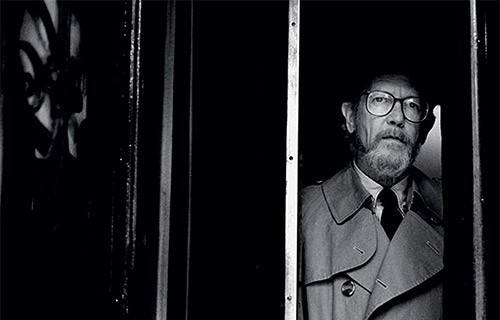
The man the Village Voice called “a craftsman working at the peak of his form” sat alone at a small table in the middle of the room, books stacked at his side, pen nearby, looking owlish in big glasses, trim – he had quit drinking six years earlier – and as uncomfortable as I felt. Except for a clerk and a woman pouring over English locked-room mysteries, the store was empty. I couldn’t not speak to him. I was standing right in front of him. So I mumbled that I was from Detroit and I knew this guy he used to work with, a friend of my Dad’s. He was gracious, but far from effusive.
Of course, I remember Dick, Leonard said. How’s he doing anyway?
I don’t recall if he gave me any advice when I told him I was an aspiring writer working on a murder mystery set in Detroit starring a hardboiled private eye named Toledo Parvum. I don’t remember if he let me in on an early version of his famous “ten rules of writing,” still 18 years from being formalized in the New York Times. (My two favorites are “Never use a verb other than ‘said’ to carry dialogue” and “Never use an adverb to modify the verb ‘said.’)
I didn’t buy a book because I couldn’t afford the cost of a new hardcover. I didn’t ask him for an autograph because I didn’t have a book for him to sign.
Murder Ink closed its doors in 2006, the victim of Barnes and Noble’s dizzying expansion in Manhattan and Amazon’s irresistible hunger to conquer the world.
My Dad died in 2008. Dick died in 2012. Dutch died on Aug. 20, 2013.
The years of their birth line up. Dutch, 1925. Dad, 1926. Dick, 1927.
I don’t know what any of this means.
Eight of Leonard’s words are stamped in my memory from that day 40 years ago in that famous, vanished bookstore. I don’t remember whether he said them gravely or lightly or quietly or emphatically.
“I don’t like mysteries,” he said. “I hate private eyes.”
Jim Bloch is a freelance writer based in St. Clair, Michigan. Contact him at bloch.jim@gmail.com.

1 comment
Great article, I met Elmore Leonard once while working at a local Public Access channel in Bloomfield Hills back in the late 90s. Great guy, I’ve never read any of his books but have seen several of his film adaptations.